Why Every Single Match at the 2026 World Cup Will Have a Mandatory Hydration Break
The 2026 FIFA World Cup — the first-ever three-nation tournament spanning Canada, Mexico, and the United States — has mandated hydration breaks in all 104 matches. At the 22-minute mark of each half, play stops for three minutes so players can rehydrate. Here's why FIFA made this a permanent fixture, and what it means for the game.
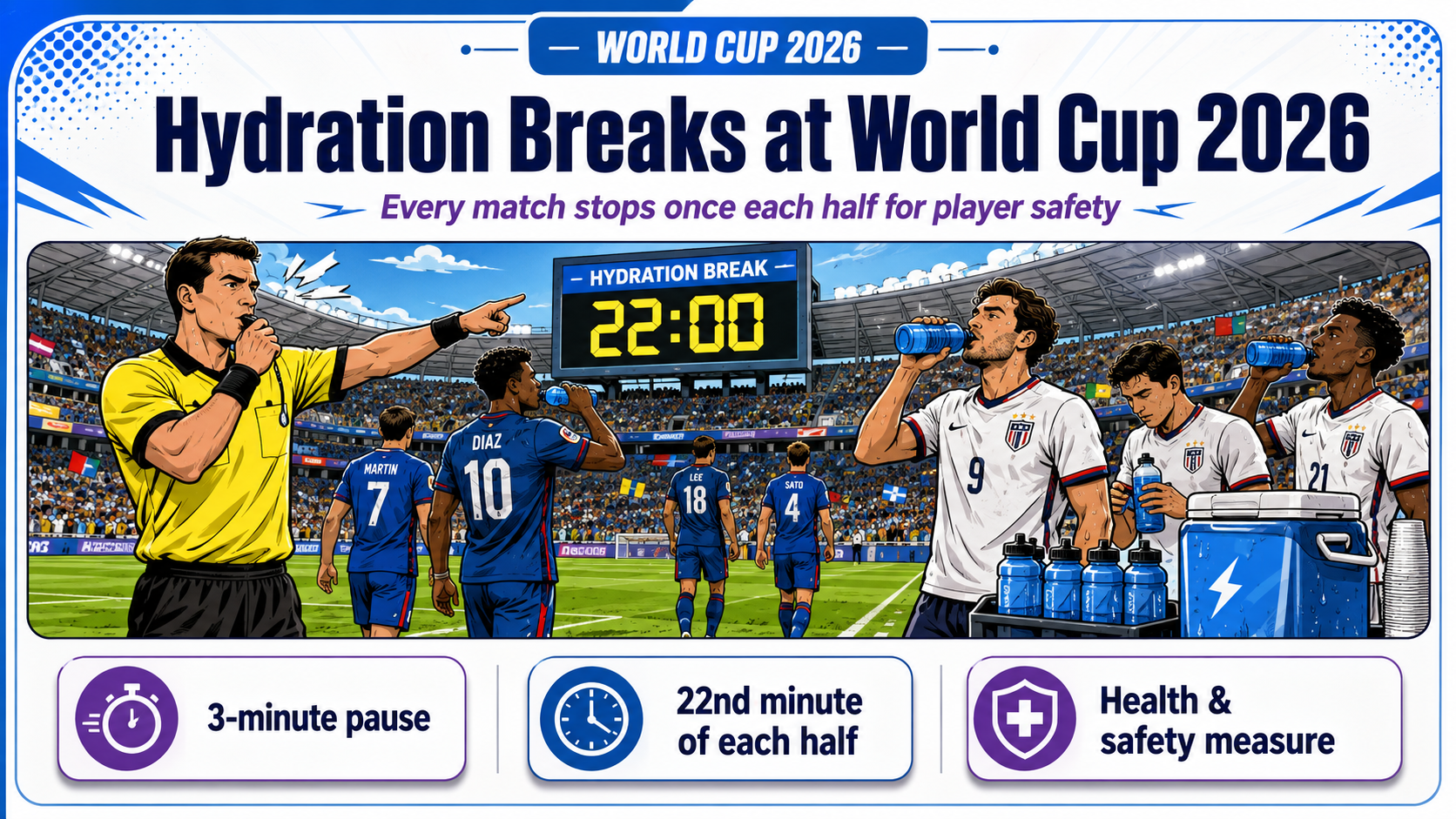
The Three-Minute Pause — What Is a Hydration Break?
A hydration break is a formal stoppage in play designed to protect players from dehydration and dangerous rises in core body temperature during hot and humid conditions. In plain terms, it's an officially designated window for players to drink water and briefly recover during a match.
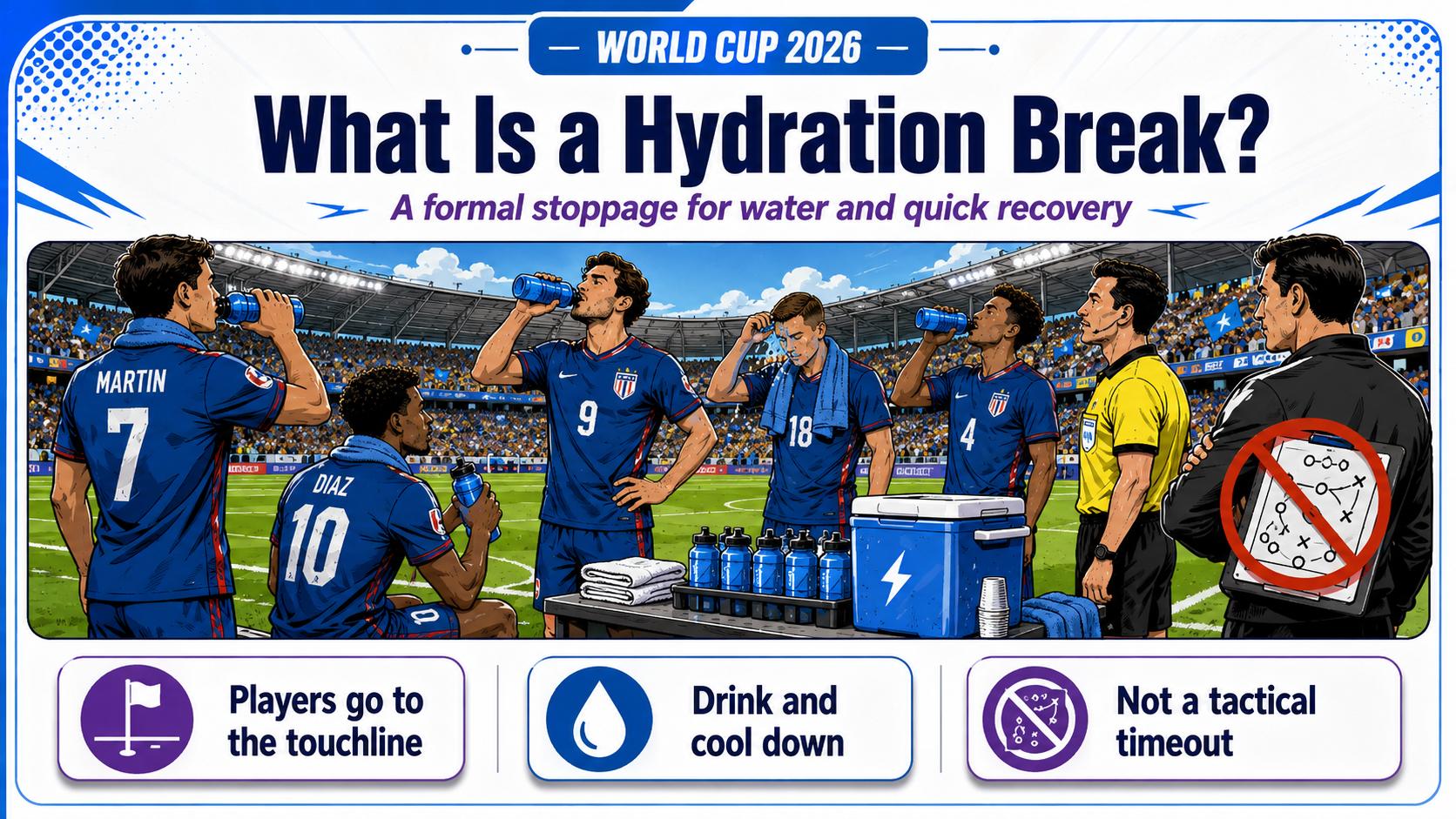
At the referee's signal, players move to the touchline, take on fluids, catch their breath, and then resume play. At the 2026 World Cup, this happens at the 22-minute mark of each half and lasts exactly three minutes.
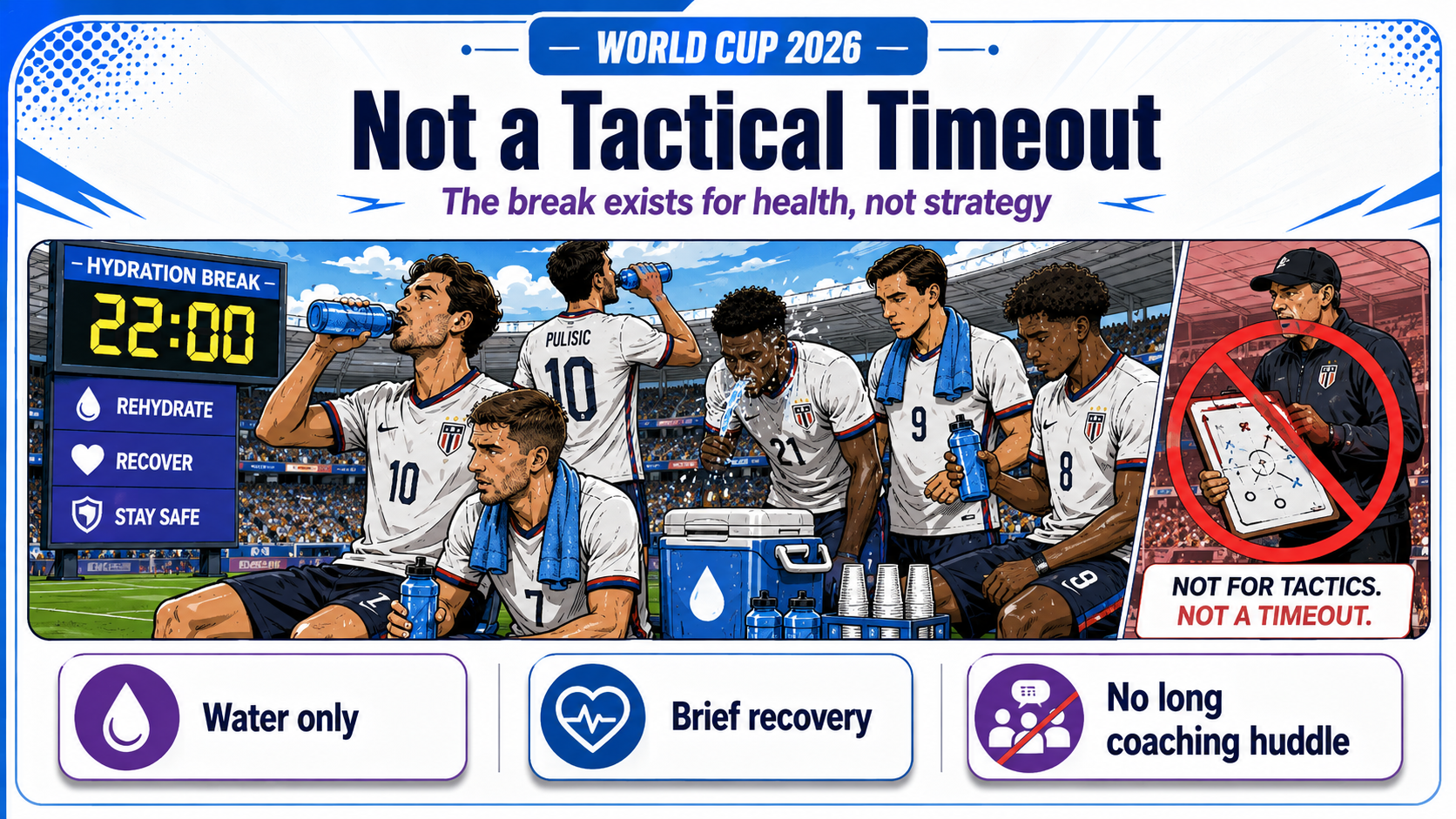
One important clarification: a hydration break is not a tactical timeout. It is not an opportunity for coaches to deliver detailed tactical instructions, and it is not designed to interrupt the flow of the game for competitive reasons. It is classified strictly as a player welfare measure — a health and safety safeguard, nothing more.
The measure has been used selectively in earlier tournaments, including the 2025 FIFA Club World Cup. For 2026, FIFA has streamlined and formalized the system — making it mandatory across every single match for the first time in World Cup history.
Why FIFA Made It Mandatory for Every Match in 2026
The 2026 World Cup is the first edition co-hosted by three nations — Canada, Mexico, and the United States — and it spans an enormous geographic and climatic range. Some venues are air-conditioned indoor stadiums; others are open-air arenas exposed to full summer sun. Temperature and humidity conditions vary dramatically from city to city.
FIFA has mandated hydration breaks in all 104 matches without exception. Hot or cool, indoor or outdoor, regardless of stadium conditions — play stops at the 22-minute mark of each half, every time. Why?
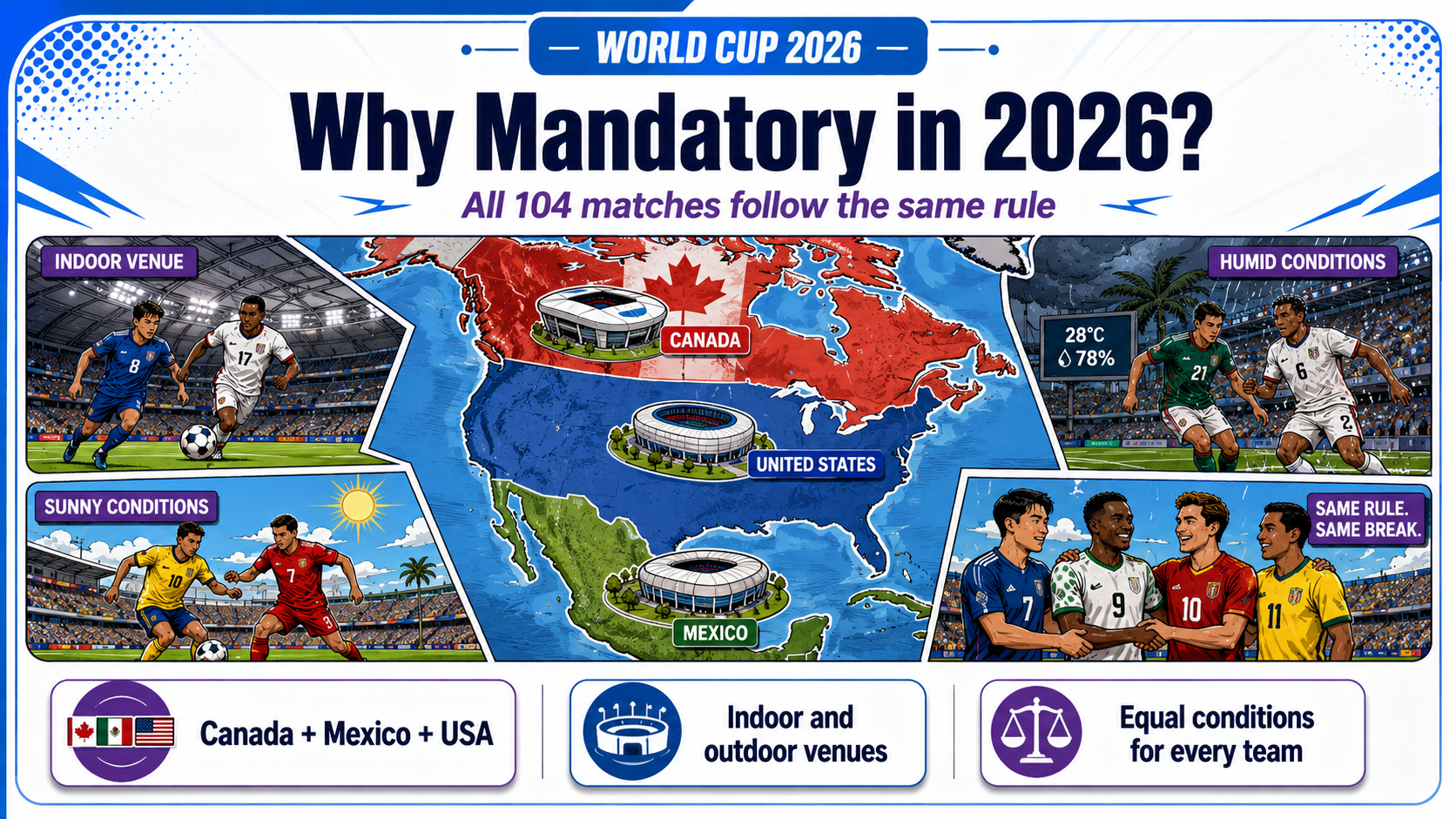
FIFA's Head of Tournament Operations, Manolo Zubiria, stated the rationale directly: "to guarantee the same conditions for all teams." If one team plays in a climate-controlled indoor venue while another sweats through a 35°C outdoor afternoon match, and breaks are only applied selectively, some teams receive rest while others don't. Applying the rule universally removes that inconsistency entirely.
Behind the equity argument lies a genuine safety concern. North America in summer is hot and often humid across many host cities. Intense athletic exertion in high temperatures and humidity creates real risks of dehydration and heat illness. Mandating hydration breaks across all 104 matches — a first in World Cup history — enshrines player protection as a standard operating principle, not a weather-dependent optional measure.
When and How It Works — The 22-Minute Rule
The hydration break is administered by the referee at approximately the 22-minute mark of each half — the midpoint of the 45 minutes. From the referee's whistle to the resumption of play, the stoppage lasts exactly three minutes. This is not a halftime or a full break — it's a short but structured rehydration window that has now become part of the rhythm of every World Cup match.
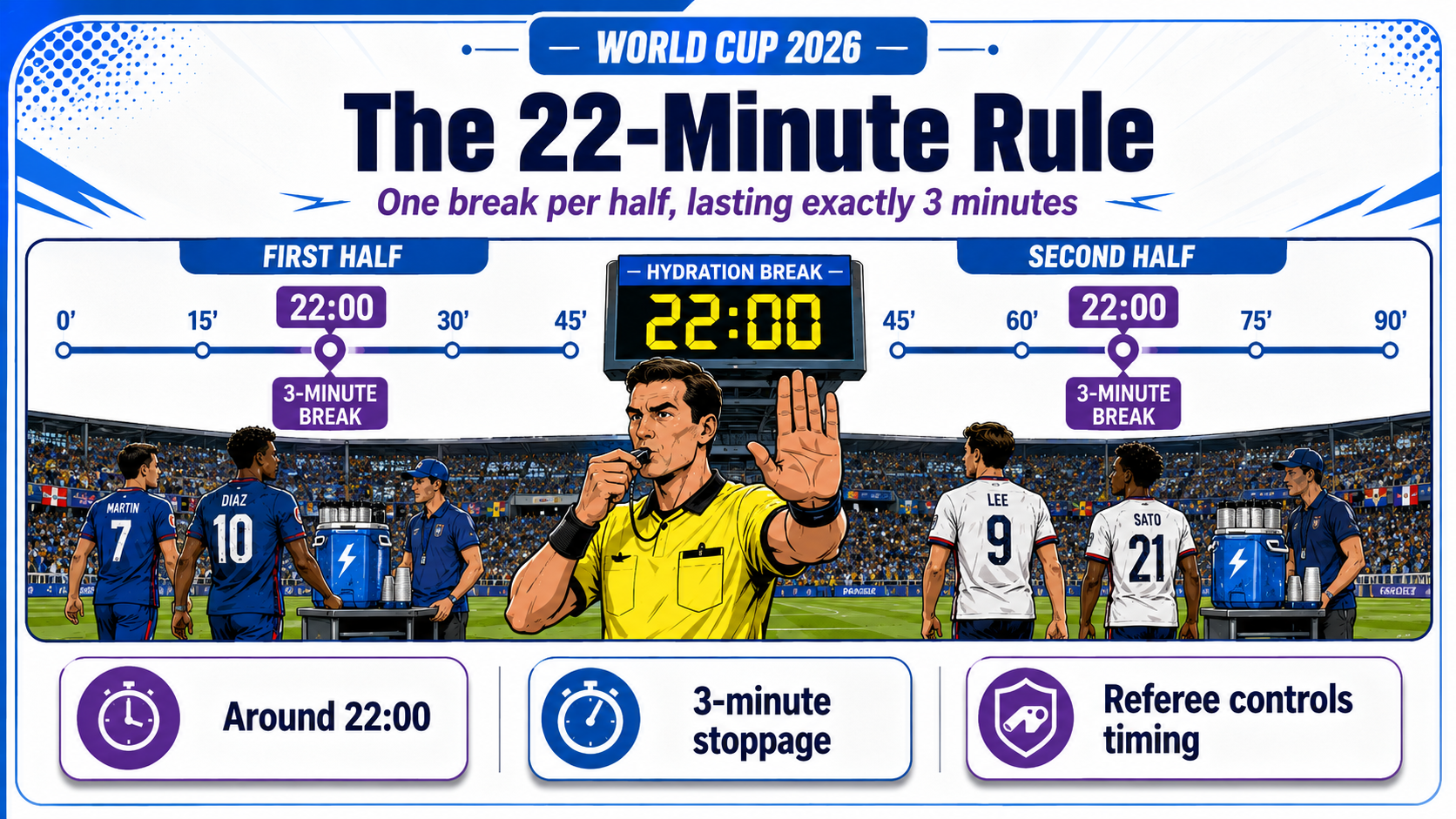
Timing can flex slightly based on game circumstances. If a player is receiving injury treatment at the 20th or 21st minute, the referee doesn't blow the whistle in the middle of that treatment — the break is coordinated with the situation and called at an appropriate moment once the immediate situation is resolved. Player safety is the first priority; unnecessary game disruption is the concern to be managed around it.

Real-world examples arrived immediately. On June 12, 2026, at the Estadio in Guadalajara, Mexico — during South Korea vs. Czech Republic, Group A, Matchday 1 — the referee blew the whistle suddenly at the 22nd minute. Many viewers watching the broadcast were momentarily confused, wondering if an injury or VAR review had occurred. It was, in fact, the first widespread experience of the mandatory hydration break in action. Players gathered at the touchline, took on fluids, rested for three minutes, and then the match resumed. One break per half, at the 22-minute mark — it's the new tempo of the World Cup.
Three Countries, Three Climates — The Science Behind the Decision
With matches spanning Canada, Mexico, and the United States, FIFA conducted detailed technical assessments of every venue — analyzing average temperatures, cooling infrastructure, transportation, security, and more. This data-driven review of environmental conditions across all host cities directly informed the player welfare design.

Based on U.S. National Weather Service heat index standards and venue-by-venue climate analysis, FIFA determined that mandating hydration breaks across all matches — regardless of roof status or reported temperature on match day — was the most scientifically consistent and equitable approach. Rather than assessing conditions match by match and applying the break selectively, the universal mandate removes ambiguity and ensures no team is ever caught without this safeguard when conditions turn unexpectedly difficult.

Player Safety First — and a Note on Broadcast Timing
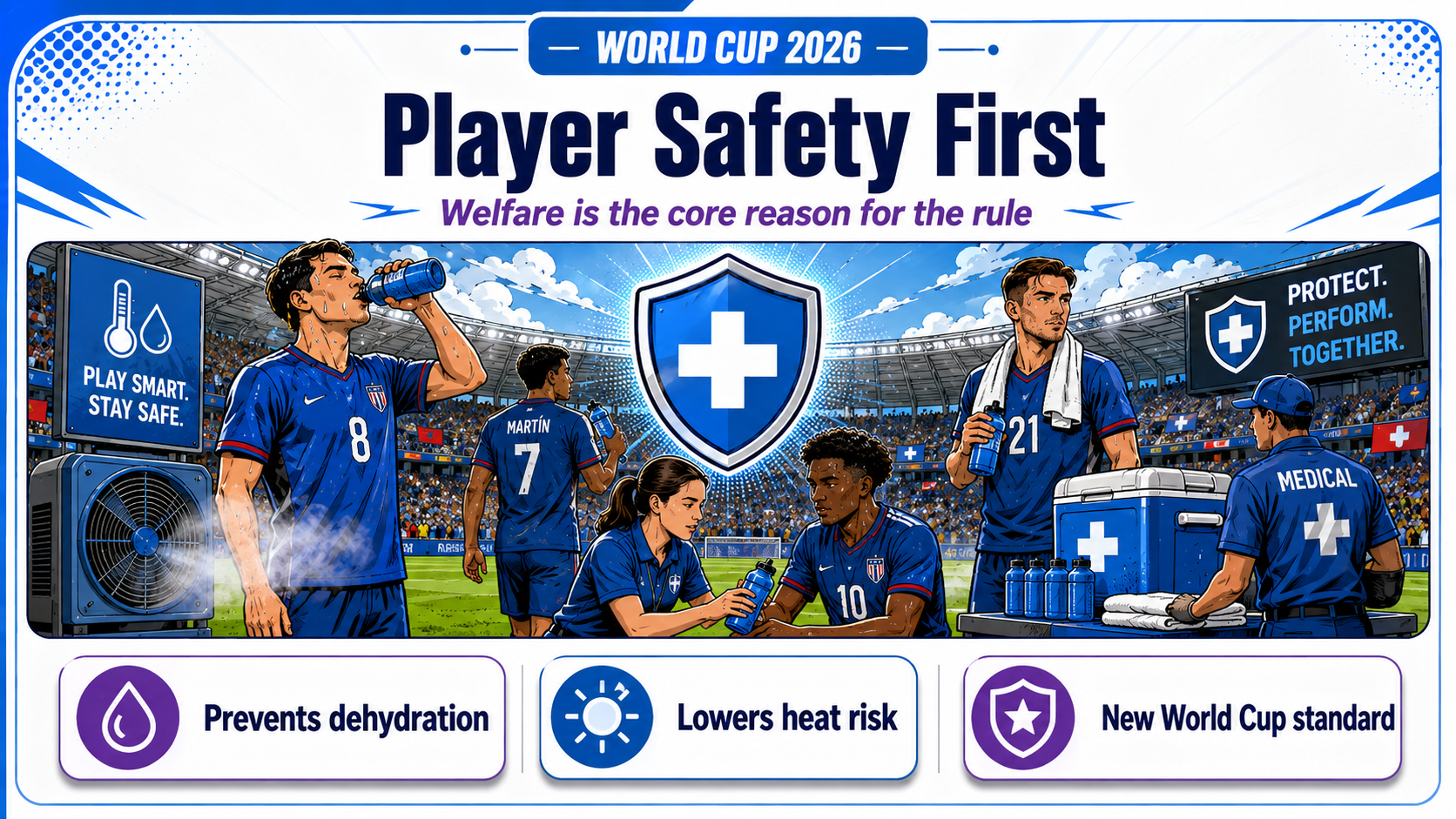
FIFA's primary reason for the hydration break is unambiguous: player welfare. The 2026 World Cup's operational design — coordinated across match management, team services, medical, broadcasting, and ticketing departments — places player health as the central organizing principle.
That said, observers have noted that a formal, predictable mid-half stoppage in the world's most-watched sporting event creates a natural commercial window for broadcasters. In a tournament of this global scale, the break will inevitably feature advertising inventory on some networks. Whether this is a welcome side effect or a concern depends on who you ask — but FIFA has been clear that it does not drive the decision.
Among football fans and analysts, debate continues about the rule's effect on game flow and tactical dynamics. Football has traditionally been defined by its near-continuous 90-minute clock — with no official stoppages beyond halftime and the final whistle. That tradition is now formally altered, at least at this World Cup.
Whatever the debate produces, the hydration break applies consistently from the June 11 opener in Mexico City through the July 19 final at MetLife Stadium in New York/New Jersey. On the foundation of player safety, a new era of the World Cup has begun.
Frequently Asked Questions
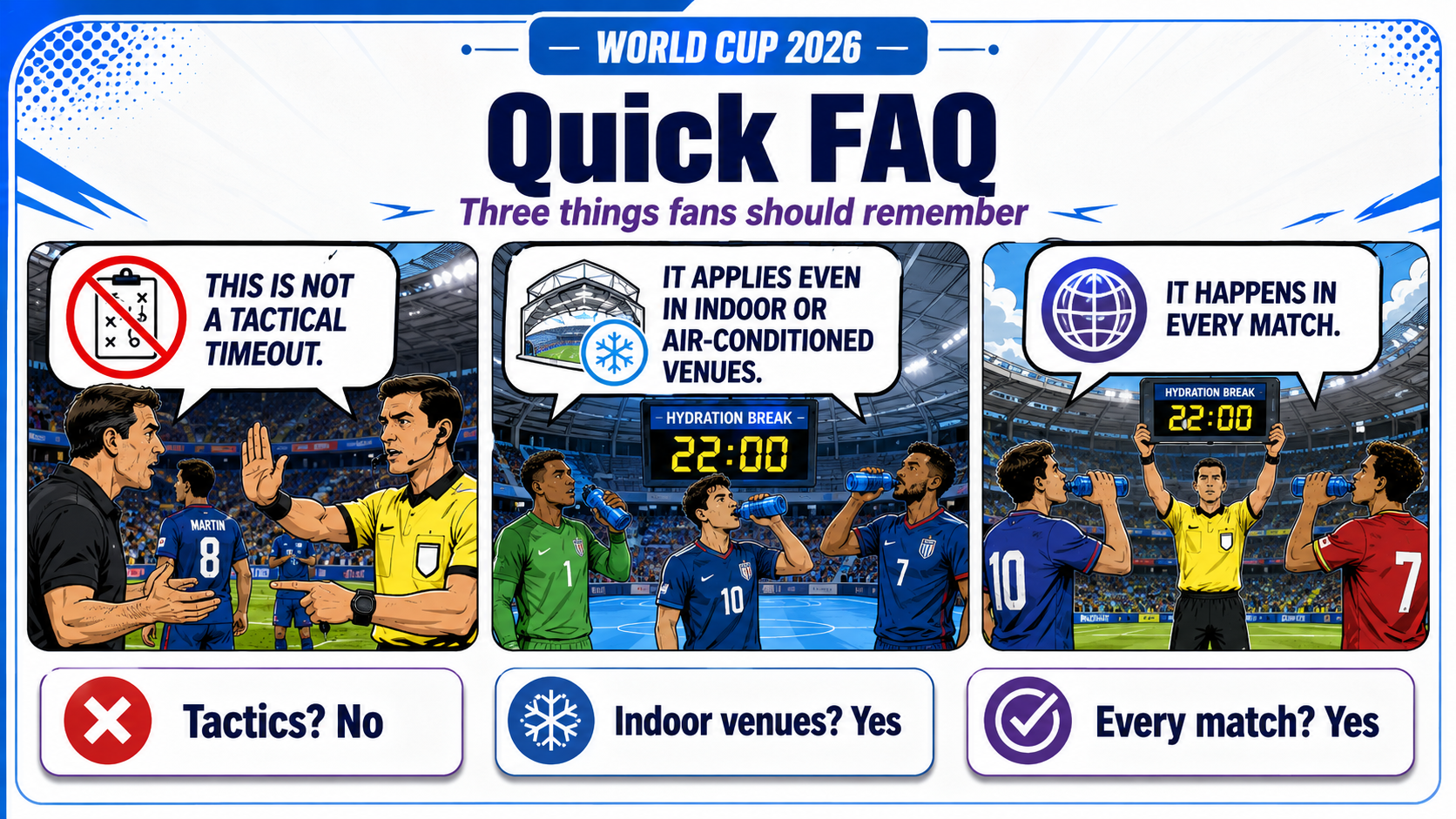
Q. Can coaches use the hydration break to give tactical instructions?
A. No. The hydration break is explicitly classified as a player welfare measure — not a tactical timeout. It is not designed to give coaches an opportunity to deliver detailed instructions, and it is not considered an interruption for competitive purposes. It is a health and safety safeguard, full stop.
Q. Does the hydration break apply in indoor, air-conditioned stadiums too?
A. Yes — without exception. FIFA has mandated the break for all 104 matches regardless of venue conditions. Whether the stadium is air-conditioned, outdoors in full sun, hot, or relatively cool, play stops at the 22-minute mark of each half. The universal application is intentional — it ensures every team receives identical conditions across every match.
Q. Why specifically the 22-minute mark?
A. The 22nd minute falls roughly at the midpoint of each 45-minute half, which sports medicine research identifies as an optimal interval for rehydration — late enough to have meaningful physiological impact, but early enough to prevent dangerous core temperature buildup. The referee administers the break at this point at their discretion, with some flexibility to adjust slightly based on live game situations such as ongoing injury treatment.
Q. Have hydration breaks appeared in previous World Cups?
A. They have been used selectively in past tournaments — including the 2025 FIFA Club World Cup — but only when specific heat index thresholds were met. Mandating them across every match in every condition is a 2026 innovation. This is the first World Cup where no match, regardless of weather, proceeds without a hydration break.
Q. Why did FIFA choose to make it mandatory in 2026 specifically?
A. The three-nation co-hosting format creates a tournament where climate conditions vary more widely than any previous World Cup — from climate-controlled domes to open-air venues baking in North American summer heat. Rather than applying breaks based on daily temperature readings (which can change unexpectedly), FIFA chose a consistent universal standard. The result: no team ever plays a match without the same safety provision their opponents received.
References
Why Did Play Stop Suddenly at the 22nd Minute? — The Hydration Break Now Mandatory at the 2026 World Cup
https://www.spotvnews.co.kr/news/articleView.html?idxno=821999
Players to Benefit from Hydration Breaks at FIFA World Cup 2026 — FIFA Official
World Cup 2026's 'Hydration Breaks' Highlight Employers' Duties to Prevent Heat Hazards — Ogletree