Why Do Korean Companies Keep Fighting Over 'Operating Profit Bonuses'? What Global Big Tech Does Instead
Korea's corporate bonus culture — distributing a fixed percentage of operating profit as uniform cash — is clashing with the talent economics of a global tech race. Here's how Apple, Google, and Meta structure compensation differently, and what it means for Korean competitiveness.
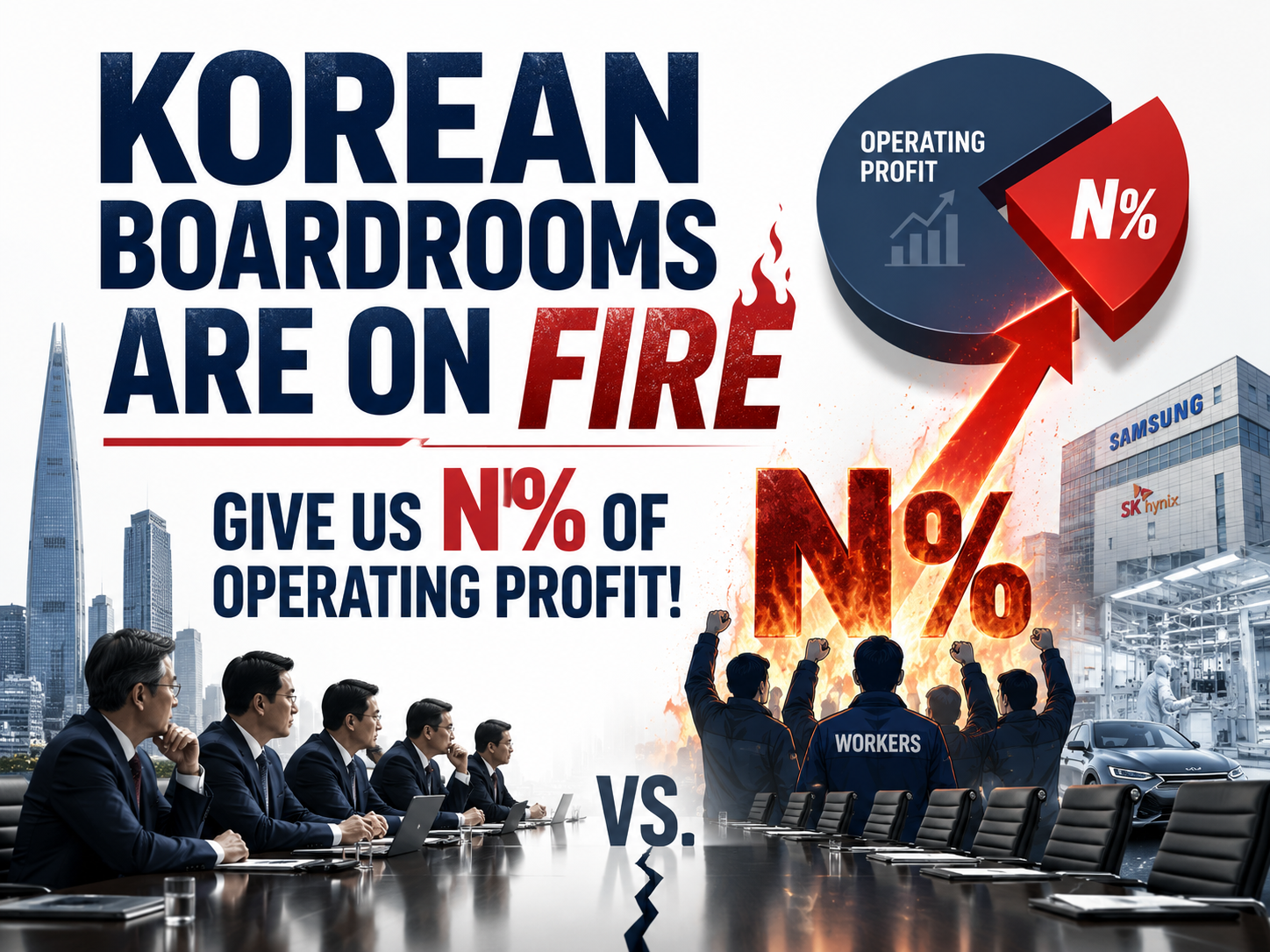
Korean Boardrooms Are on Fire — "Give Us N% of Operating Profit!"
The Samsung Electronics labor-management negotiating table has been running hot after reconvening for the first time in roughly 40 days. Talks that had been deadlocked were barely restarted after government mediation — but the tug-of-war continues. The central demand: the union wants a formal rule enshrining 15% of operating profit as the guaranteed bonus pool. In other words, a fixed percentage of whatever the company earns, locked in as official policy.

This is not unique to Samsung. SK hynix set a precedent last year by formally committing 10% of operating profit as its bonus pool, effectively creating what the industry now calls the 'N% rule.' Since then, similar demands have spread like wildfire. Hyundai Motor's union is calling for 30% of net profit; LG Uplus's union wants 30% of operating profit. The 'operating profit N% relay' has become a powerful industry-wide trend.
In the past, employees largely accepted whatever bonus the company decided to hand out based on business conditions and investment needs. That era is over. The demand now is direct and intuitive: "The company made money — the operating profit number is right there in the public filings, so let's split it at a fixed rate."
But this raises a legitimate question. Why has operating profit become the universal benchmark? And is this model of short-term cash distribution against a fixed percentage of operating profit actually as clean a system as it sounds?
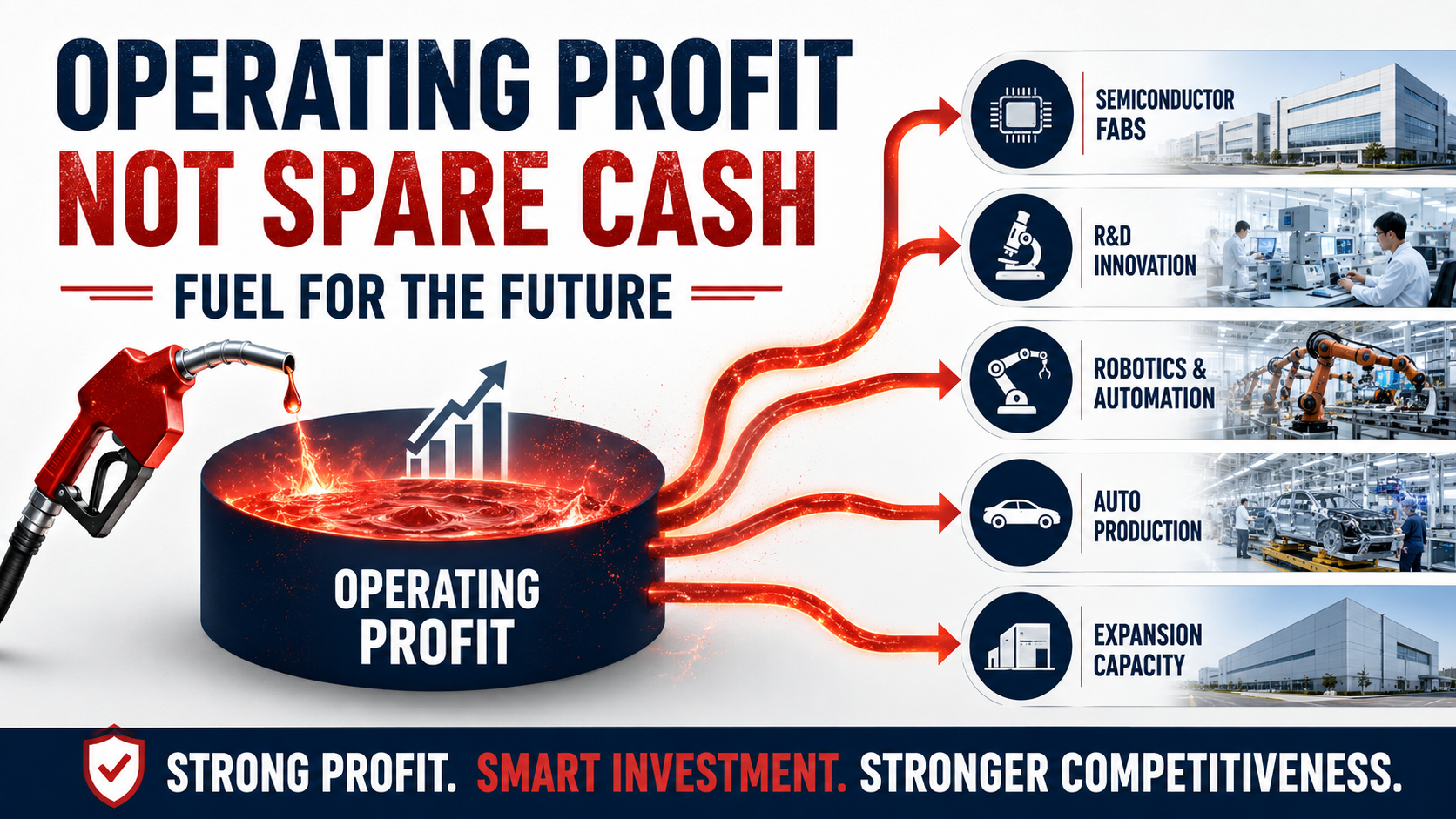
What's Wrong With Splitting the Cash Equally Every Year?
It's tempting to think of operating profit as a leftover pile of cash available for distribution. But for Korean manufacturers — especially in semiconductors and autos, where enormous capital investment is the price of staying competitive — operating profit is less a surplus and more the ammunition needed to fight the next battle. Building new fabs, funding next-generation R&D, expanding production capacity — all of it draws from the same pool.
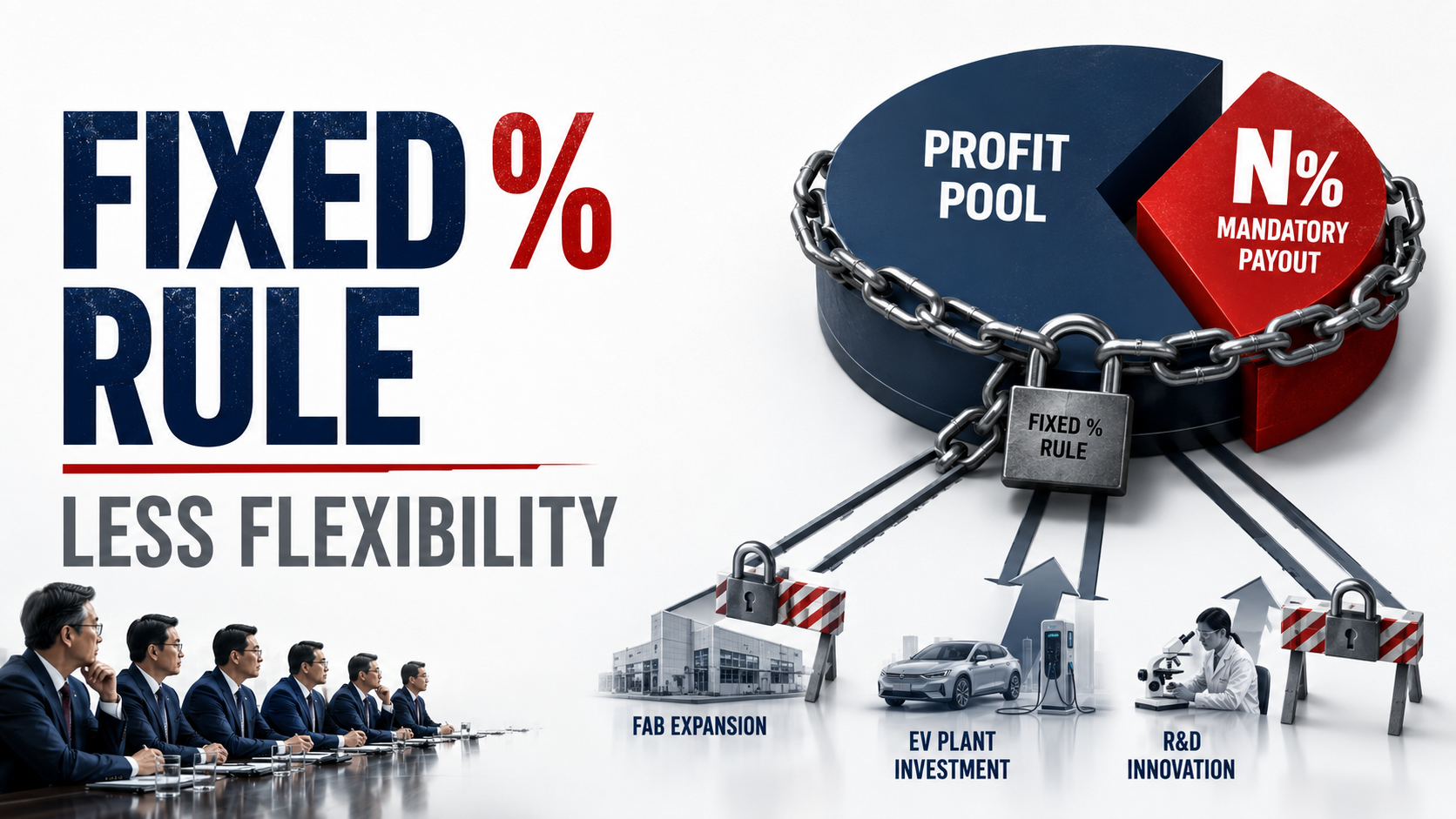
The problem emerges when a fixed percentage of that pool is locked in as a mandatory annual cash payout. Even in a great year, there are moments when a company needs to hoard cash against an impending downturn or fund an aggressive capital push. If the formula "N% of operating profit = bonus, always" is set in stone, management loses the flexibility to allocate capital where it's needed most. This is precisely why economists warn that Korea's manufacturing competitiveness could be fundamentally eroded if this model becomes industry-wide gospel.
A related concern is what might be called bonus inflation. Once a percentage is established, it becomes an entitlement. In boom years it balloons; in down years, cutting it is nearly impossible without a labor crisis. Energy that should go toward growing the pie instead gets burned in a destructive war over how to slice it. As one senior executive put it: if one company's negotiated outcome sets the benchmark for the entire Korean corporate landscape, the consequences will be felt across the whole industrial ecosystem.

Valuable investment capital flowing out as short-term cash payouts — while global rivals plow those funds into the next generation of technology. Is this the right direction? Which naturally invites the question: how do the global tech giants who keep breaking profit records and attracting the world's best talent actually run their compensation systems?
Apple and Google's Answer: Not Cash — This
Across the Pacific in Silicon Valley, the bonus envelope looks very different. At Apple, Google, and Meta, you won't find a company-wide policy of taking a slice of operating profit and distributing it equally in cash to every employee. Instead, two principles are foundational: strictly differentiated pay based on individual performance, and equity — not cash — as the primary reward vehicle.

The compensation architecture is calibrated to individual contribution. Meta, for example, runs annual performance reviews and awards top performers (roughly the top 20%) with bonuses at 200% of the target — and a tiny cohort of exceptional individuals receives 300%, treated quite literally as superstars. Rather than everyone collecting a roughly similar slice based on seniority, performance determines the payout — sharply and deliberately. Google and Apple operate similarly, with next year's compensation determined by this year's individual evaluation score.
The primary instrument for delivering that differentiated reward is not cash but RSUs (Restricted Stock Units). The concept is simple. An RSU is essentially a promise: "Stay with us, hit your targets over the next three years, and we'll deposit 100 shares of company stock directly into your account — no purchase required."

If the stock options that became famous during the startup era were like discount coupons — letting you buy stock at a set price with your own money — RSUs are closer to a gift voucher: hit the conditions, receive the shares, no cash out of pocket. You become an actual shareholder simply by meeting the terms and staying the course. So why has this simple equity voucher become Silicon Valley's single most powerful tool for retaining the world's top engineers? The mechanics of why it works so well are worth understanding in detail.
When the Company Grows, So Does Your Stake — The Power of RSUs
The real power of RSUs comes from a smart timing mechanism called vesting. Being awarded RSUs does not mean you can immediately sell the shares. Typically, they vest gradually — say, 25% per year over four years. You earn your equity by staying.

This creates what the industry calls Golden Handcuffs. If an employee leaves before the vesting schedule is complete, the unvested portion is forfeited. Companies can retain hard-won talent through even the most aggressive recruiter campaigns, and employees build a meaningful long-term asset simply by continuing to contribute. Both sides benefit from the passage of time.
More profoundly, RSUs change the psychological relationship between an employee and their work. A cash bonus hits the bank account once a year and fades from consciousness shortly after. But when your compensation is tied to company stock, something different happens: every gain in the company's share price is a gain in your personal wealth. Employees stop thinking only about this quarter's metrics and start thinking about what drives long-term enterprise value — because those two things are now the same thing.

RSUs transform the employee-employer relationship from a transactional one into something closer to co-founder alignment. When the company creates value through innovation, your stake in that value grows. Rather than an exhausting annual negotiation over how to divide last year's operating profit, energy flows toward building something worth more next year. That is the mechanism — and it is both practically effective and psychologically elegant.
The Global Talent War: Where Korean Compensation Needs to Go
The Samsung compensation dispute is not just one company's growing pain. It is a symptom of a structural inflection point for the entire Korean industrial economy. The global market is in the middle of an intense talent war — and in that war, attracting and retaining the right engineers and innovators is not a nice-to-have but an existential capability.

Annual battles over short-term cash distribution percentages cannot win that war. A system that releases enormous cash payouts in good years and sees key talent walk out in bad years — when bonuses dry up — corrodes the fundamental competitive capabilities of the enterprise. The time has come for labor and management to move beyond the cash grab and seriously engage with long-term equity compensation: designing RSU frameworks, working through the tax treatment, and building the regulatory infrastructure to support it.
Encouragingly, the conversation is beginning. Across the Korean corporate landscape, companies are starting to look beyond increasing cash bonus ceilings toward long-term equity structures that genuinely align employee and shareholder incentives — not just in theory but in practice.
To compete globally for talent, Korean companies need to adopt compensation paradigms that are globally legible, sustainable, and motivationally aligned with long-term value creation. A compensation model where the company's future growth becomes directly, tangibly the employee's wealth — that is the most powerful and durable win-win available to Korean enterprises and their people in the fight ahead.
Frequently Asked Questions
Q. What exactly is an RSU (Restricted Stock Unit)?
A. An RSU is a form of equity compensation in which an employee receives company shares — at no personal cost — once they have satisfied a vesting condition, typically a combination of continued employment over a set period (usually 3–4 years) and performance milestones.
Unlike stock options, which require the employee to purchase shares at a set exercise price, RSUs involve no cash outlay — you simply fulfil the conditions and the shares are deposited into your account, making you a genuine shareholder. RSUs serve as "Golden Handcuffs," discouraging attrition and aligning employees' long-term financial interests with the company's share price performance.
Q. What is the biggest difference between operating profit bonuses and RSUs?
A. The core difference is the timing and nature of the reward.
- Operating profit bonuses: Short-term cash distributed uniformly based on last year's reported earnings. This approach can drain capital needed for future investment and create a ratchet effect that locks in unsustainable payout commitments.
- RSUs: Differentiated, performance-linked equity awards that vest over time. The company's long-term share price appreciation is directly linked to the employee's personal wealth, creating genuine alignment rather than a transactional annual negotiation.
Q. Can Korean companies actually adopt RSUs?
A. Yes. RSU programs are legally permissible in Korea, and the conversation about adopting them is actively underway across the corporate sector. The key remaining work involves tax treatment, regulatory frameworks, and building labor-management consensus around the transition from cash-centric to equity-centric compensation structures.
Shifting from an annual operating-profit-sharing model to a globally competitive equity compensation model is increasingly viewed not as a cultural luxury but as a strategic necessity — the prerequisite for winning the talent war on a global stage.
References
'N% of Operating Profit' Demands Spreading — Corporations Fear Bonus Inflation
https://n.news.naver.com/article/023/0003975476
"Give Us 30% of Operating Profit" — Bonus Demands Hit Telecom Sector; Industry on High Alert
https://www.autodaily.co.kr/news/articleView.html?idxno=543820
SK hynix Ignites Bonus Debate — Telecom Unions Now Demanding '30% of Operating Profit' Linkage
https://v.daum.net/v/20260506050113142
SK hynix Bonus 'Dam Break' Effect — Ripple Hits Samsung Electronics, Samsung Biologics, Hyundai Motor, LG Uplus
https://www.newsspace.kr/news/article.html?no=13676
SK hynix's 10% Is Now the Floor — Hyundai Motor Union Demands 30% of Net Profit
https://www.chosun.com/economy/economy_general/2026/04/19/IKO52HBB3FGYHOYS6NJYPNLSEM/
The Real Issue Behind the SK hynix and Samsung Electronics Bonus Controversy
https://www.sisain.co.kr/news/articleView.html?idxno=57830
Samsung Electronics Union: "Give Us 15% of Operating Profit" — Total Pool ~40 Trillion KRW, ~$620K Per Employee
https://www.chosun.com/economy/tech_it/2026/04/13/K7TDRXY5OFAKTEO7SDPIQV6PNQ/
RSU compensation Korea, operating profit bonus Korea, Korean labor dispute Samsung, equity compensation vs cash bonus, restricted stock units Asia, Big Tech compensation model, golden handcuffs vesting, Samsung Electronics union bonus, SK hynix bonus rule, talent war Korea, performance-linked pay, stock compensation Korea, Meta Google Apple RSU, Korean corporate compensation reform