Korea's Stock Just Rose Between Washington and Beijing — What Bessent's Seoul Stop Really Means
Treasury Secretary Scott Bessent's decision to visit Seoul ahead of Trump's China trip signals that Korea's strategic value in the US-China rivalry has quietly surged. Here's what this unusual diplomatic choreography means for Korea — the opportunities it creates, and the risks it conceals.
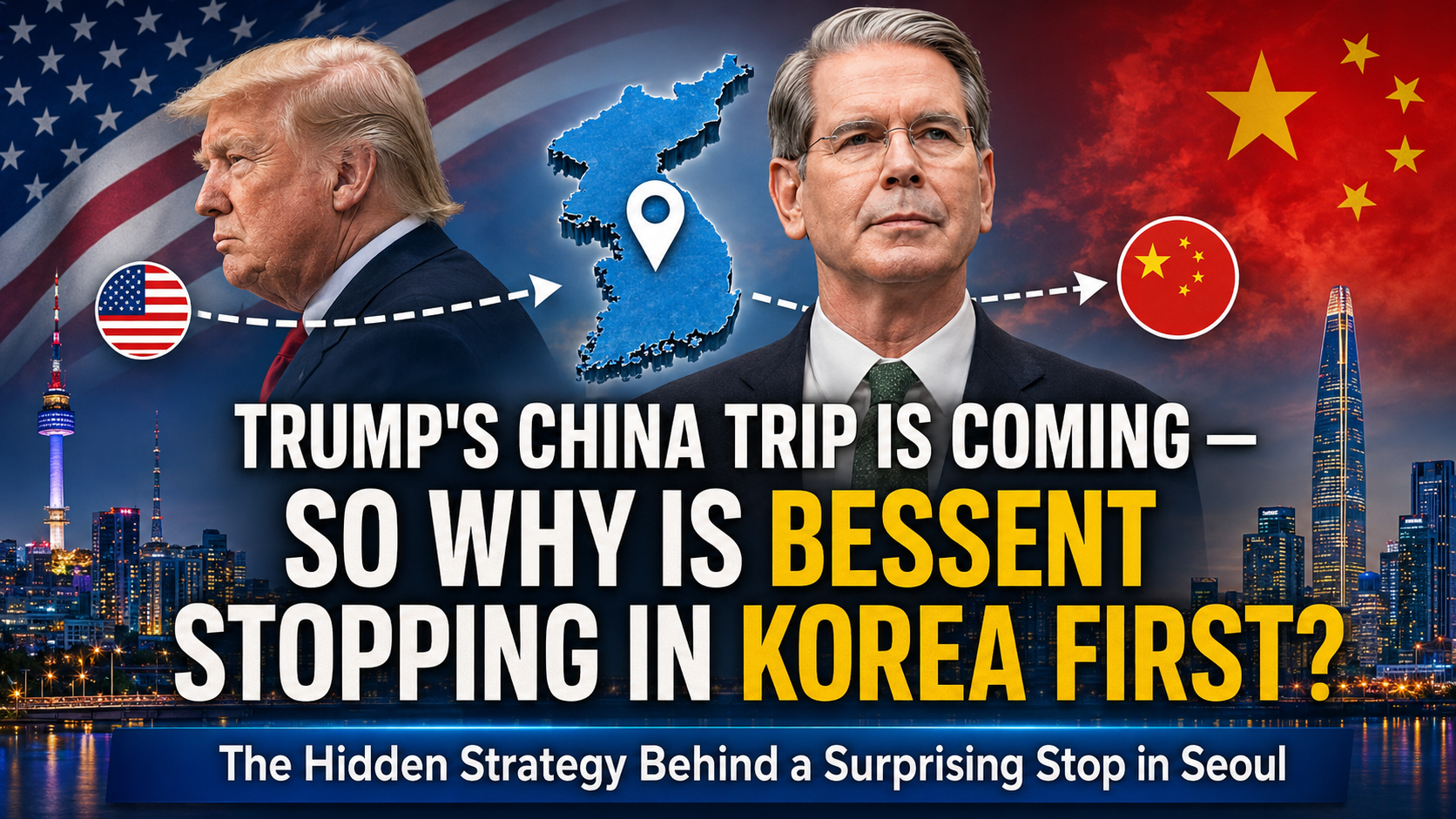
Trump's China Trip Is Coming — So Why Is Bessent Stopping in Korea First?
All eyes are on the impending Trump-Xi summit — a meeting between the leaders of the world's two rival superpowers that carries enormous consequences for the global order. But a fascinating subplot has emerged in the run-up. U.S. Treasury Secretary Scott Bessent has announced he will visit South Korea on May 13 — specifically before Trump departs for Beijing.
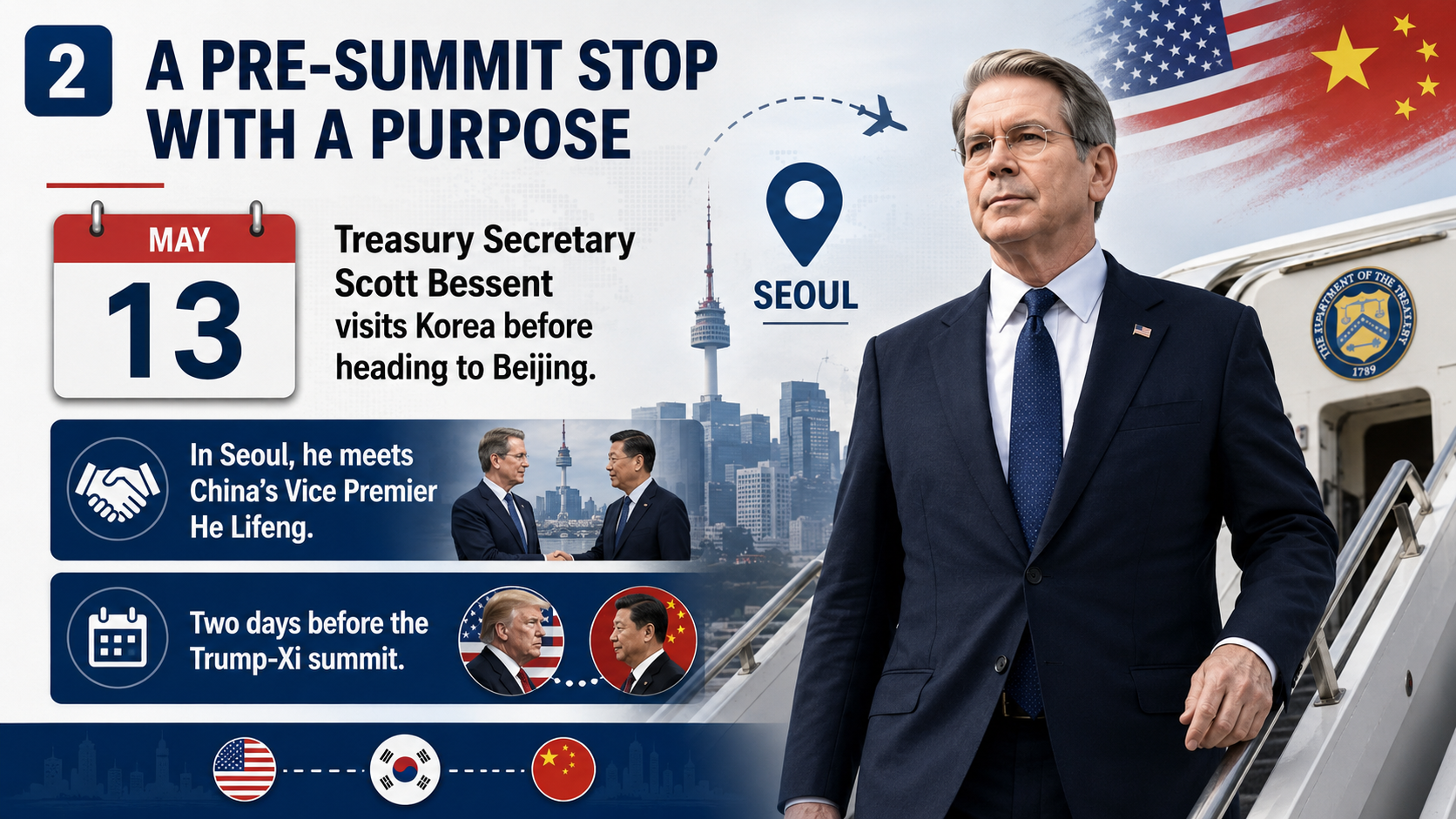
What makes this particularly striking is not just the Korea stop itself, but what Bessent will do while he's there. He is scheduled to hold a preliminary meeting in Seoul with Chinese Vice Premier He Lifeng — China's economic czar. Two days before a major US-China summit, the economic leads of both countries are sitting down together in a third country: Seoul.
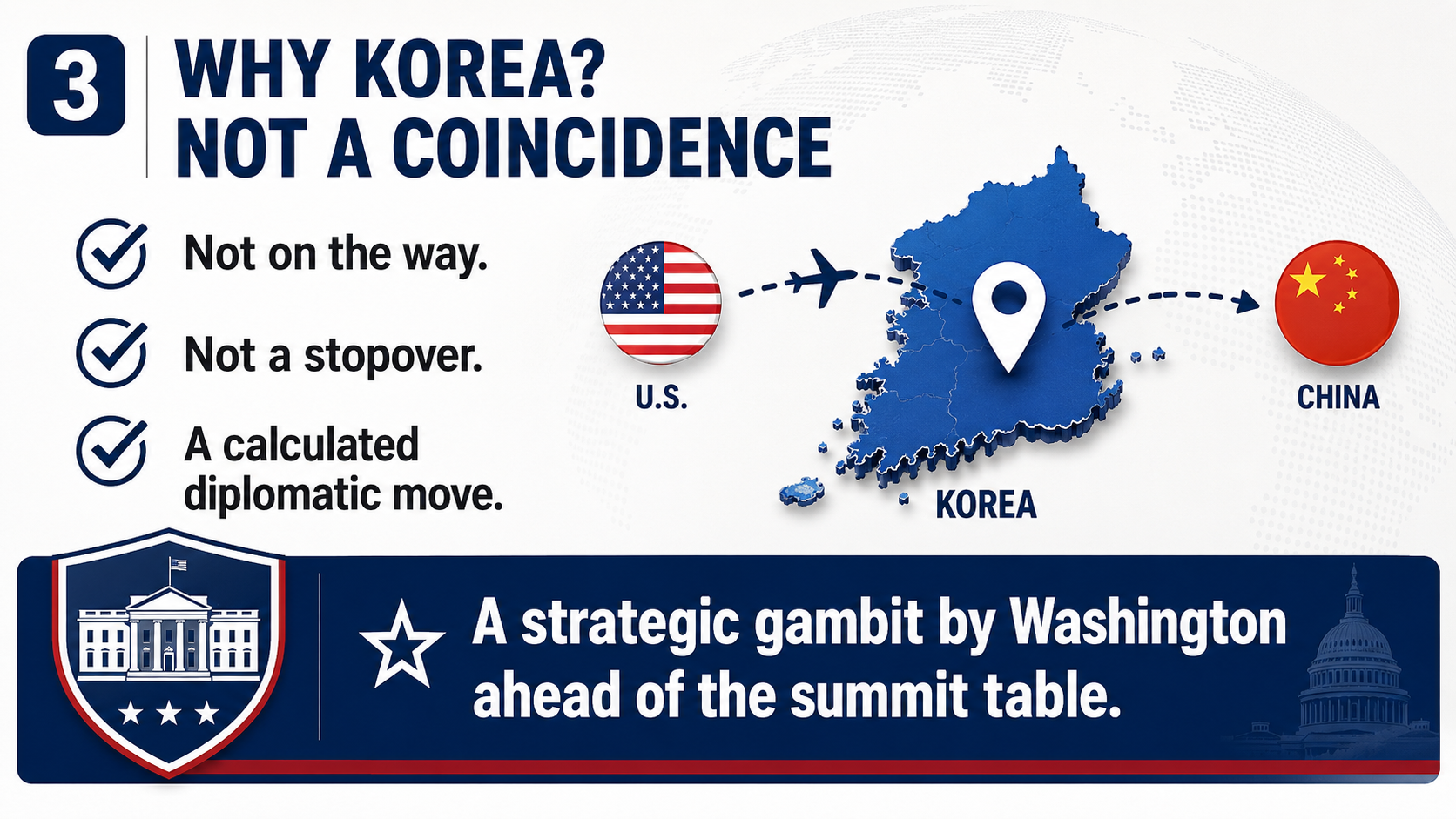
Diplomatic convention would normally have an official heading directly to a counterpart's capital, or conducting pre-summit coordination from home. Bessent's choice to make Seoul his first stop — rather than flying straight to Beijing — is not a logistical coincidence. It strongly suggests a carefully calculated diplomatic gambit by Washington ahead of the summit table.
So why Korea, and why now? What is the calculation hidden behind this unusual itinerary? The answer reveals a great deal about how the geopolitical chessboard has shifted — and where Korea now sits on it.
Korea's New Geopolitical Price Tag in the US-China Rivalry
Behind Washington's move is a classic 'show of strength before the talks' strategy — demonstrating tight solidarity with a key Asian ally before sitting down with Beijing, in order to enter the negotiation with greater leverage. The optics of locking arms with Seoul send an unspoken message of pressure toward China before a word is exchanged at the summit table.
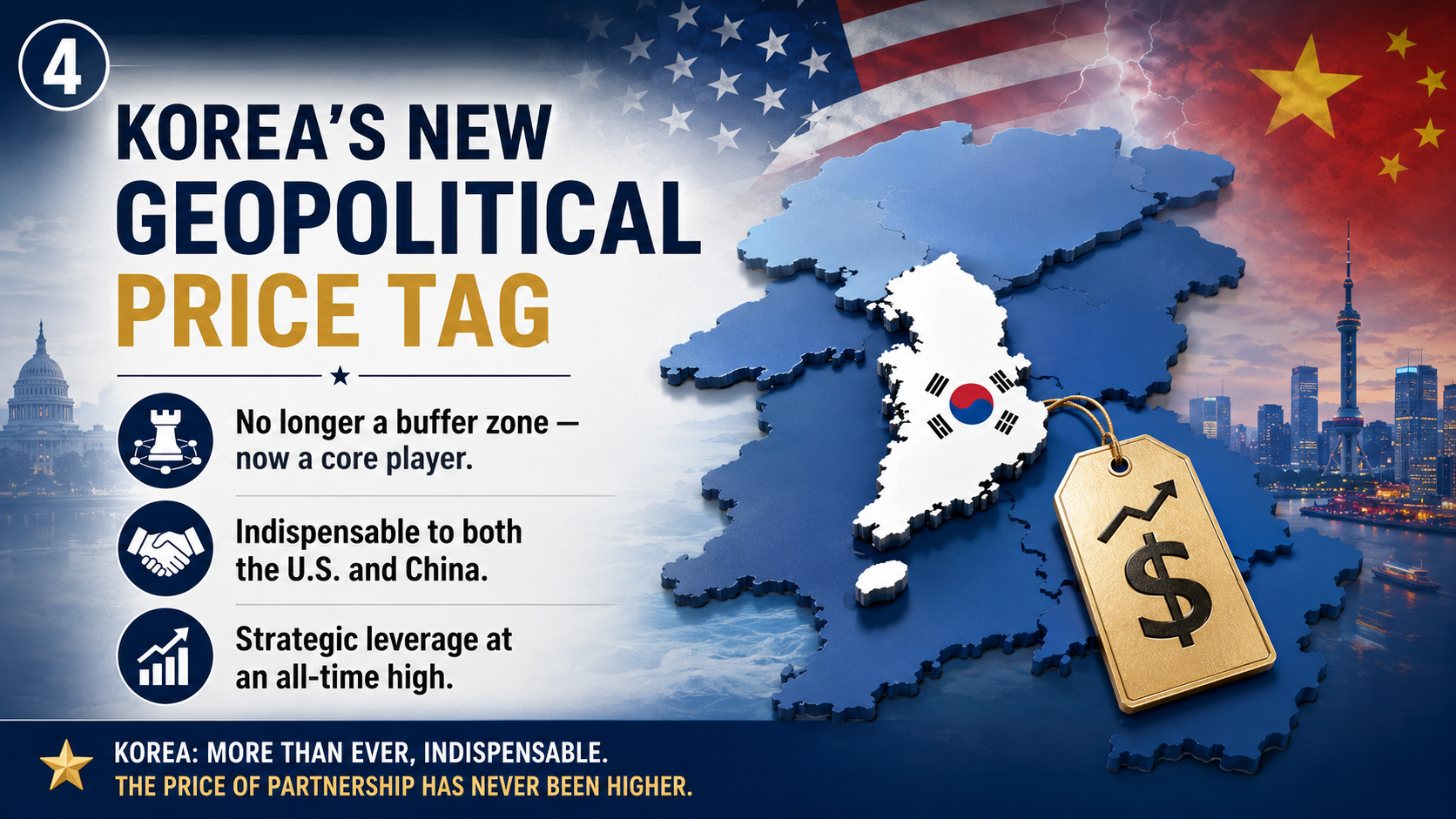
But this move also reflects a genuine shift in Korea's geopolitical standing. Korea is no longer merely a buffer zone navigating between great powers — it has been elevated to a core player on the global stage. The more intense the US-China competition becomes, the more indispensable Korea becomes to both sides.
The reason for this surge in Korea's strategic value is its economic irreplaceability. Korea's dominance in advanced semiconductors and EV batteries gives it outsized influence within the global supply chain. For Washington, building a stable supply chain that reduces reliance on China and contains Beijing's tech rise requires Korea's unmatched manufacturing capability and technological depth. From Beijing's perspective, Korea's economic connectivity is equally too valuable to forfeit — particularly as China seeks pathways through tightening tech controls.
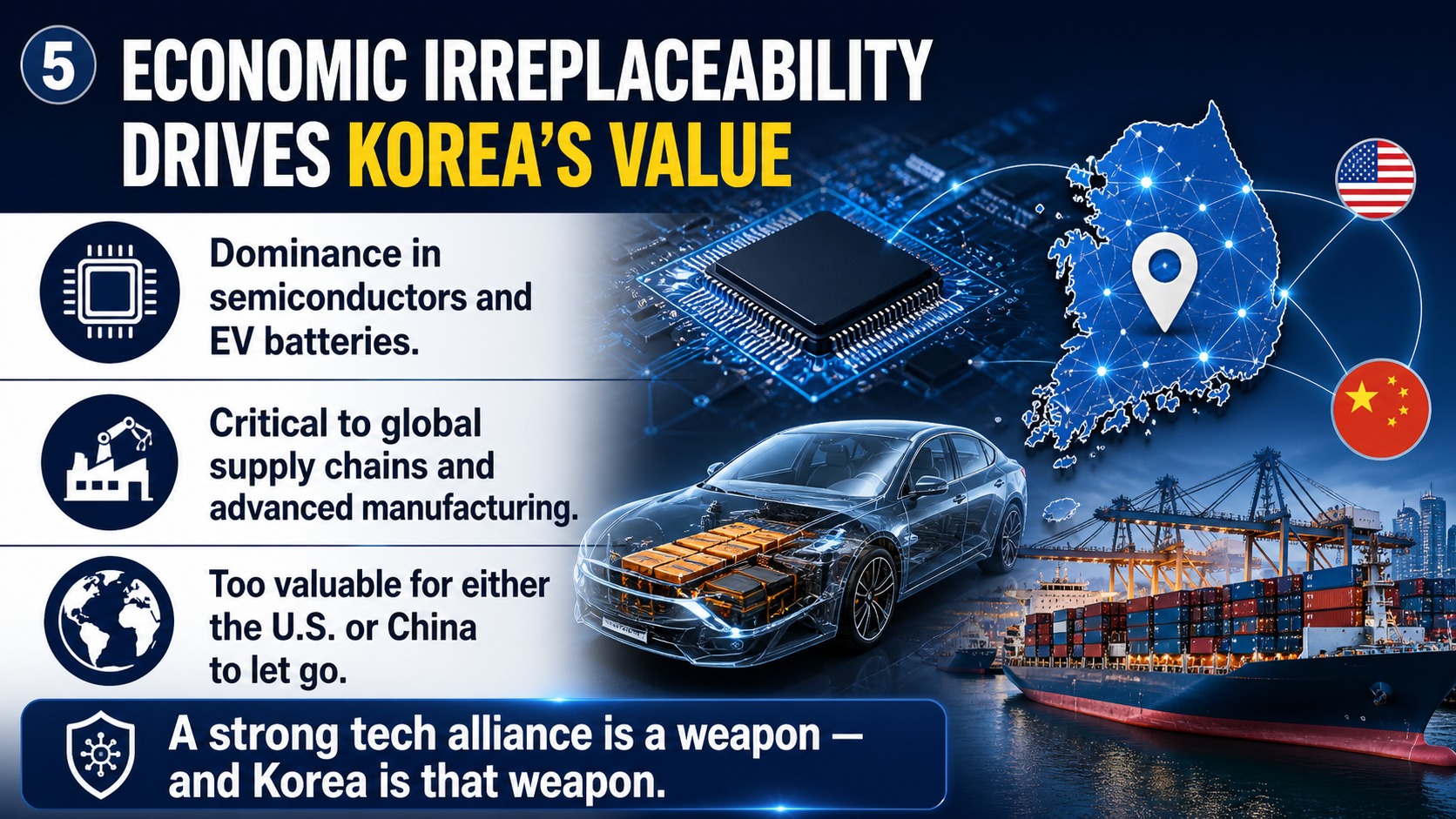
The fact that America chose to stop in Korea on the way to China is a recognition that a strong tech alliance at your side is itself a negotiating weapon — one Washington understands how to deploy. Korea's strategic leverage has rarely been higher than it is right now. The question is how to use it wisely.
The Opportunities Bessent's Visit Opens for Korea
Washington's move throws open an attractive window of opportunity. The most immediate gain is stronger negotiating leverage at the bilateral economic table. On issues where Korea has been in a relatively supplicant posture — the Inflation Reduction Act (IRA), semiconductor subsidy access, tariff relief — the dynamics have shifted. With the U.S. needing Korea's firm support and alignment ahead of a consequential Beijing summit, this is a uniquely favorable moment to press Korean corporate interests more assertively.
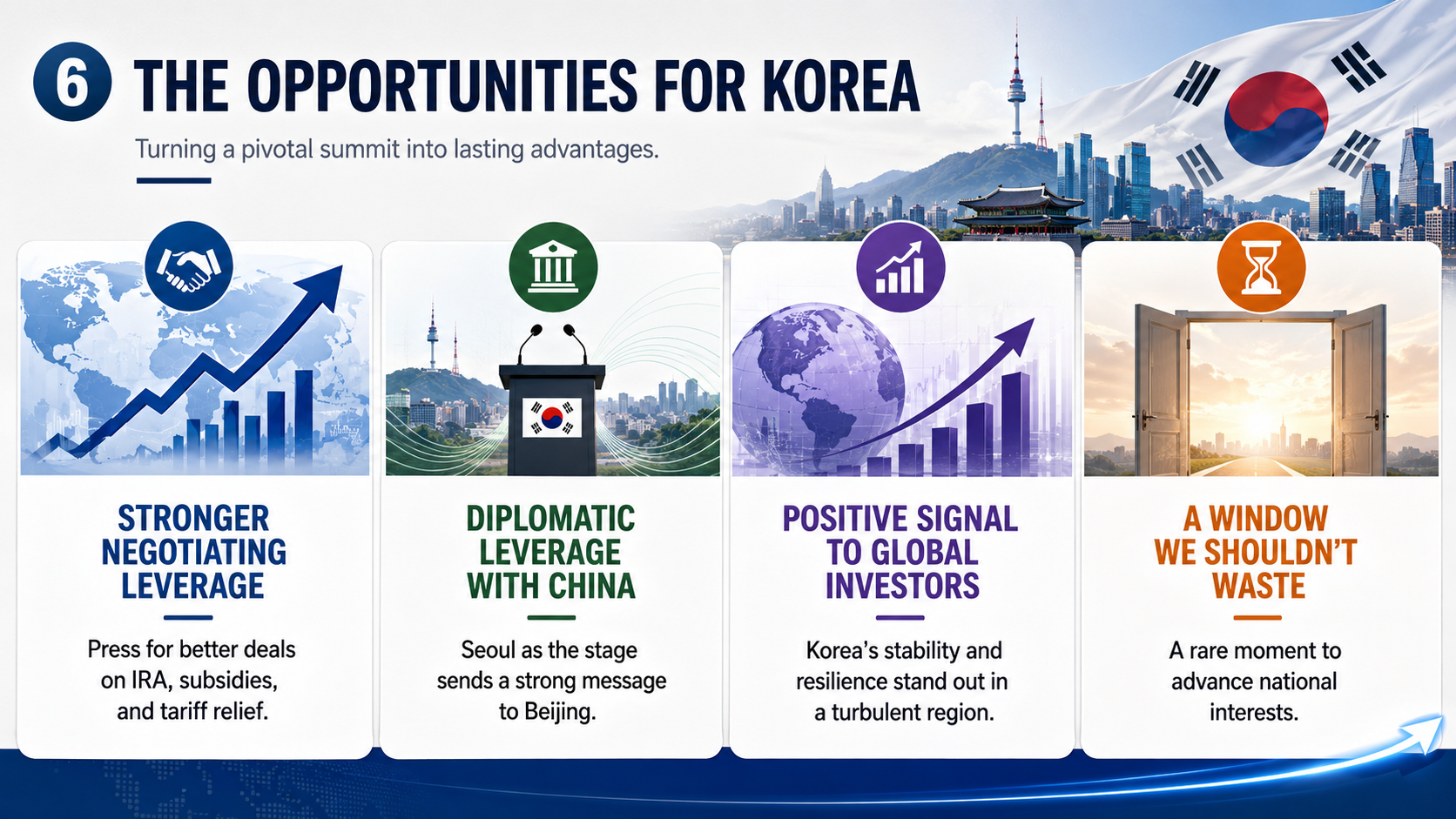
Korea also gains diplomatic leverage in dealing with China. Having Seoul serve as the venue for a US-China economic dialogue — in Korea's own backyard — carries significant symbolic weight. It sends a quiet but unmistakable message to Beijing: Korea has a strong alliance behind it. That visibility translates into real leverage in future trade negotiations and economic exchanges with China, where Korea can speak with more authority.
The signal to global investors is equally meaningful. Watching Korea be treated as an indispensable partner — even as US-China tensions simmer — is a powerful advertisement for Korean economic stability and resilience. Foreign capital looking for a safe harbor in a turbulent Indo-Pacific will notice.
But it would be a mistake to bask too long in the warmth of these opportunities. After every banquet, someone has to pay the bill — and behind the favorable optics, some very uncomfortable realities are waiting.
Don't Get Comfortable — The Hidden Risks Korea Must Watch
The first risk is the 'alliance invoice' that Washington may present in return. Tighter alignment with the U.S. will almost certainly come with stronger pressure to participate in expanded export controls against China. Restrictions on semiconductor equipment, cutting-edge materials, and dual-use technology sales to Chinese entities could be toughened significantly. The ask for additional economic concessions from Korean companies could also intensify — and for industries with deep China exposure, that bill could be substantial.

Beijing's reaction is the second concern. China will not be pleased to see the U.S. publicly cementing alliance solidarity with Korea on its doorstep, just before the summit. The risk of economic retaliation — a replay of the THAAD episode, when China imposed sweeping trade restrictions and market punishments against Korea — cannot be dismissed. Given how dependent significant parts of the Korean economy remain on China-linked demand, this is a genuinely precarious exposure.
The underlying dilemma is that both great powers are now applying pressure on Korea to choose sides more explicitly. Take one hand, and the other glares. The diplomatic fatigue from being perpetually squeezed between two giants is accumulating — and the need for a sophisticated, durable strategy has never been more acute.
Being a Smart Dolphin Among Whales — Korea's Strategic Choices
Korea does not need to be the shrimp getting crushed between whales. It can be the dolphin — nimble, intelligent, surfing the waves on its own terms and carving out its own path.
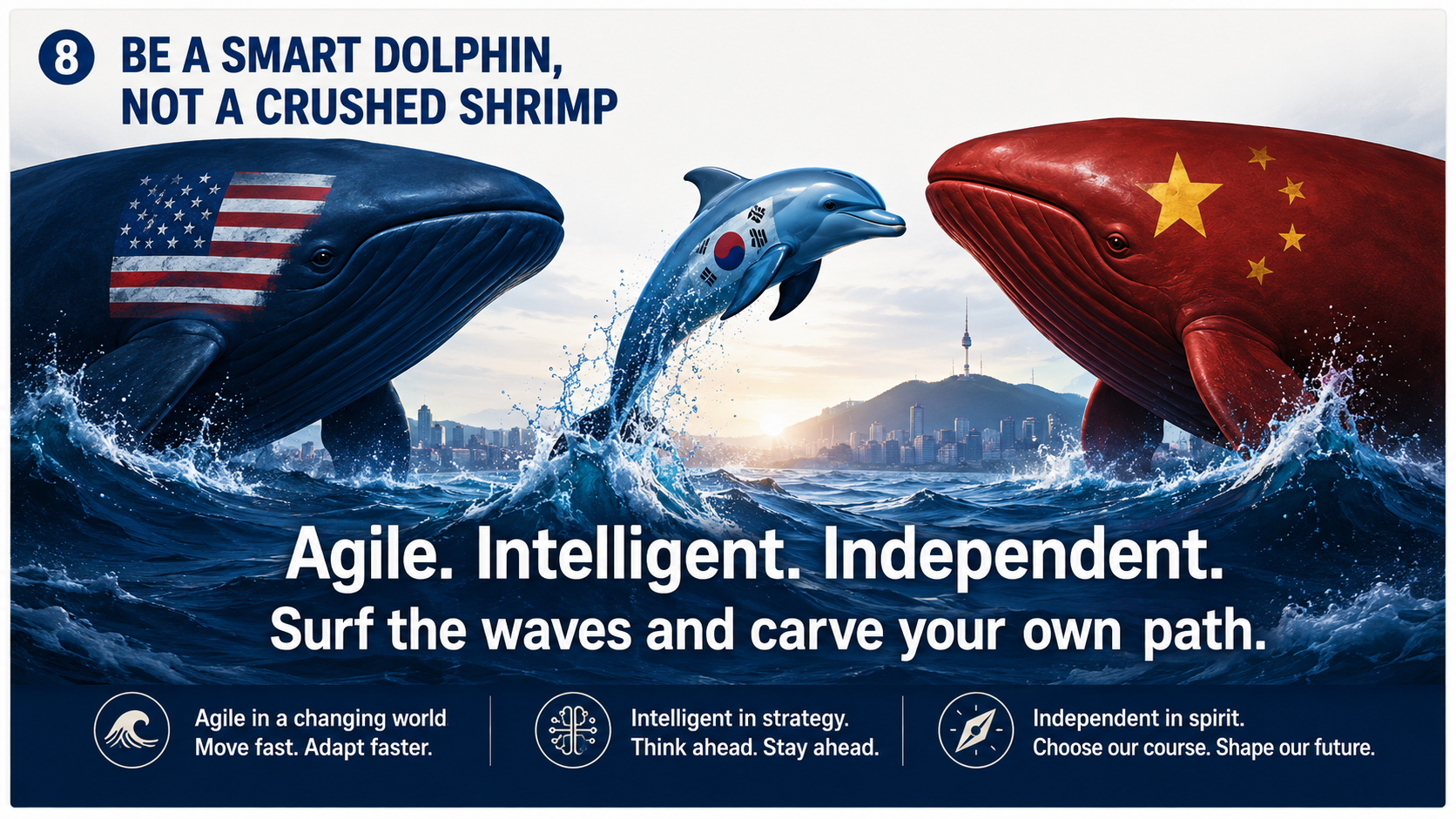
The foundation of any durable strategy is 'principled diplomacy' anchored in Korea's core national interests: its advanced semiconductor industry and its national security. Rather than being buffeted by each new round of pressure, Korea needs firm, clearly articulated red lines — non-negotiable principles that hold regardless of which direction the wind is blowing. That kind of clarity is what allows a mid-sized power to hold its ground without being pulled in by either side.

On top of those principles, precision in messaging is essential:
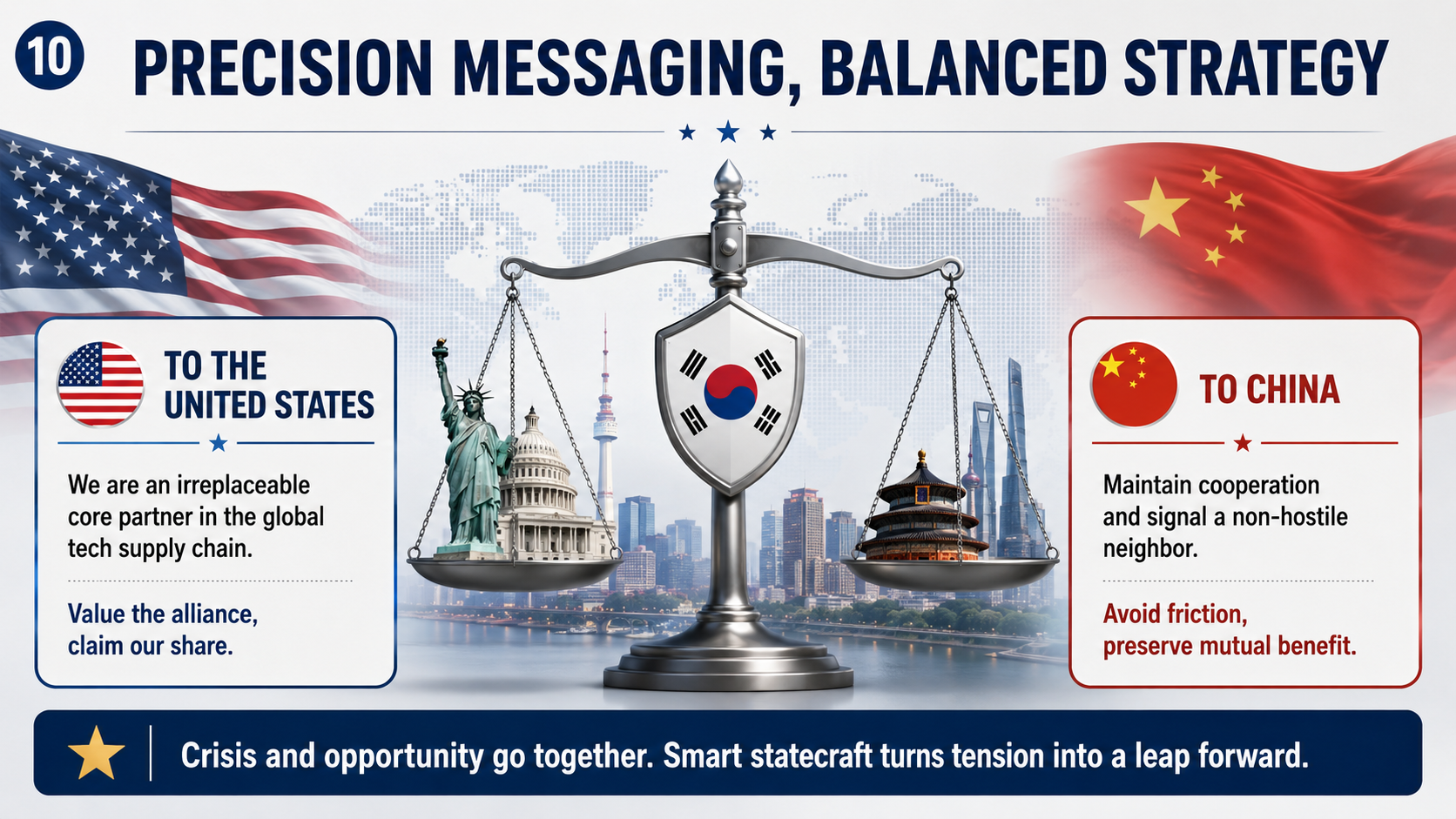
- To the United States: Reinforce that Korea is an irreplaceable core partner in the global technology supply chain — not just a passive ally. Demonstrate the alliance's value while firmly claiming Korea's rightful share at the table.
- To China: Maintain economic cooperation and continuously signal that Korea is a non-hostile neighbor — not a frontline combatant in American containment strategy. Keep friction to a minimum and preserve the channels of mutual economic benefit.
In diplomacy, crisis and opportunity have always traveled together. The ability to build Korea's own survival formula — right in the middle of a giants' struggle — ultimately rests on the agility and resolve of Korean statecraft. The current high-wire tension could, if navigated well, become the platform from which Korea's global standing and national interests take a meaningful leap forward.
Frequently Asked Questions
Q. What is Treasury Secretary Bessent specifically scheduled to do during his Korea visit?
A. Secretary Scott Bessent is scheduled to visit South Korea on May 13 — immediately before President Trump departs for China.
The headline item on his Seoul agenda is a preliminary meeting with Chinese Vice Premier He Lifeng — China's economic lead. Having the U.S. and Chinese economic chiefs meet in Seoul as a pre-summit warm-up, rather than in either capital, is highly unusual — and underscores just how significantly Korea's diplomatic standing has risen on the global stage.
Q. Will Bessent's visit have an immediate impact on Korean markets or the economy?
A. It is likely to function as a positive signal to global investors — demonstrating Korea's role as a stable, valued partner even amid US-China turbulence.
With Washington needing Korea's cooperation ahead of its Beijing summit, this also creates favorable conditions to press Korean interests on issues like the IRA and semiconductor subsidy access. However, the visit may simultaneously come with pressure for Korea to participate in tighter export controls on China — making preparation for the hidden invoice equally important.
Q. How is China likely to view the United States' unusual Korea stop?
A. China will almost certainly find it uncomfortable. The optics of the U.S. publicly cementing alliance solidarity with Korea on China's doorstep — just before a summit on Chinese soil — is a deliberate pressure move.
Washington is playing a classic 'show of strength before the talks' strategy. This raises the risk that China responds negatively toward Korea — potentially echoing the economic retaliation of the THAAD episode. Careful, nuanced messaging that avoids unnecessarily provoking Beijing is essential.
Q. In the US-China rivalry, which side is it ultimately more advantageous for Korea to align with?
A. Rather than picking a side and playing a passive, anxious role — Korea should pursue 'principled diplomacy' grounded in its core national interests: semiconductors and security.
- To the U.S.: Demonstrate that Korea is an irreplaceable partner in global tech supply chains — valuable enough to earn genuine reciprocity, not just rhetorical appreciation.
- To China: Maintain economic cooperation and project the image of a non-hostile neighbor — not a willing participant in containment — through flexible, measured signaling.
The wisest strategy is the one that avoids being pulled entirely into either orbit — and instead positions Korea as the indispensable swing partner that neither side can afford to alienate.
References
U.S. Treasury Secretary Bessent: "Visiting Korea on May 13, Meeting China's He Lifeng in Seoul"
Bessent Korea visit, Trump China summit, US China summit 2026, Scott Bessent He Lifeng Seoul, Korea geopolitics US China, Korea strategic value semiconductors, US China trade rivalry Korea, Korea diplomatic leverage, IRA Korea semiconductor, THAAD economic retaliation, Korea foreign policy, Indo-Pacific supply chain Korea, principled diplomacy Korea, US alliance Korea China