Turning CO₂ from Factory Exhaust into Gasoline? Korea Research Institute of Chemical Technology Successfully Demonstrates Naphtha Production!

Captured CO₂ From Factory Exhaust — Turned Into Gasoline?
Every morning the news cycle brings the same words: 'climate change' and 'carbon neutrality.' Carbon dioxide — long considered humanity's most intractable environmental problem and the primary driver of global warming — has always been something to be reduced at all costs. But what if this troublesome greenhouse gas could be transformed into the very gasoline that powers our cars? What once sounded like medieval alchemy — turning worthless stones into glittering gold — has finally become reality.
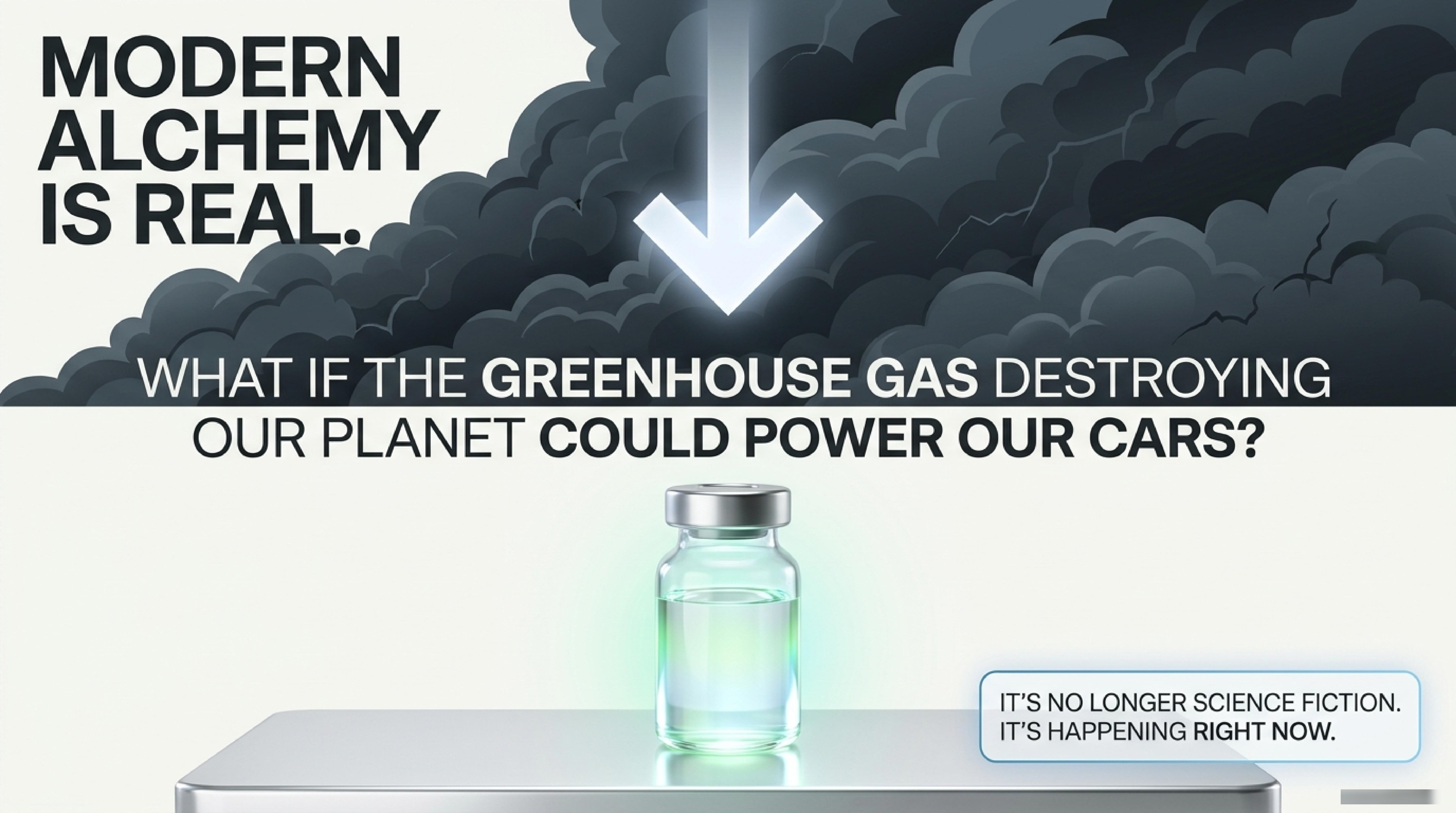
April 28, 2026. The Korea Research Institute of Chemical Technology (KRICT) delivered world-stopping news. The institute officially announced that it had successfully converted CO₂ captured from industrial exhaust gases — combined with hydrogen — directly into liquid hydrocarbons including gasoline and naphtha. What makes this landmark achievement extraordinary is that the team has moved beyond lab-scale experiments into a pilot production phase — manufacturing these fuels continuously at a visibly tangible scale.

Until now, dealing with CO₂ has felt like receiving a bill — you pay enormous costs just to bury it underground or neutralize it. But this announcement changes everything. Waste greenhouse gas is now reborn as economically valuable fuel and industrial feedstock. The delightful implications of this shift include:
- A problem transformed: The greenhouse gas that has been heating the planet is reborn as a useful resource
- Technology validated at scale: What was once only an idea on paper has been confirmed as a workable, continuous production process
- New value creation: Environmental responsibility and economic benefit achieved simultaneously — a genuine win-win
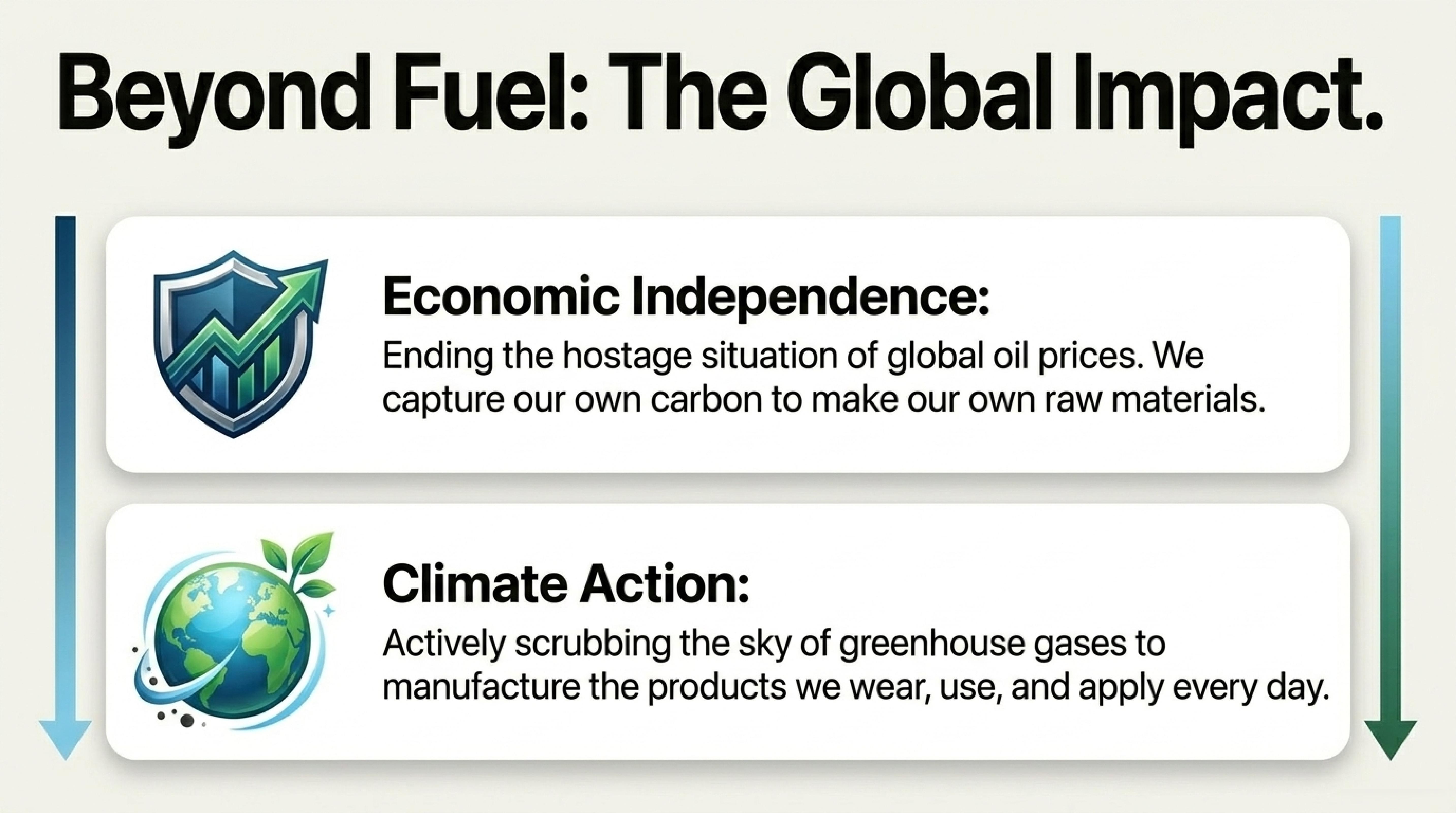
Protecting the planet while simultaneously generating economic value — this is close to magic. But alongside gasoline, one other word in this announcement is drawing equally intense attention from industry: 'Naphtha.' We can intuitively grasp CO₂ turning into gasoline by picturing a car — but why is everyone in the industry so excited about naphtha specifically? To fully appreciate why this technology is such a big deal, let's first unpack the mystery behind this crucial word.
What Is Naphtha, and Why Is Everyone So Excited About It?
The smartphone case in your hand. The synthetic fabric in the clothes you're wearing. The moisturizer you apply every morning. Trace any of these back to their origins, and you'll arrive at a single name: naphtha.

Naphtha is often called the 'rice' of the petrochemical industry. Just as rice is the irreplaceable staple at the heart of Asian cuisine, naphtha is the single most fundamental feedstock in making virtually everything modern people use daily. Plastics, rubber, vinyl — virtually all mass-produced chemical products are derived from naphtha.
The problem is that obtaining this precious 'rice' has been a complicated and costly affair. Until now, producing naphtha has required importing crude oil from underground reserves. Only after this expensive imported oil has been boiled, refined, and processed at enormous temperatures in a refinery does naphtha finally emerge.
- Precarious import dependency: South Korea imports 100% of its crude oil. Every time conflict erupts in the Middle East or global oil prices swing wildly, the entire Korean industrial ecosystem lurches with it — a deep structural vulnerability.
- Carbon emissions threatening the environment: Transporting and superheating crude oil through the refining process releases enormous quantities of greenhouse gases. As the climate crisis intensifies and the world scrambles to cut emissions, the conventional naphtha production model has been on a direct collision course with the demands of the times.

Naphtha is essential for maintaining our modern lifestyle — but obtaining it has required accepting economic vulnerability and environmental damage. This is precisely why the world has been so urgently waiting for a completely new production method that doesn't rely on crude oil at all.
Collapsing Two Complex Steps Into One — The Magic of KRICT
So how does one actually convert CO₂ into naphtha? Prior technologies for producing liquid fuel from CO₂ did exist — but the process was as tedious and expensive as cooking a meal twice in a row. The first step required removing one oxygen atom from CO₂ to produce carbon monoxide through the 'reverse water-gas shift reaction' — a process demanding temperatures exceeding 800°C. The second step then reacted this intermediate product with hydrogen to synthesize the target hydrocarbons. The different temperature and pressure requirements at each stage made the equipment extraordinarily complex.
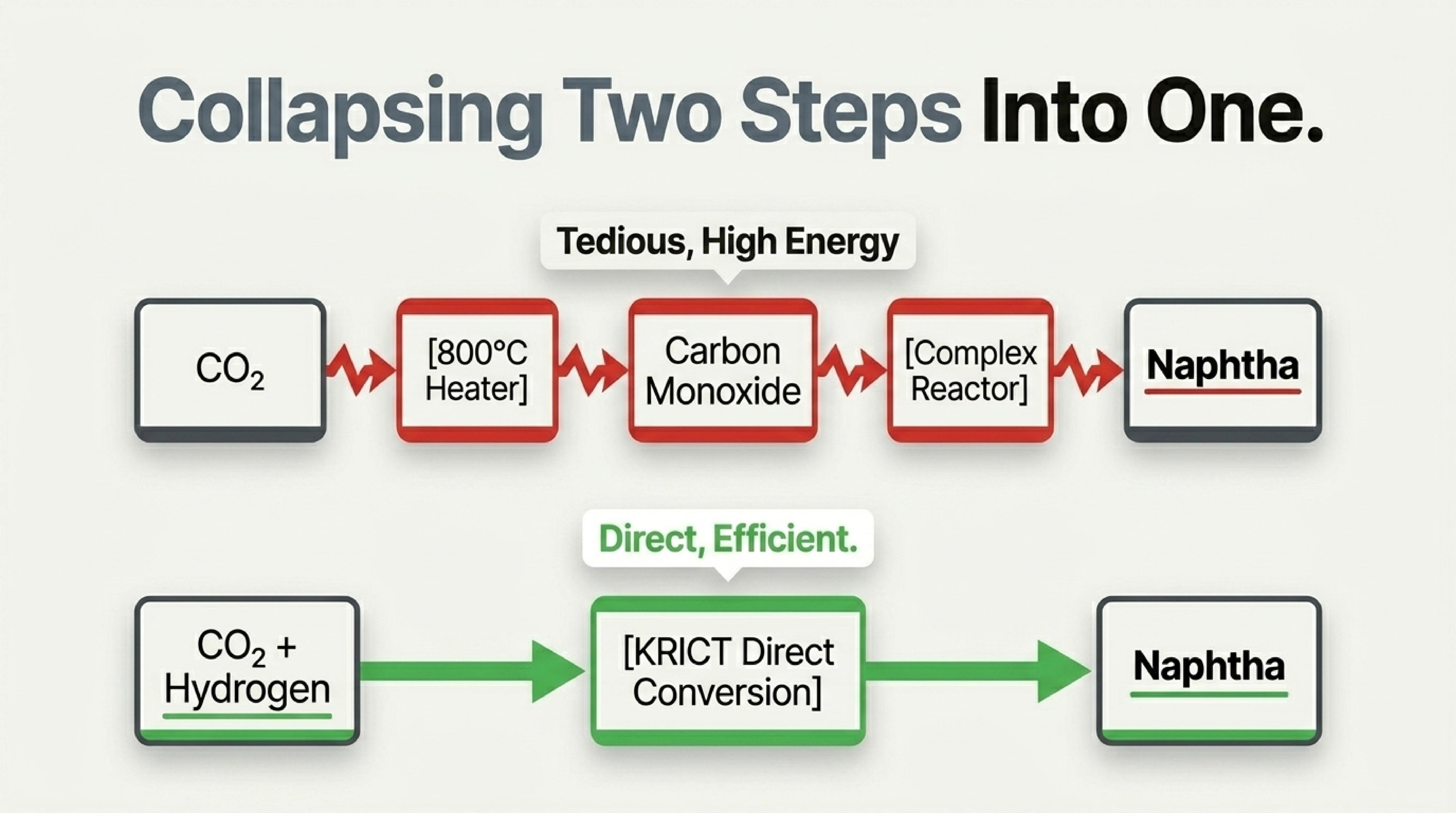
Then the KRICT research team performed something remarkable: they compressed the entire two-step indirect conversion process into a single step. By eliminating the intermediate carbon monoxide conversion stage entirely, they developed a 'direct conversion technology' that reacts CO₂ and hydrogen directly to produce liquid hydrocarbons in one shot.
The hero that makes this possible is the team's proprietary specialized catalyst. This catalyst acts as an outstanding conductor, enabling two complex reactions to occur simultaneously within a single process. Thanks to this breakthrough, the extreme 800°C+ superheating environment is no longer necessary — the reaction can now be driven at a comparatively mild temperature of around 300°C and a pressure of approximately 20 atmospheres.
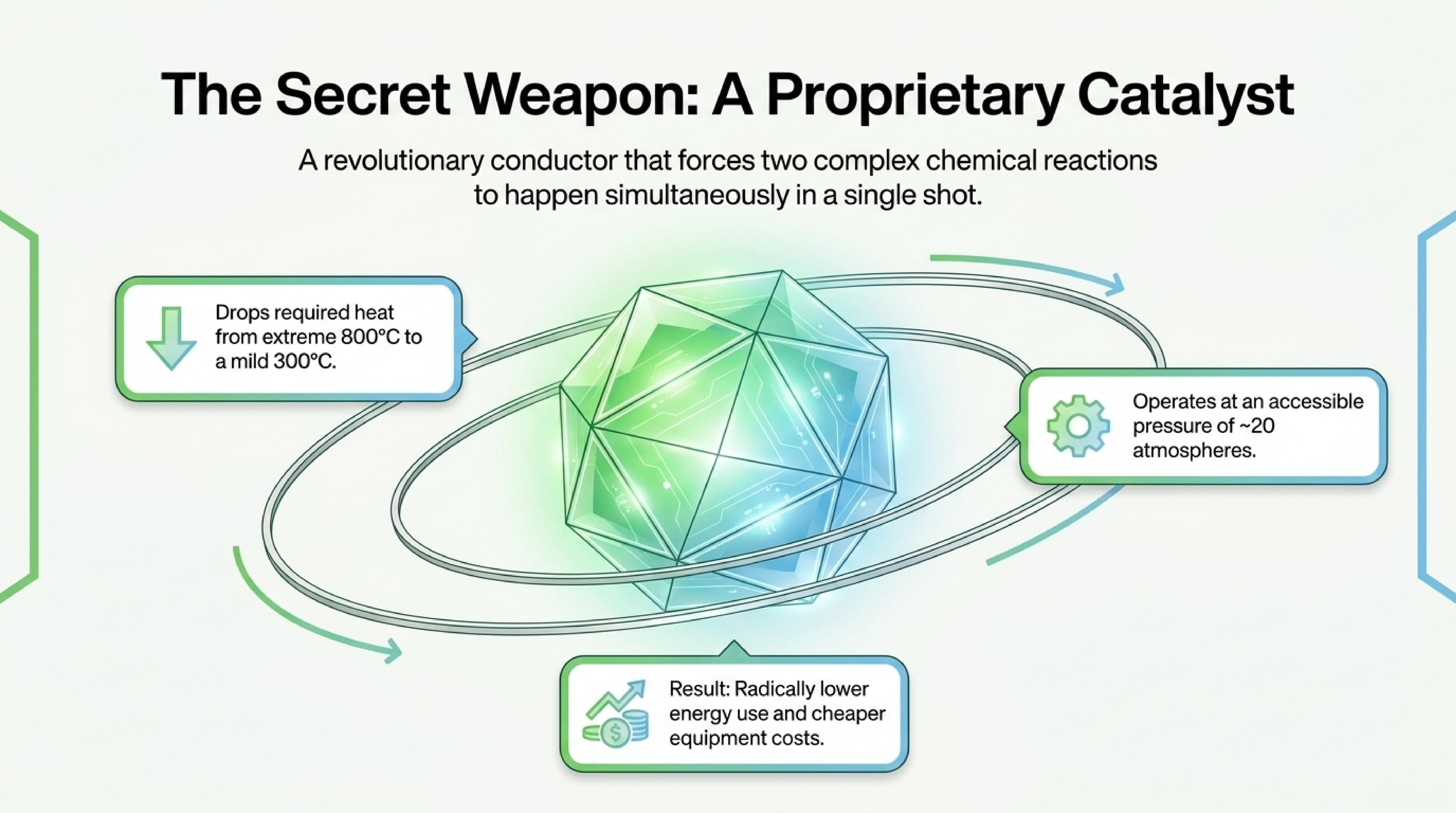
The benefits of consolidating into a single step are enormous. Cutting operating temperatures by more than half means energy consumption drops dramatically. Equipment that previously had to be complex and elaborate to manage different temperature and pressure requirements at each stage can now be greatly simplified — which in turn substantially reduces facility construction and production costs. The whole process of converting troublesome greenhouse gas into a valuable resource has become dramatically leaner and more efficient.

Now that we understand the remarkable science behind it, the natural next question is: does this magic catalyst actually perform outside the laboratory? Let's look at the remarkable results from real-world pilot production.
50kg Per Day Successfully Demonstrated — Why Does That Matter So Much?
50 kilograms per day. Some might wonder — isn't that tiny compared to industrial-scale production? But in the world of chemical technology, moving out of a laboratory beaker and producing 50kg continuously per day means clearing the highest single hurdle on the path to commercialization.
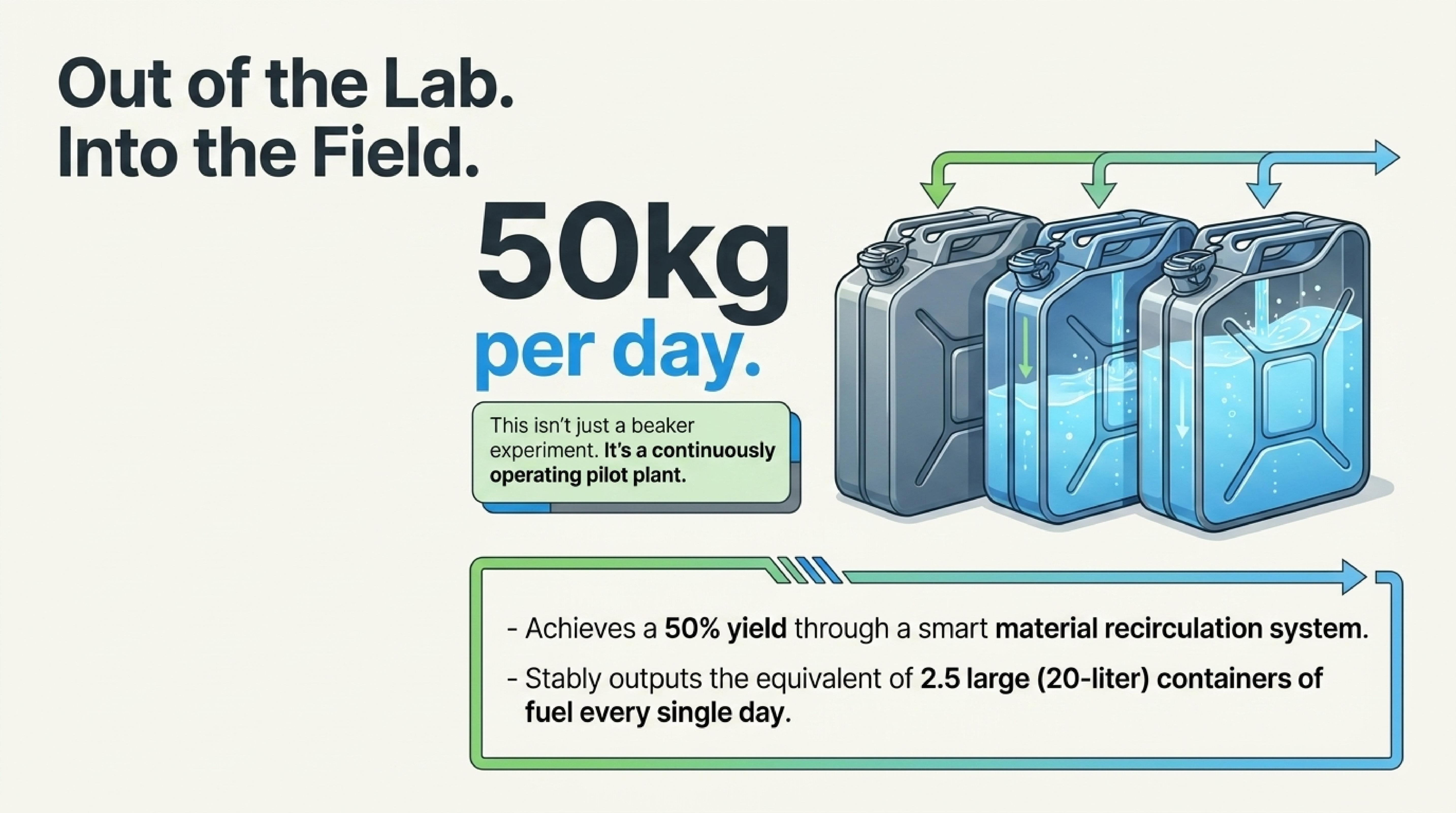
This is the successful completion of what is called the 'pilot plant' stage: proof that the remarkable reaction which worked in small quantities in the lab also functions reliably in a harsh, real-world industrial environment. The research team applied a recirculation approach — unreacted materials are fed back into the process rather than discarded — to push synthesis yields up to 50%. This confirms the durability and continuity needed to stably output the equivalent of roughly 2.5 large (20-liter) containers of liquid hydrocarbons every single day.
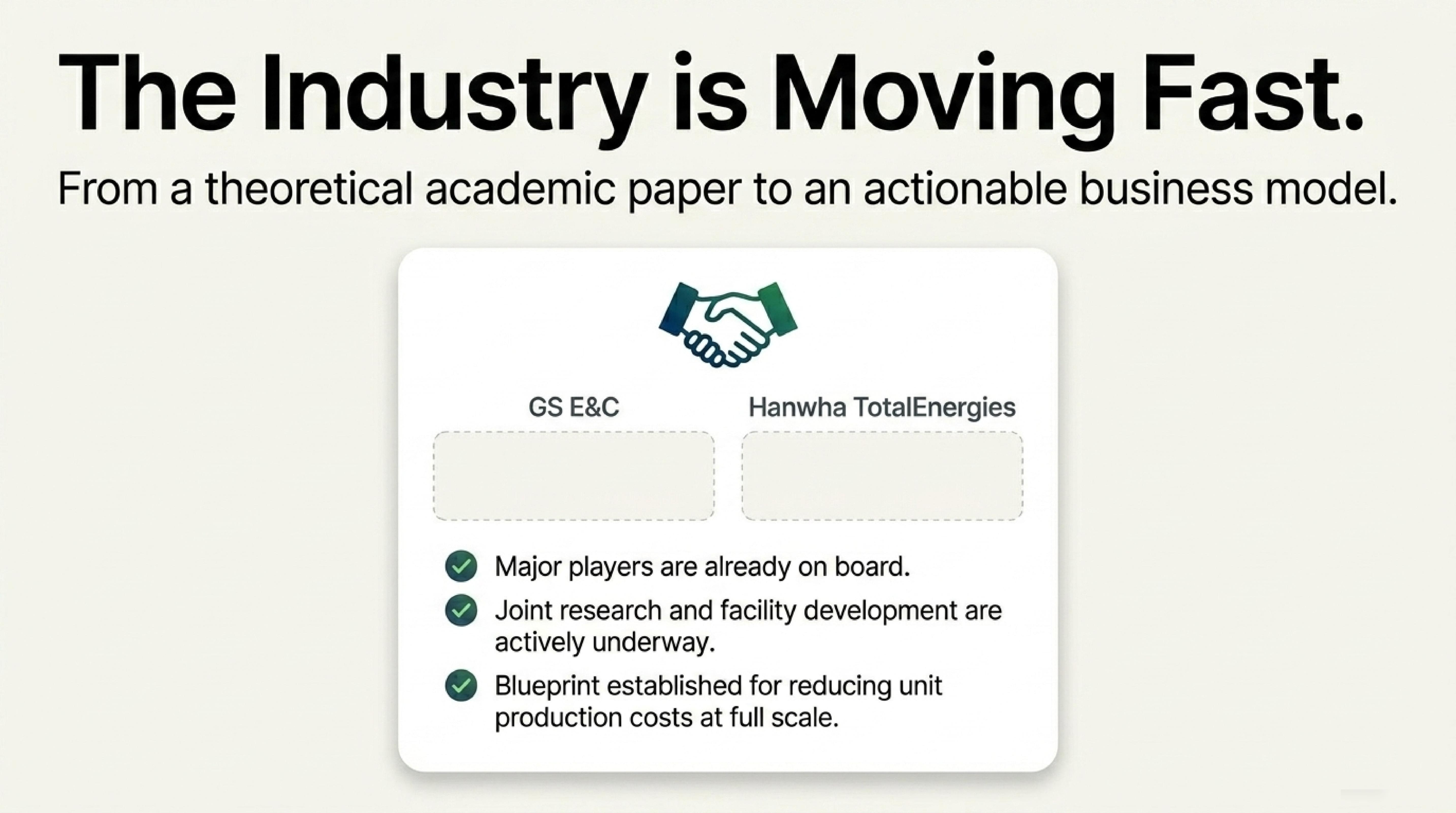
This is exactly why industry is responding with such immediate and intense excitement. The technology has evolved from a theoretical result that exists only in academic papers into an 'actionable business model' ready to be applied in real industrial settings. Notably, major players including GS Engineering & Construction and Hanwha TotalEnergies have already committed to joint research and are contributing to facility development.
- From lab to field: Moving beyond the previous 5kg-scale micro-demonstration to successful 50kg facility operation — a miniaturized real-world commercial process — opens the door to scale-up.
- Stability and economic viability proven: Demonstrating that continuous production is achievable under mild conditions provides a clear blueprint for reducing energy costs and lowering unit production costs at full industrial scale.
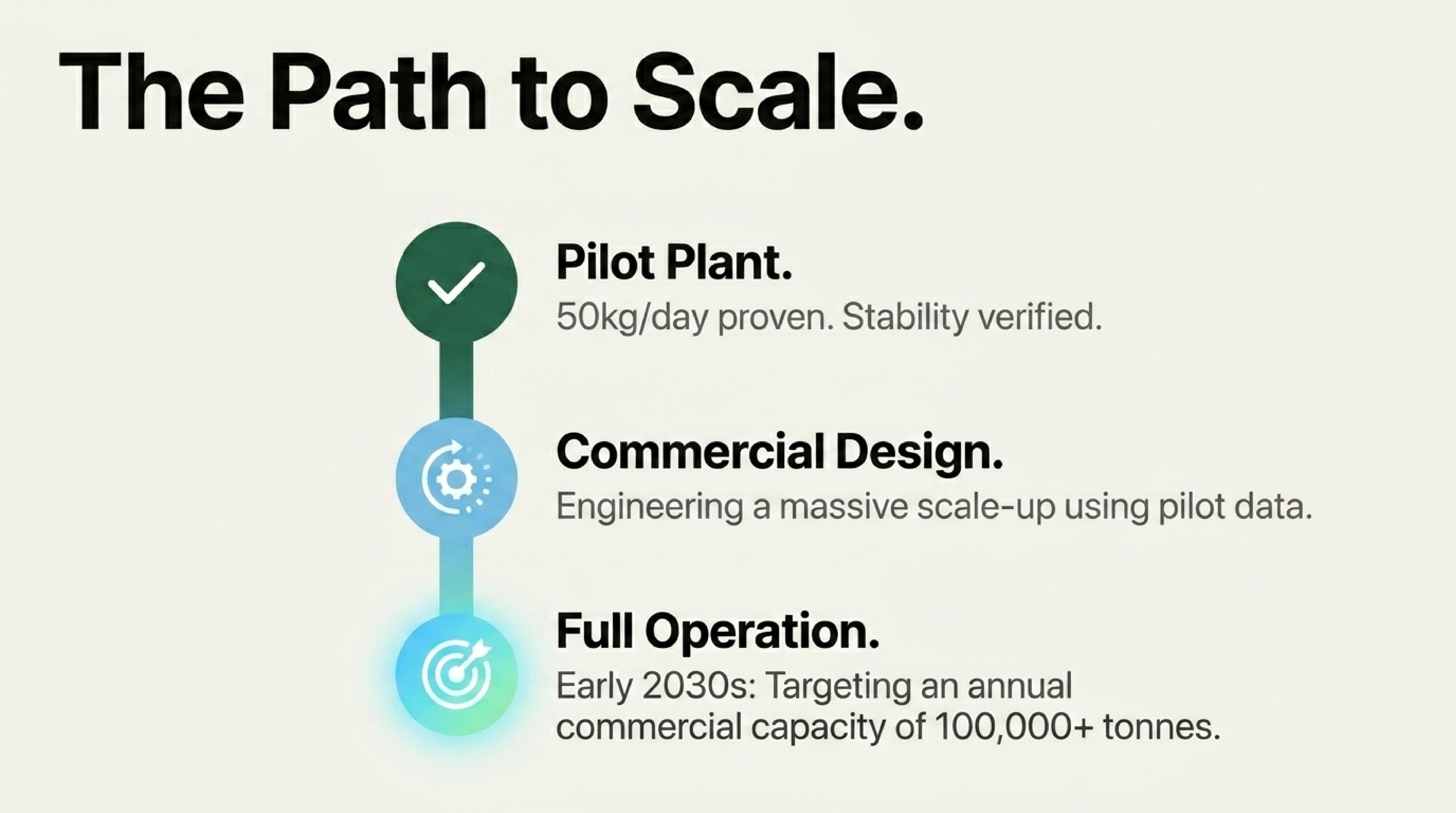
- Commercialization roadmap activated: Partner companies will now use this pilot demonstration data as the foundation for beginning full commercial process design — targeting annual production capacity of over 100,000 tonnes.
This is more than a research success — it is a confirmed stepping stone on the road to full commercial production. With the technology's real-world industrial performance now verified in person, it's time to look at the enormous butterfly effects this innovation will have on Korea's future and the global environment.
A World Where Waste Becomes a Resource — What Does Our Future Look Like?
Now our gaze turns toward a larger future. Imagine the day when this technology matures further and a commercial plant producing 100,000+ tonnes per year is fully operational. No longer anxiously watching Middle Eastern geopolitics or swings in global oil prices — instead, capturing carbon from power plants and industrial sites and using it to manufacture the raw materials for the everyday products we wear, use, and apply to our skin, entirely on our own. A truly carbon-neutral circular economy — where previously discarded greenhouse gases cycle back as the most valuable of resources — is now beginning to come into view.
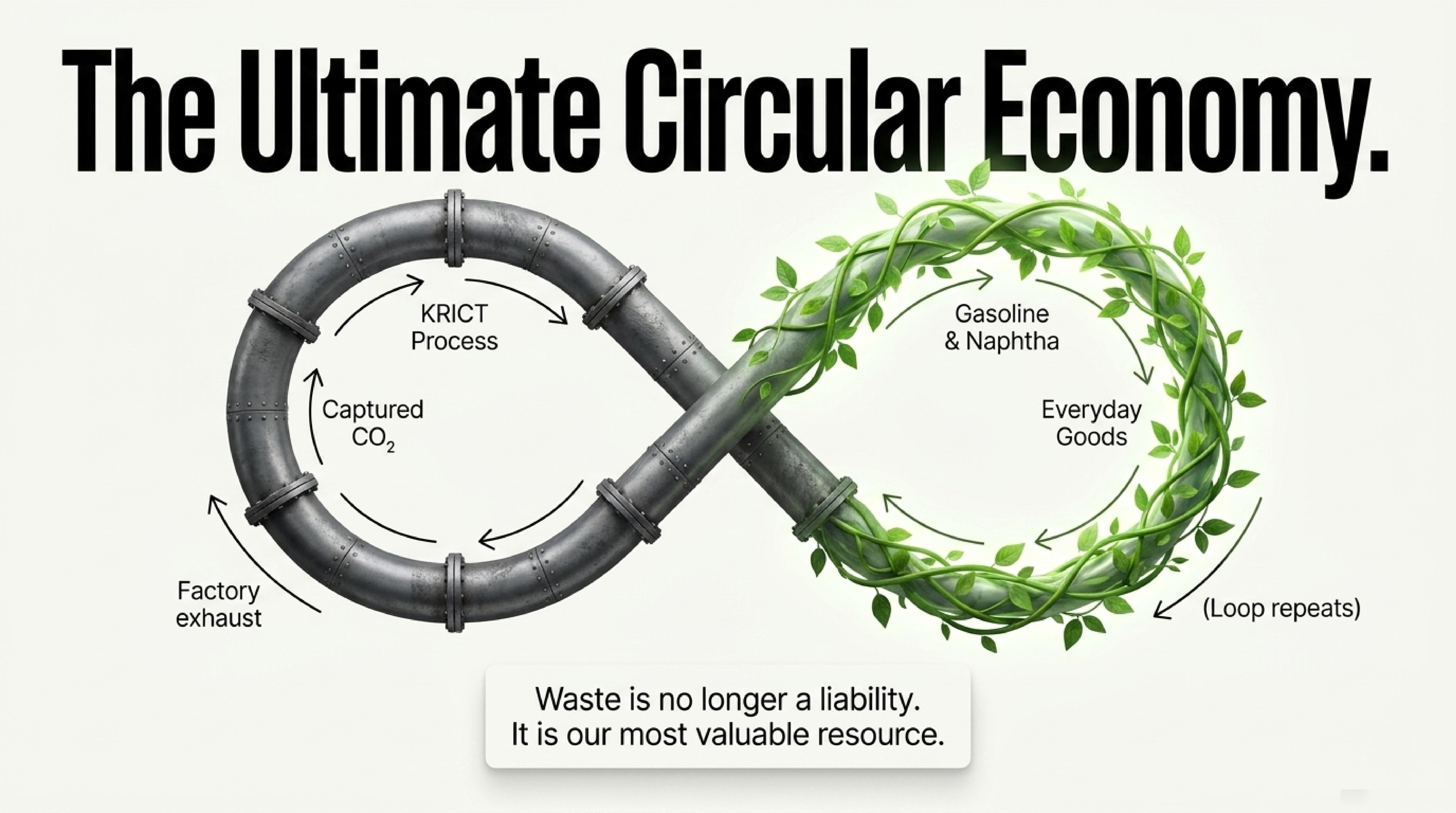
The air we breathe becomes cleaner, and the carbon that once troubled us comes back to our hands as smartphone cases, durable textiles, clean cosmetic packaging — a magical transformation. This small spark of hope that KRICT has successfully ignited — it's tremendously exciting to think about where it might lead us.
A world where waste becomes a resource is no longer the distant future of a science fiction film. Here's to a warm and positive tomorrow — one where we protect the environment while continuing to enjoy the comforts and abundance of modern life. May this remarkable and heartening news add a little brightness to your day, and let's welcome the brilliant green era ahead with genuine excitement.
Frequently Asked Questions
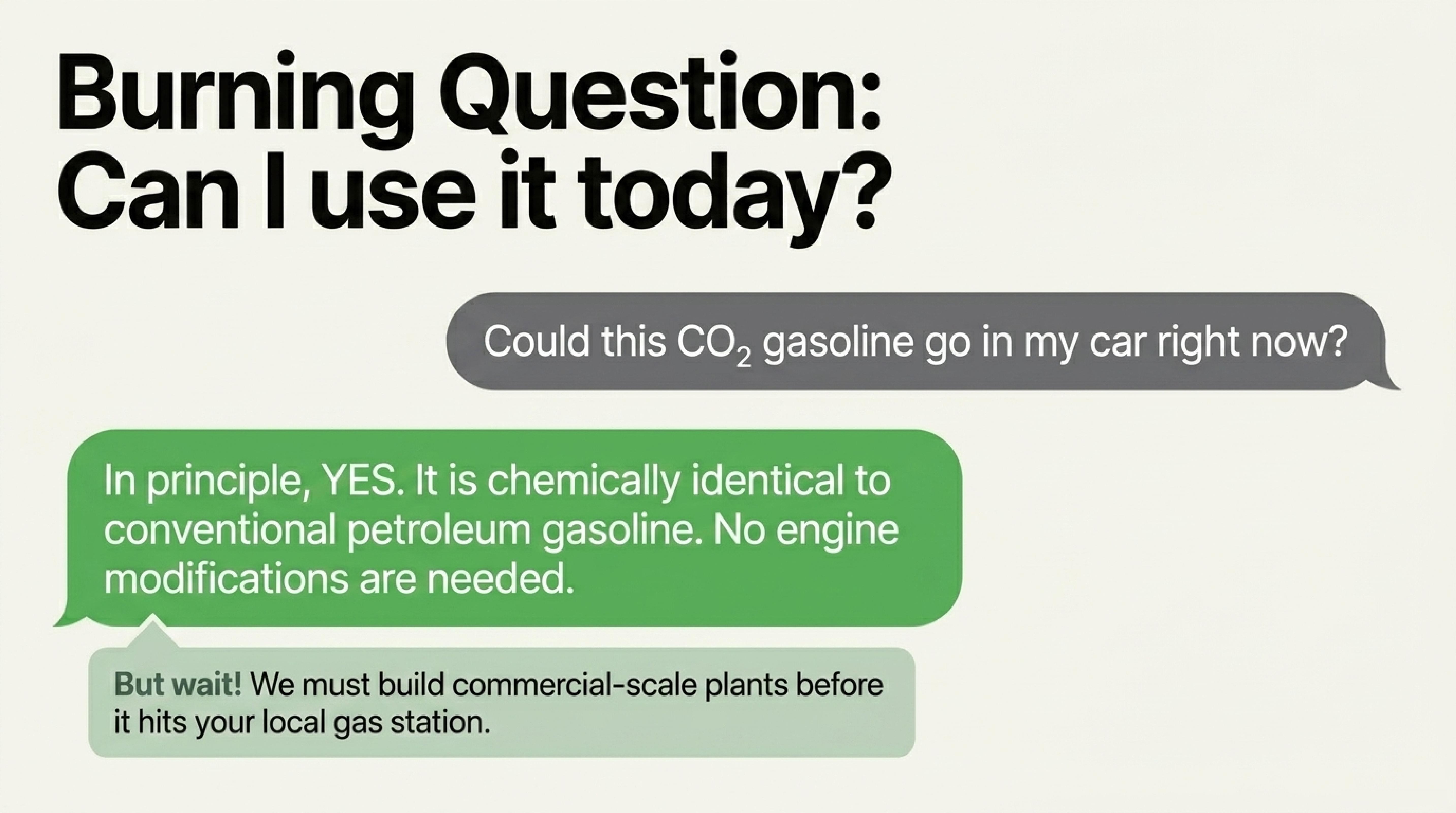
Q. Could the gasoline made from CO₂ actually be used in my car right now?
A. In principle, yes. The technology produces liquid hydrocarbons that are chemically similar to conventional petroleum-derived gasoline. This means the fuel could be used in standard internal combustion engines without any engine modifications.
However, the process is currently at the 'pilot plant' stage, producing 50kg per day. Before this eco-friendly gasoline is available at ordinary petrol stations, a fully scaled commercial production process must first be developed — so it will take some time before it reaches your fuel tank.
Q. What is the biggest difference between conventional naphtha production and this new technology?
A. The biggest differences lie in the source of feedstock and process simplification.
- Feedstock: Conventional production requires high-temperature refining of 100% imported crude oil. The new technology recycles the greenhouse gas CO₂ as the starting material.
- Process: Existing CO₂ utilization technology required two separate high-temperature steps at over 800°C. The new technology uses KRICT's proprietary specialized catalyst to produce naphtha and gasoline in a single step (direct conversion) at the relatively mild temperature of approximately 300°C.
The result is a dramatic reduction in energy consumption and production cost, while simultaneously achieving strong environmental credentials.
Q. The 50kg-per-day pilot demonstration is complete — when will full commercialization happen?
A. The successful continuous 50kg-per-day production is a major milestone proving the technology operates stably in a real industrial environment. The research team and partner companies including GS Engineering & Construction and Hanwha TotalEnergies have now begun full commercialization preparations based on this demonstration data.
The next step is to begin large-scale commercial process design targeting annual production capacity of 100,000+ tonnes. Researchers are targeting full commercialization in the early 2030s. Once large-scale commercial plants are operational, a truly carbon-neutral circular economy is expected to become a real-world reality.
References
Making Gasoline and Naphtha from CO₂ — 50kg Daily Pilot Production Achieved
https://www.ddaily.co.kr/page/view/2026042811244525137
Middle East Conflict, Oil Supply Emergency — Gasoline and Naphtha Successfully Produced from CO₂
https://biz.heraldcorp.com/article/10727099
Making Gasoline from CO₂ — Naphtha 50kg Daily Production Achieved
https://www.fnnews.com/news/202604271709172417
Discarded CO₂ Transformed — Feed It Into a Plant and Out Comes Golden Naphtha
https://www.dt.co.kr/article/11388197
KRICT Develops New Technology to Produce Gasoline and Naphtha from CO₂
https://www.daejonilbo.com/news/articleView.html?idxno=2272134