Samsung's General Strike Crisis Makes Global Headlines: AI Chip Dominance and Competitive Standing at Stake (A Plain-Language Breakdown)
Why 30,000 People Are Converging on Samsung's Pyeongtaek Campus
On April 23, 2026, something unprecedented happened: the massive eight-lane highway in front of Samsung Electronics' Pyeongtaek campus was shut down entirely. On a normal day, this road — a vital artery of industrial activity — would be in constant motion with employee commuter vehicles and logistics trucks. But on this day, instead of traffic, it was filled with a wave of more than 30,000 Samsung Electronics union members.

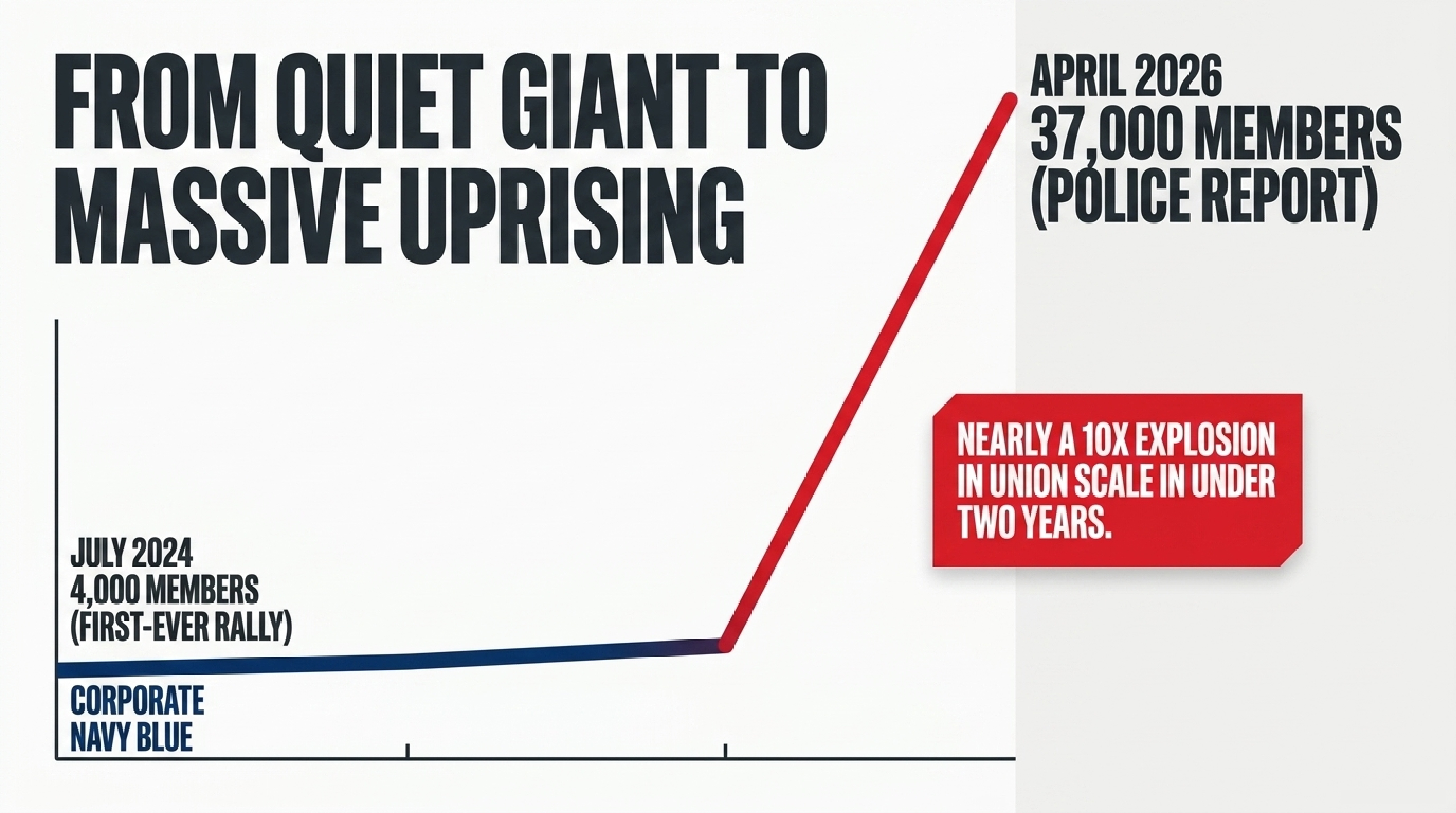
Samsung Electronics has long been the quiet backbone of the South Korean economy — a diligent, low-drama institution. But now, that once-quiet company has erupted with the loudest labor action in its entire history. Just two years ago, in July 2024, Samsung's first-ever strike rally drew roughly 4,000 people, with around 6,000 participating in the actual action. Now, the April 23 rally was reported to police at 37,000 union members — an explosive expansion of scale in an extremely short span of time.
This massive gathering is not a one-day outcry. The union has declared a full general strike and warned that on May 21, semiconductor production lines at all five of Samsung's major domestic facilities will be brought to a complete halt. A terrifying scenario is approaching — one in which the core factories at the heart of the global semiconductor supply chain could all go dark simultaneously.

So what exactly brought tens of thousands of people into the streets? Let's look at the real reasons why this once-quiet workforce has taken such drastic collective action.
What Are the Union and the Company Actually Fighting Over?
Strip away the economic jargon, and the core issue in the Samsung dispute comes down to one thing: how bonuses are paid. The dynamic is not unlike a standoff between a parent and child arguing over allowance.

The two sides are staking out diametrically opposite positions:
- Union (guaranteed cash now): "Put it in writing — we want a fixed cash bonus, clearly documented, no ambiguity."
- Management (conditional reward): "Take stock for now. If the company reaches number one in the industry, we'll give you the best compensation package possible."
The specifics make the gap even clearer. The union is demanding that 15% of operating profit be paid out as a performance bonus with no upper cap. Crucially, they want this codified in writing as a transparent, permanent system — not a one-time gesture of goodwill.
Management, meanwhile, has proposed paying out more than 10% of operating profit in the form of long-term retention stock. On top of that, they've played a conditional card: if Samsung achieves the top position in domestic industry revenue and operating profit in 2026, memory division employees will receive compensation at or above competitor levels.

The union rejected this offer as an opaque, non-binding promise that falls far short of a formally institutionalized guarantee, and walked out of negotiations. With these two parallel lines — "guaranteed cash" vs. "conditional best-in-class treatment" — failing to converge, it's time to look at the staggering financial damage a strike would cause.
What Happens When a Chip Factory Stops: '$22 Billion Evaporated'
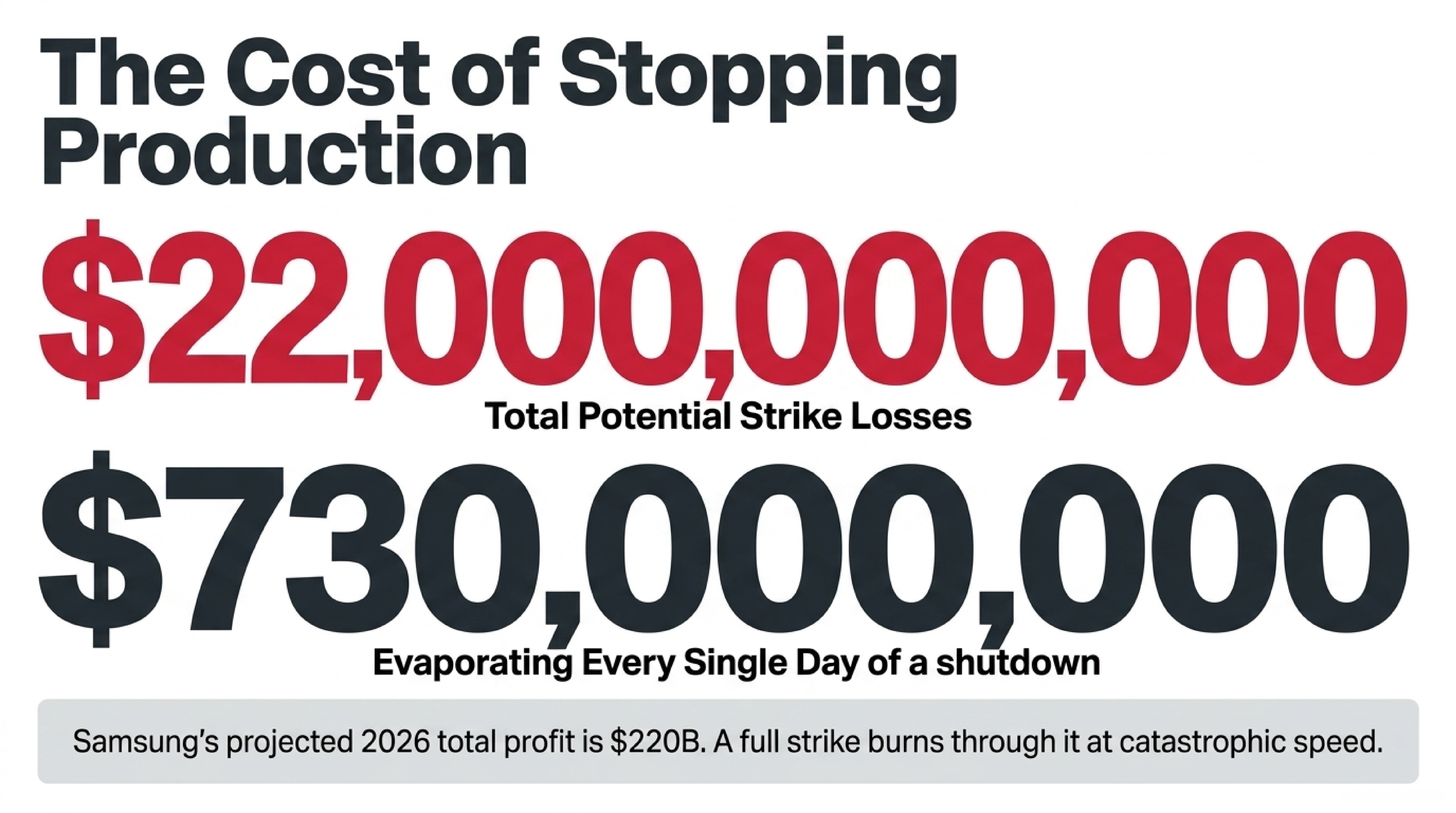
If the union follows through on May 21 and all five of Samsung's core semiconductor lines go down simultaneously, what happens? The union itself has warned that the total strike could inflict losses of up to 30 trillion KRW (~$22 billion USD) on the company. With Samsung's projected annual operating profit for 2026 running at around 300 trillion KRW (~$220 billion), a production shutdown would mean roughly 1 trillion KRW (~$730 million) vanishing into thin air every single day.
The reason losses snowball so catastrophically comes down to the uniquely sensitive nature of semiconductor manufacturing. Think of it like cooking rice in a sealed pot. If you lift the lid or cut the heat halfway through, the rice is ruined and inedible. Likewise, if a semiconductor production line — which must run continuously 24 hours a day — is interrupted for even one minute, every wafer (silicon disc) currently in process must be completely scrapped. It's not a matter of flipping a switch back on. Decontaminating the line, recalibrating equipment, and restoring full normal operation requires enormous additional time and expense on top of the direct production losses.

The fear is that a realized strike would deliver a fatal blow not just to Samsung but to the Korean economy as a whole. Yet despite this criticism, the union has dug in, insisting the strike was "a choice we had no alternative to" and refusing to back down. They are willing to push the historically unprecedented shutdown card all the way to force their demands through.
The astronomical potential damage has drawn the eyes of the global economy and international media far beyond Korea's borders.
Even Bloomberg Is Alarmed: The Global AI Chip Crisis Narrative
Samsung's current situation resembles an Olympic gold medal favorite — competing in the AI chip race — getting into an argument with their coach over their shoelaces right before the starting gun fires. Rivals are already sprinting down the track, while the frontrunner is in danger of not even clearing the starting line due to internal conflict.
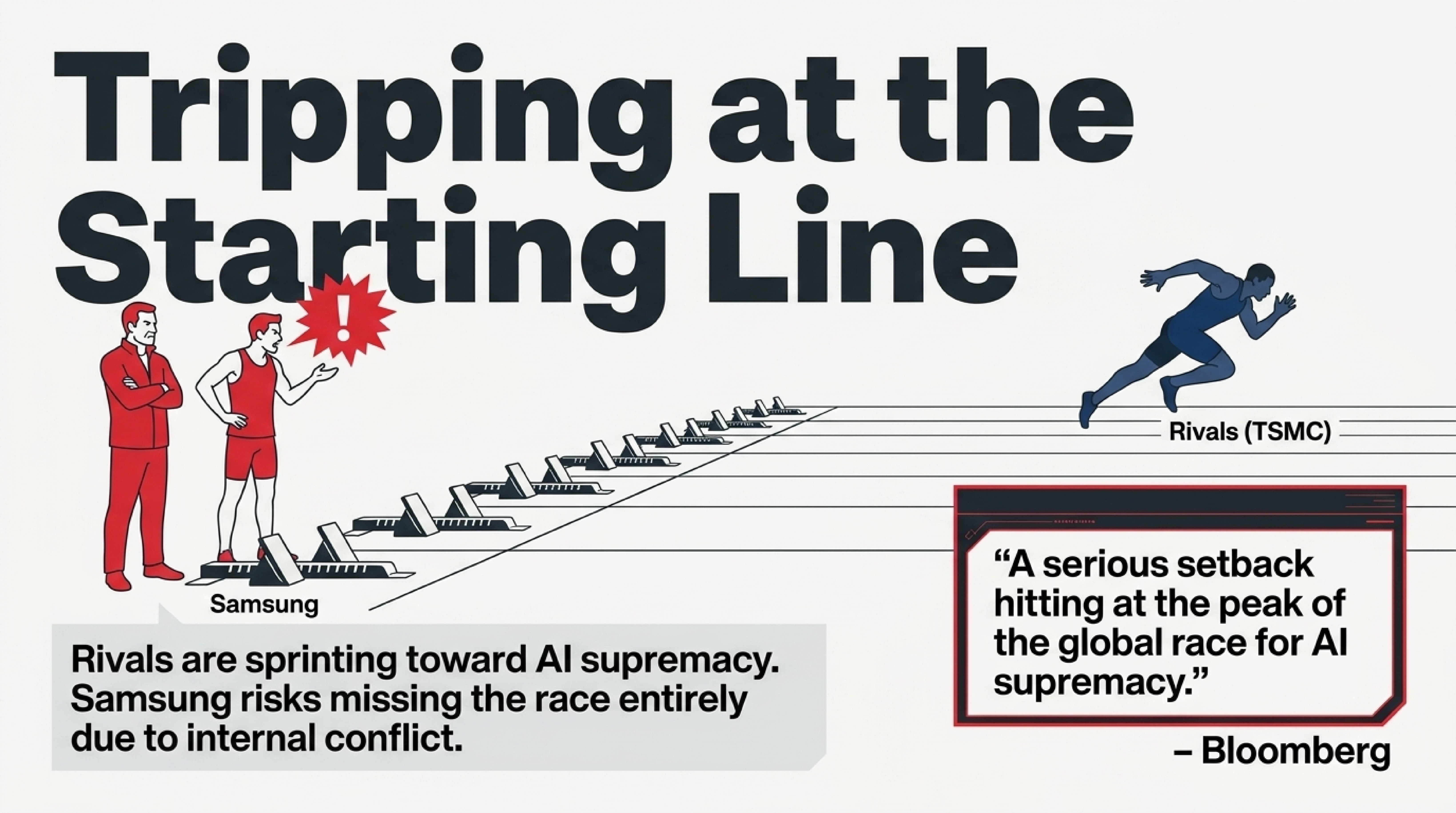
The most concerned observers are the international financial press. Bloomberg recently characterized the strike action as "a serious setback hitting at the peak of the global race for AI supremacy." Reuters has also been reporting intensively that Korea's 'militant union' narrative could become the key variable that disrupts Samsung's global supply chain reliability and shakes customer confidence.
- Bloomberg: Warned that the strike — arriving at a moment of peak AI competition — could cause Samsung to lose momentum in recovering its competitive edge in critical chips like HBM (High Bandwidth Memory)
- Reuters: Flagged that the escalating bonus dispute is increasing the probability of global semiconductor supply chain disruption
The deeper concern is the 'competitive gap crisis' with rivals. In the global semiconductor market, major competitors including Taiwan's TSMC are advancing at a frightening pace, backed by strong government support and stable labor relations. In the chip industry, on-time delivery and supply reliability are existential. If a strike introduces even the slightest uncertainty into Samsung's production schedule, global Big Tech customers will immediately begin diversifying their supply chains to avoid the risk.
Ultimately, this strike has the potential to go far beyond an internal corporate dispute and become a fatal vulnerability that erodes the global competitiveness of Korea's entire semiconductor industry. As outside observers watch with growing alarm, the company's other stakeholders — its shareholders — have also moved into action.
Unprecedented: Five Million Shareholders Stage Their Own Counter-Protest
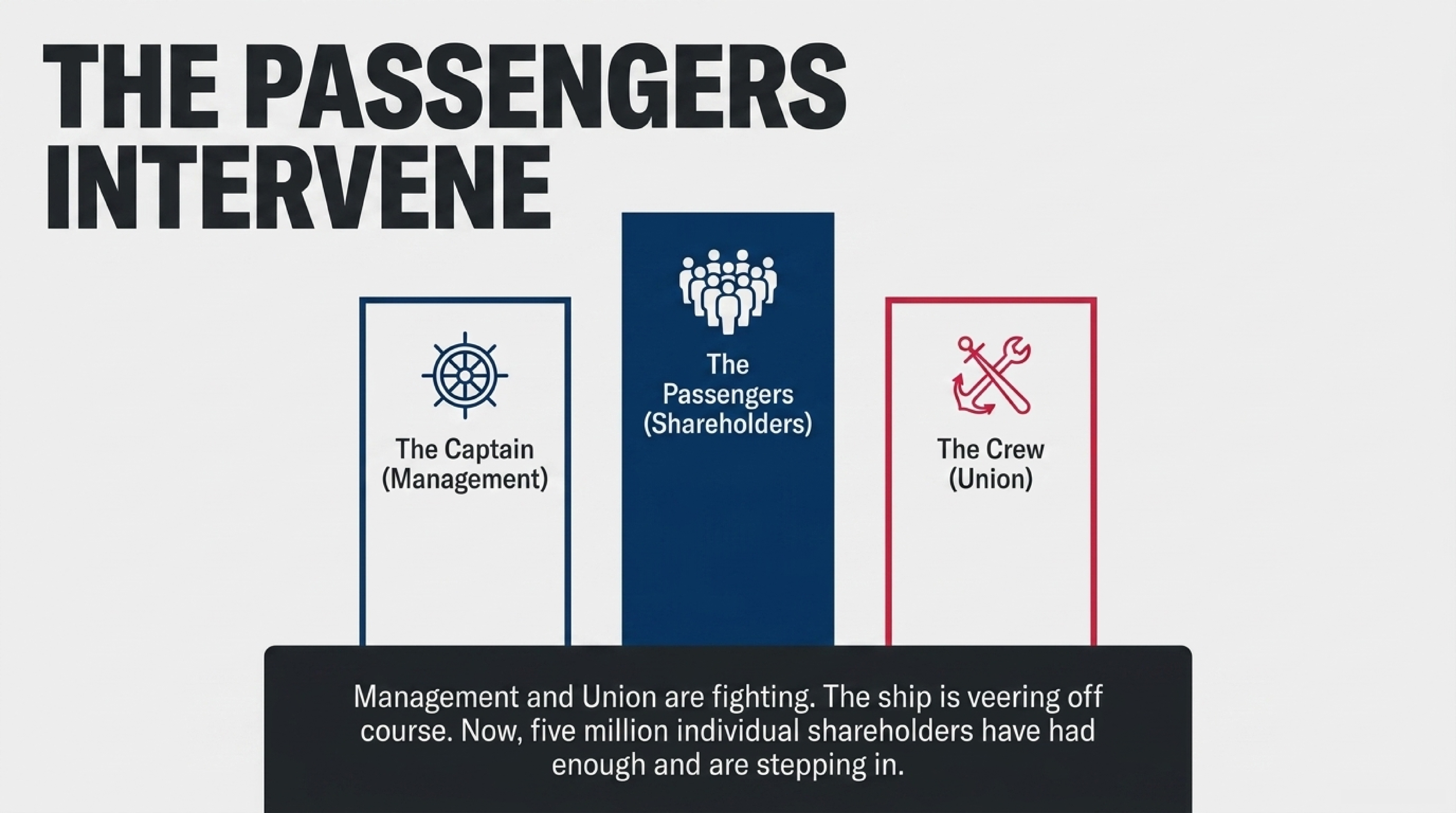
Imagine a ship battling through a violent storm, with the captain (management) and the crew (union) locked in a furious argument on deck. The ship is veering dangerously off course — and now the passengers have had enough and are stepping in to break it up. That is exactly where Samsung stands right now. The passengers — approximately five million individual shareholders — have jumped directly into the middle of the labor dispute.

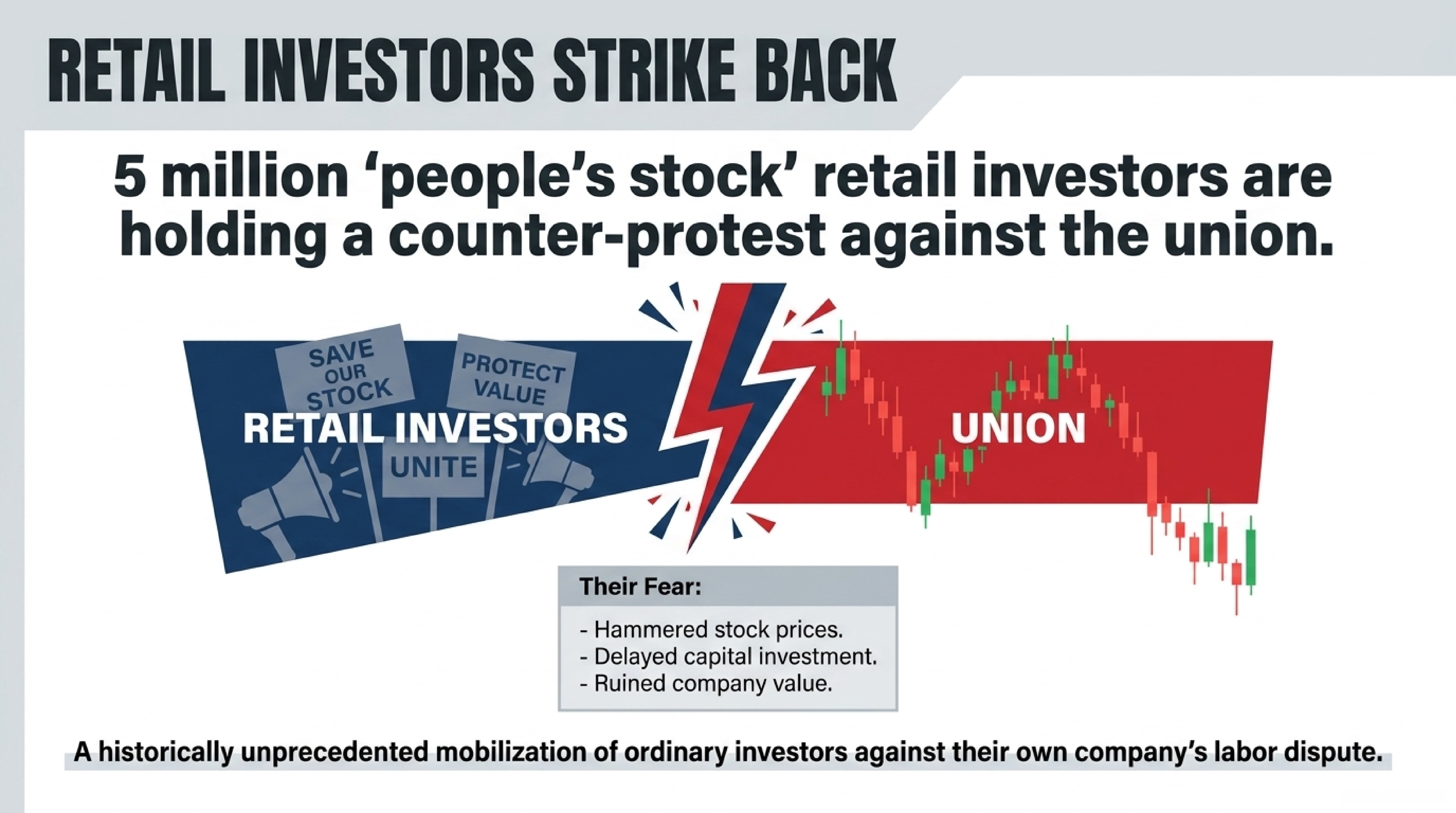
Samsung Electronics is Korea's quintessential 'people's stock' — a company held by millions of ordinary households as a long-term investment. For those five million long-term shareholders, the strike news has landed like a thunderbolt. They are deeply concerned that the strike will disrupt semiconductor production, delay critical capital investment, and hammer the stock price. In an extraordinary step, they have organized a 'counter-protest' in direct opposition to the union's action — a historically unprecedented move in which ordinary retail investors mobilize as a group against an internal labor dispute at their own company.
Pointed criticism is pouring in from inside and outside the company as well. Lee Chan-hee, chairman of Samsung's Compliance Committee, has repeatedly stressed that "Samsung is a national institution," strongly urging the union to exercise restraint before pulling the trigger on a full strike. Given the enormous impact Samsung has on the national economy and society, both sides — management and union — must bear that public responsibility heavily.
This situation has now far outgrown a simple internal compensation dispute. A hardline union, an unyielding management, five million furious shareholders, and an anxious global market are all tangled up together. The question is: how does this knot get untied?

Samsung in Crisis: What Does the Path Back to World-Class Leadership Look Like?
The situation is unprecedented — a perfect storm hitting from every direction. But even the fiercest storms eventually pass, and a crisis often carries within it the seeds of a new and better order. What Samsung needs most right now is to break out of the outdated 'militant union' narrative that worries the outside world, and build a forward-looking relationship in which the company and its employees can genuinely win together. If the current bonus dispute becomes the catalyst for establishing a transparent, rational compensation system, it would be more than just solving a problem — it would become a long-term engine of growth.
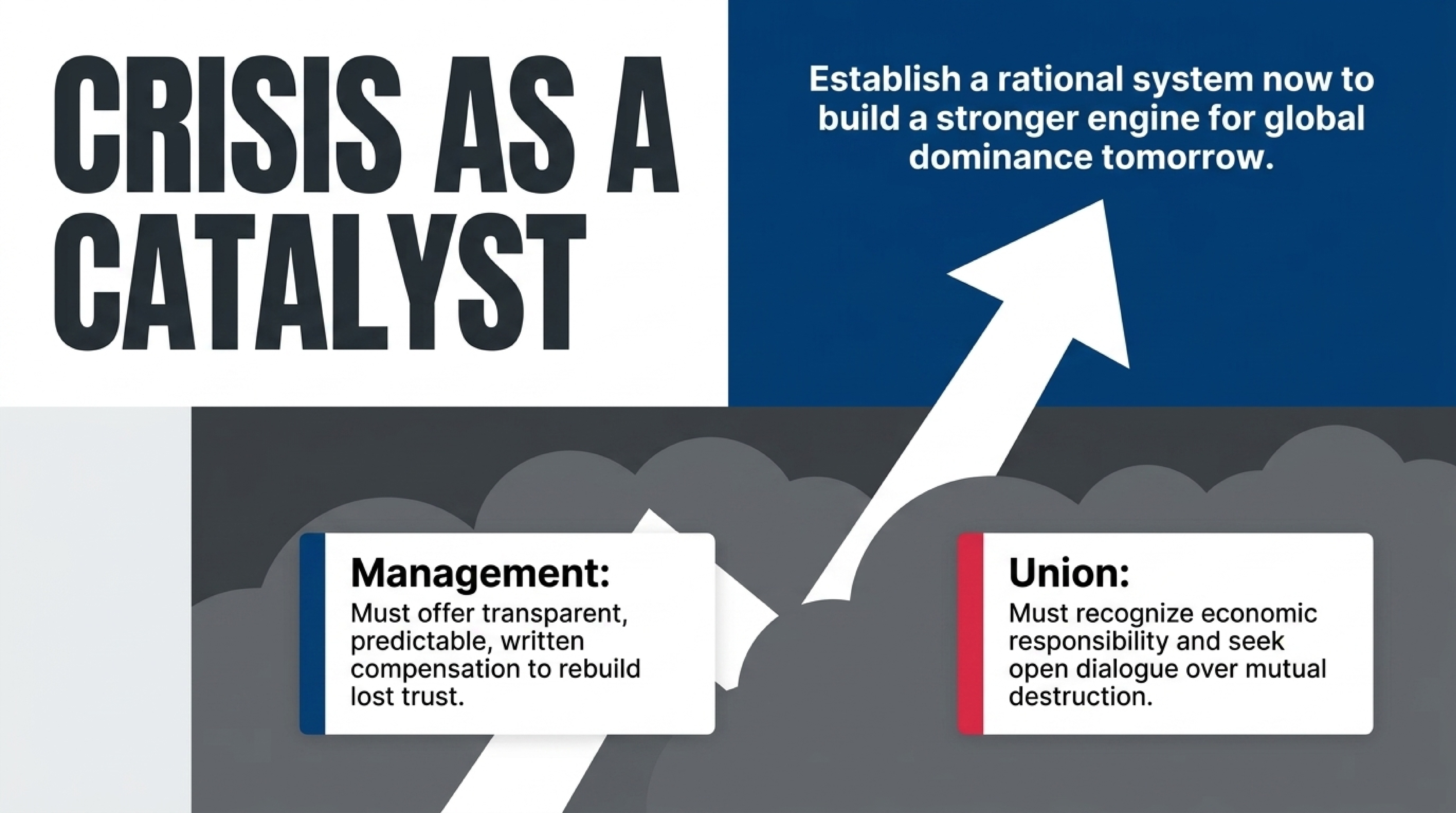
Dominating the world stage technologically requires strong internal cohesion. Management needs to offer clear, predictable compensation benchmarks commensurate with employees' contributions — and in doing so, rebuild the trust that has been lost. At the same time, the union must also recognize the weight of responsibility that comes with representing a company that underpins the Korean economy — and seek a dramatic compromise through open dialogue rather than racing toward mutual destruction.
There's an old saying: the ground hardens after rain. Here's hoping this painful disruption serves as the vaccine that makes Samsung's corporate constitution fundamentally healthier. May the hard-won agreement that both sides reach by each taking one step back become the solid foundation from which Samsung — having weathered this crisis — emerges as an even more mature global technology leader.
We've covered the key flashpoints and economic ramifications of the Samsung labor dispute. The FAQ section below addresses the most pressing questions that likely emerged while reading.

Frequently Asked Questions
Q. What exactly is Samsung's union demanding, and why are they striking?
A. The root cause of the dispute is the bonus payment structure.
- Union: Demands that 15% of operating profit be paid as a guaranteed cash performance bonus, codified in a formal, binding written policy.
- Management: Has proposed paying out more than 10% of operating profit in company stock, plus a conditional special bonus if Samsung achieves industry-leading results in 2026.
The unbridgeable gap between "guaranteed cash" and "conditional stock compensation" is what pushed the dispute to the brink of a strike.
Q. Will the chip factories actually shut down on May 21?
A. As things stand, the union has formally announced its intention to bring all semiconductor production lines across five facilities to a complete halt on May 21.
Given the nature of semiconductor manufacturing, a single line stoppage requires enormous time and cost to recover — and if the strike goes ahead, total economic losses are estimated at 30 trillion KRW (~$22 billion USD). That said, whether the lines actually stop will ultimately depend on how negotiations between the union and management develop in the coming weeks.
Q. Why are Samsung's shareholders holding their own counter-protest against the union strike?
A. Samsung's approximately five million retail shareholders are deeply concerned that the strike will directly translate into a decline in company value and the share price.
If the strike disrupts semiconductor production and delays critical capital investment, it could fatally damage Samsung's competitive standing in the fiercely contested global AI chip market. To protect their investments, shareholders have taken the extraordinary step of organizing a 'counter-protest' — a historically unprecedented form of collective action by ordinary investors against a labor dispute at their own company.
References
Samsung Electronics Moves Toward General Strike — Will Chip Lines Stop Amid Record Boom?
https://imnews.imbc.com/replay/2026/nwdesk/article/6817251_37004.html
30,000 Union Members to Converge — Samsung's Pyeongtaek Campus 8-Lane Road Blocked on April 23 (Yonhap)
https://www.yna.co.kr/view/AKR20260422075600061
"Stand Against the Strike" — Five Million Samsung Shareholders Organize Counter-Protest
https://biz.chosun.com/topics/topics_social/2026/04/22/HUC3XNBCNNH7RAQANP7UTG6JJM/
"Samsung Is a National Institution — The Union Must Act with Restraint" — Maeil Business News
https://www.mk.co.kr/news/society/12023172
Samsung Union Ahead of General Strike: "We Could Cost the Company 30 Trillion KRW" (Yonhap)
https://www.yna.co.kr/view/AKR20260417080151003
Samsung Offers Top Industry Compensation — But Union Still Walks Out (Yonhap)
https://www.yna.co.kr/view/AKR20260330082800003
"Samsung Could Be Shaken" — International Media Sound the Alarm on Samsung's Worst-Ever Crisis