SpaceX Files for IPO — Is This the Start of the 2026 Space Economy Revolution?
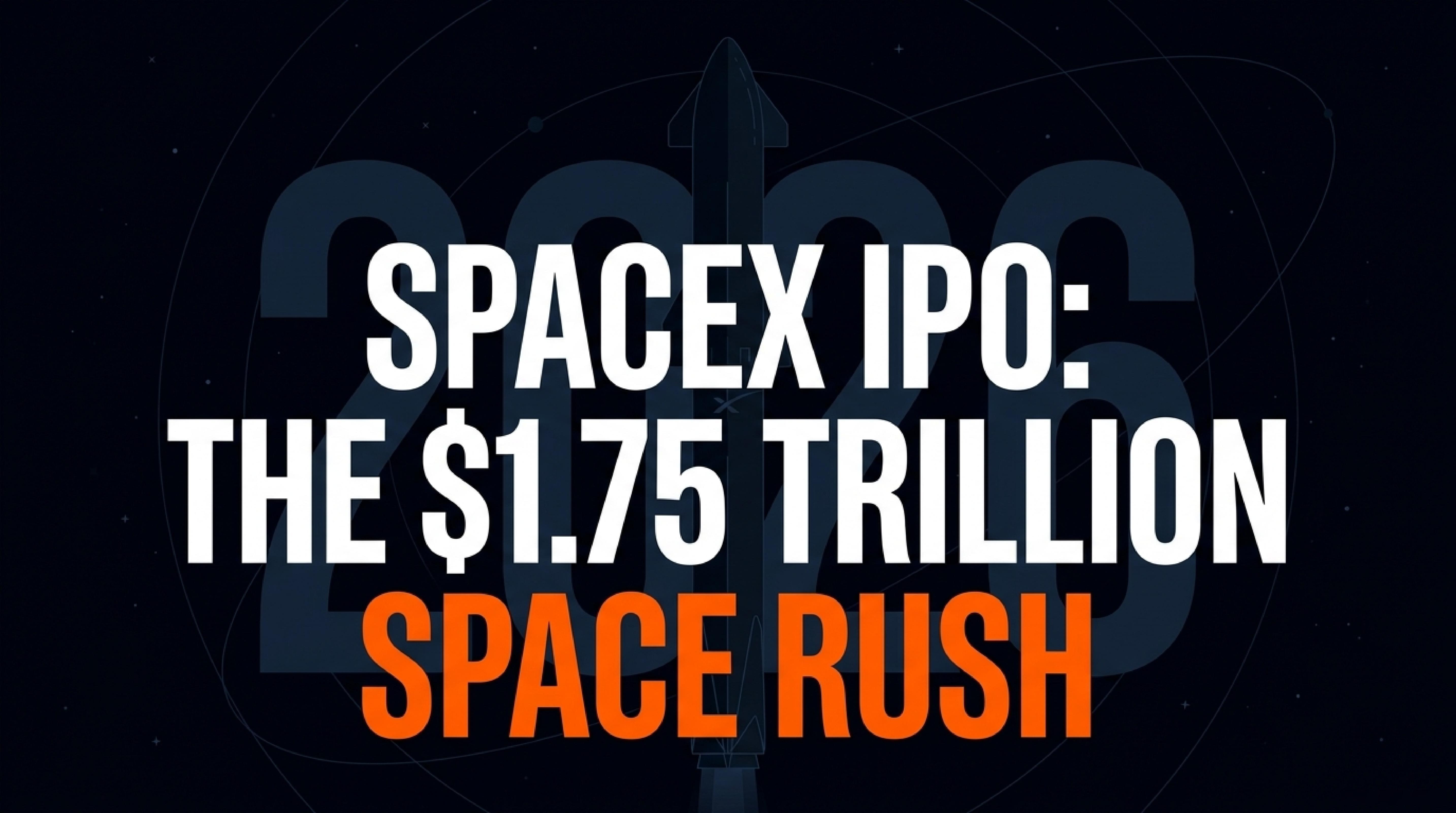
Thought It Was an April Fool's Joke? SpaceX Is Actually Going Public
On April 1, 2026, the news that shook global financial markets was no April Fool's joke. Elon Musk's space exploration company SpaceX has confidentially filed for an IPO with the U.S. Securities and Exchange Commission (SEC). The most jaw-dropping part? The valuation SpaceX is targeting with this listing: $1.75 trillion.

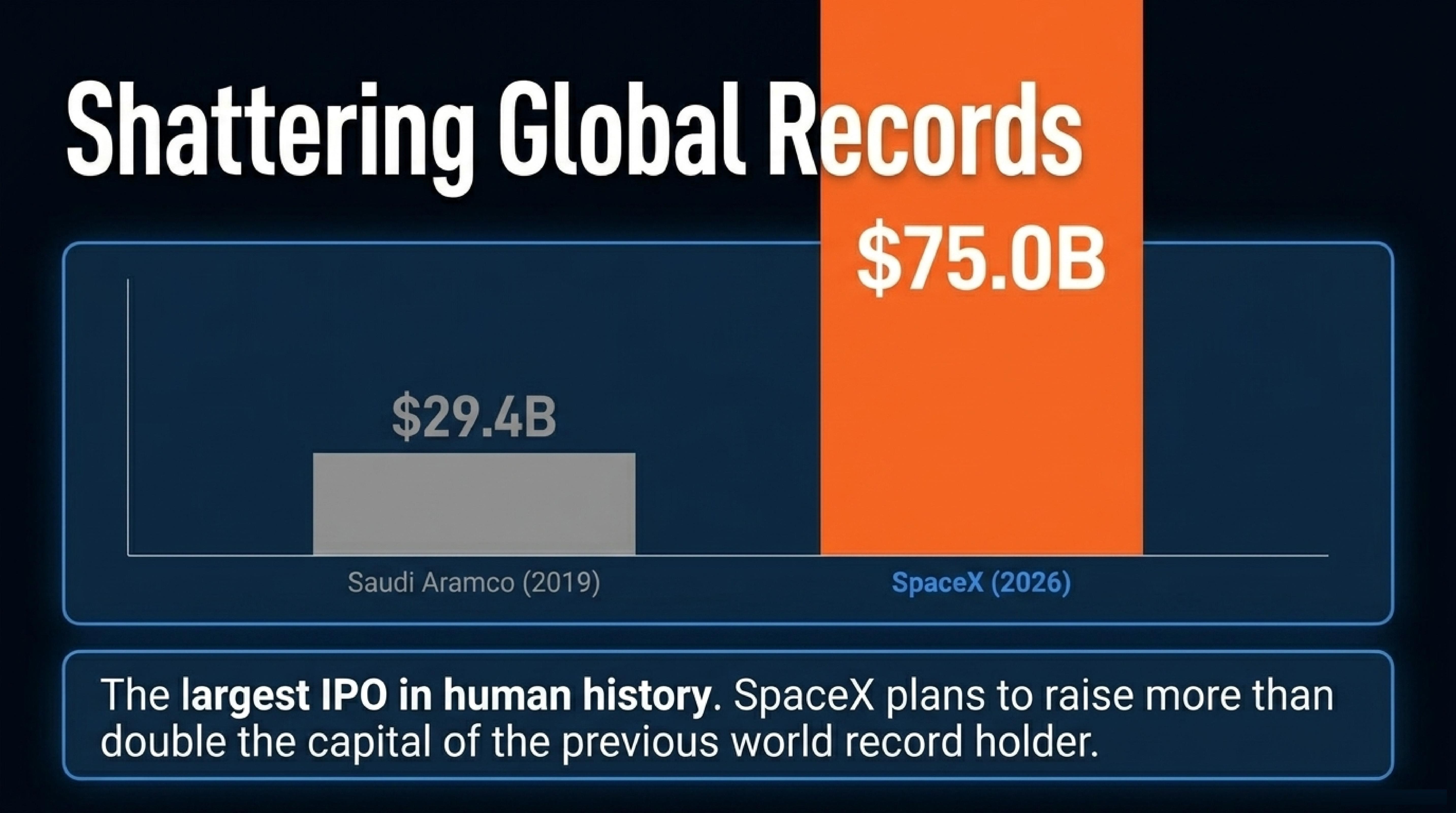
To put that number in perspective: SpaceX plans to raise up to $75 billion through this offering. That would comfortably shatter Saudi Aramco's 2019 record for the largest IPO ever — which raised $29.4 billion. This is unprecedented, at any scale.
The reason global investment markets have been sent into a frenzy goes beyond the simple arrival of a blue-chip mega-stock. The world's number one private space company — which has until now kept its doors firmly shut to the public, accessible only to a handful of venture capital firms and institutional investors — is finally opening up to ordinary investors. SpaceX's valuation in the run-up to listing has already surged well past its previous private market estimates, positioning it to stand shoulder-to-shoulder with the world's biggest Big Tech companies by market cap.
SpaceX's record-shattering market debut is more than a financial event — it's a new landmark for capital markets. And it's a perfect signal of how the frontier of space is descending from science fiction into the very real terrain of economic activity.
Government-Led Space Programs Are Over — This Is Space That Actually Makes Money
Why is SpaceX's IPO more than just a mega-event? Because it proves that the entire economic paradigm around space has been turned on its head.
Think back to the old model of space exploration. The Apollo missions and Cold War-era space races were colossal money pits — firing astronomical sums of taxpayer money into the sky. This was the era of "Old Space" — entirely government-controlled, entirely driven by national prestige and security objectives. Profitability was never part of the conversation.

Today, the picture is completely different. As the cost of reaching space has fallen dramatically, control of the space industry has shifted entirely — from governments spending tax money to private companies and investment capital generating revenue. The era of "New Space" has fully arrived.
- Cost revolution: Reusable rocket technology has transformed launch economics — what was once an enormous one-time expense is becoming genuinely cost-effective.
- Real business models: Satellite internet, space-based data analytics, and other services are already generating actual cash revenue.
Space has transformed from a realm of wonder into the most exciting investment asset class that global capital is racing to enter. That's precisely why experts forecast the coming "Space Economy" in staggering terms. SpaceX's stock market debut is a grand declaration that the space industry has fully entered the domain of capital markets.
Now that space has become a genuine battleground for capital — and SpaceX already commands an overwhelming market position — why is Musk moving to raise this much money right now?
Why Now? Inside Elon Musk's Bigger Picture
Why did SpaceX choose 2026 as the moment to pull the IPO trigger? The answer lies in a fatter wallet and an even bigger dream.
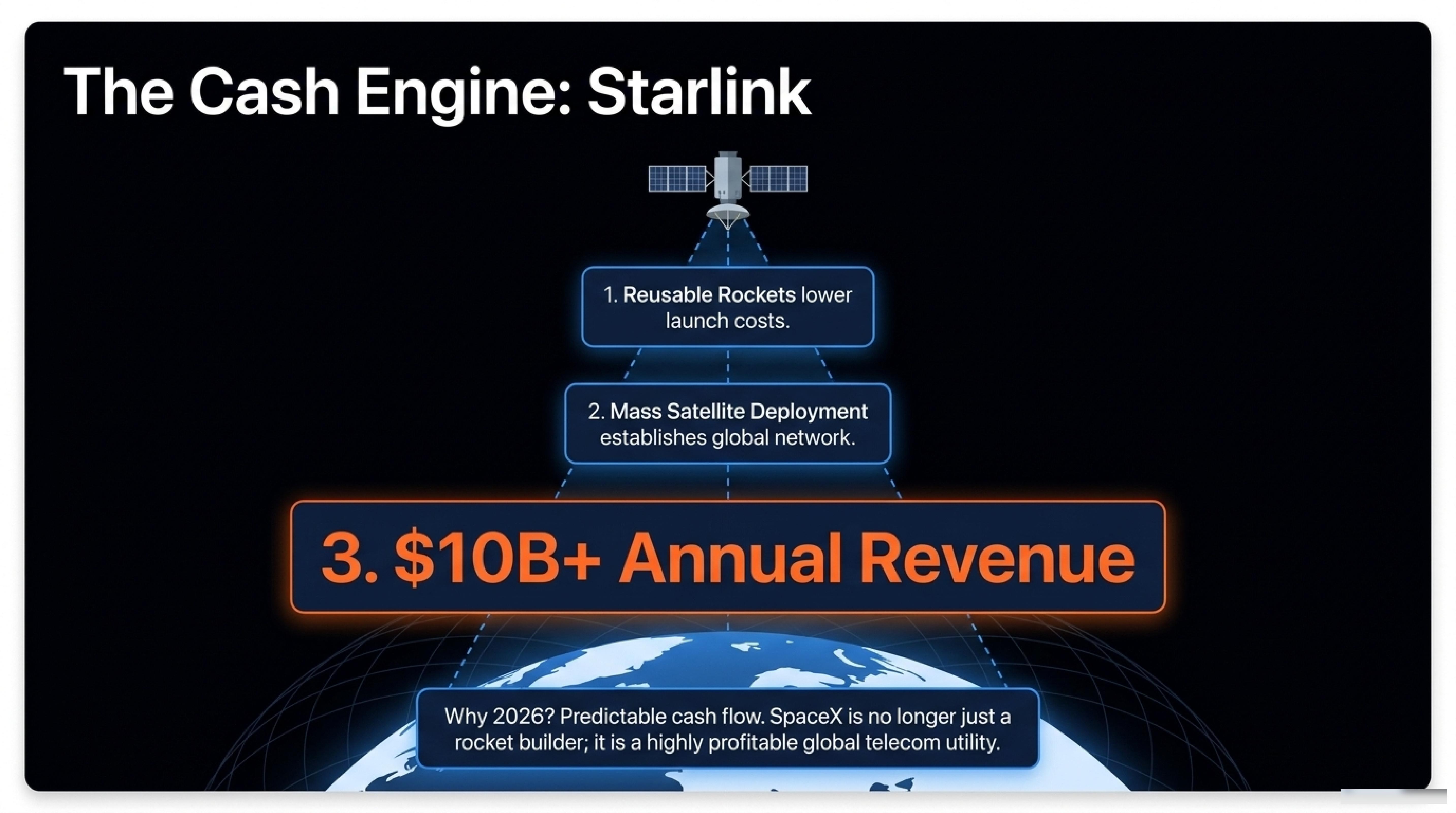
The single most decisive factor is the proven profitability of its cash cow: satellite internet service Starlink. Musk has previously said he would consider an IPO when cash flows became reasonably predictable. That moment has arrived. Starlink has amassed millions of subscribers worldwide and achieved profitability, generating over $10 billion in annual revenue. Analysts have described it as "a machine that prints cash." SpaceX has fully transformed from a rocket company into a global telecommunications utility.
But even with all that cash flowing in, SpaceX still needs an astronomical amount of additional capital. That's because of Musk's ultimate ambitions: colonizing Mars and, more recently, an entirely new vision for space-based data centers.
- The Starship program and Mars colonization: Making humanity a multi-planetary species requires commercializing and mass-producing the next-generation Starship spacecraft — a project whose costs dwarf almost any other private enterprise in history.
- Space data centers meets AI: Following its early 2026 merger with AI company xAI, SpaceX has unveiled a new blueprint: orbiting satellite-based data centers powered by solar energy.
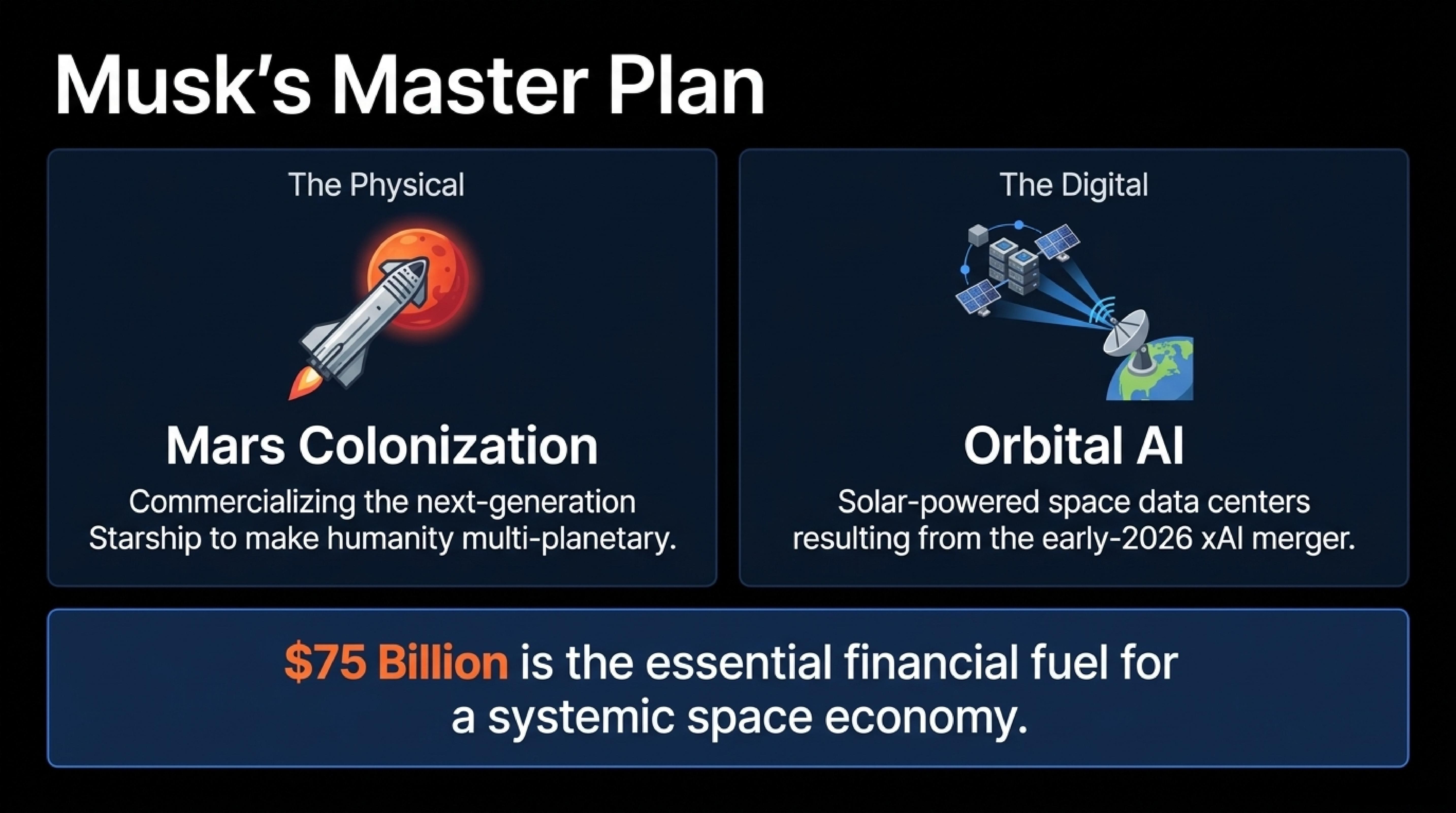
Ultimately, this record-breaking IPO targeting up to $75 billion is the essential financial fuel for the vast space economy system Musk is building. With Starlink's proven track record as the foundation, and the human futures of space exploration and AI stacked on top, 2026 is the perfect moment to unlock the world's investment capital. Now it's time to look at the broader ripple effects this event will send across equity markets.
After Tesla, Space? The 2026 Space Stock Market Is Already Moving
SpaceX's IPO news is generating a massive trickle-down effect that is shaking the entire space industry value chain — far beyond just one company's debut. As reusable rocket technology has dramatically cut the "fare" to reach orbit, companies across the ecosystem — from low-Earth orbit satellite communications to launch vehicle components and space data services — have begun a synchronized rally. Just as component-makers surged when smartphones or electric vehicles first opened up as market categories, equity markets are now reacting with intense excitement to a new theme: "Space Tech."
This naturally calls to mind the "Tesla Effect" that swept global markets a decade ago. And the parallel is intentional: Musk is reportedly considering allocating up to 30% of the SpaceX IPO to individual retail investors — compared to the typical 5–10% retail allocation in major offerings, this is extraordinary.

The goal appears to be transplanting the powerful, loyal retail investor community that supported Tesla's rise directly into SpaceX, creating a "second Tesla Effect" — using retail investor enthusiasm to defend the post-listing share price and lock in SpaceX's dominance over the space economy narrative.
As the space stock market expands, new investment trends are forming rapidly. Given the high technical barriers and volatility of individual space company stocks, aerospace and space-themed ETFs and index funds are proliferating at an explosive pace for investors who want to bet on the sector's overall growth. Asset managers worldwide are racing to launch new ETFs specifically designed to include SpaceX at maximum weighting the moment it lists, all competing for investor inflows. Just as Tesla anchored the electric vehicle boom, SpaceX's gravitational pull is firmly establishing the "Space Age" as a defining mega-trend across global equity markets. So how exactly can ordinary retail investors get a boarding pass for this ride?

Can Regular Investors Get on This Rocket? Your Boarding Pass Guide
Already searching for SpaceX's ticker symbol in your brokerage app? Pump the brakes — just slightly. When a company files a confidential S-1 with the SEC, it typically takes several months of rigorous review and amendments before the prospectus is made public. After that comes the roadshow to gauge institutional investor demand, price setting, and finally the public subscription and listing that most people associate with an IPO. The most optimistic scenario points to sometime in the second half of 2026; a more conservative estimate puts it in early 2027.

So how should ordinary investors actually approach this? In mega-IPOs, institutional investors typically receive the lion's share of allocations, making it genuinely difficult for retail investors to get direct access to IPO shares. In that case, an excellent alternative is investing indirectly through space industry ETFs. A range of aerospace, satellite communication, and space-themed ETFs already trade in markets globally. Using SpaceX-focused ETFs or existing aerospace ETFs that suit your investment profile allows you to reduce the concentrated risk of a single stock's volatile post-IPO period while achieving diversified exposure across the entire space economy ecosystem.
With investment excitement at peak levels, there's one more essential reality check to make before deciding. Behind the spectacular rocket launches — what are the real risks lurking?
Rockets Can Still Explode — Risks to Check Before You Invest
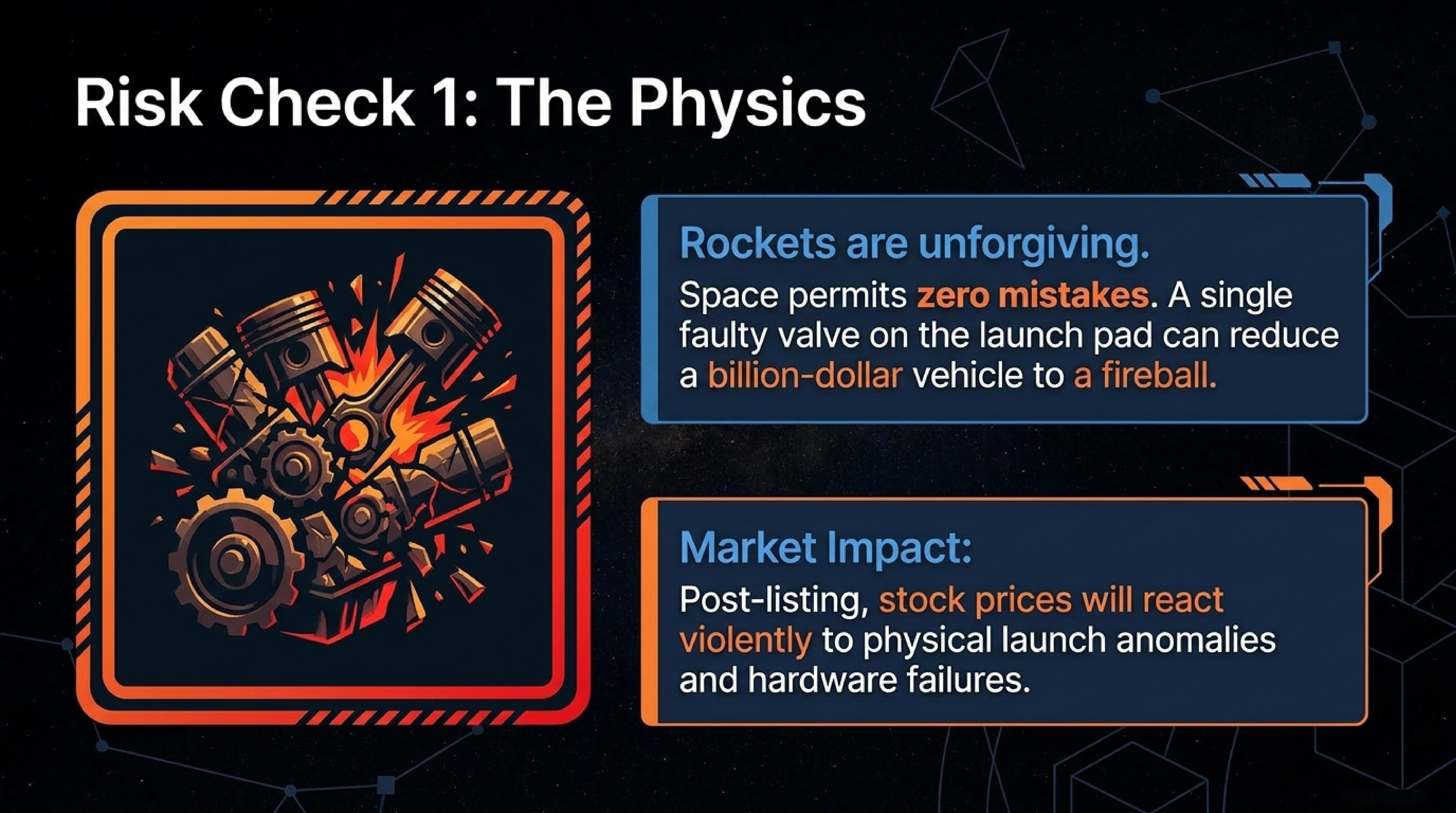
Behind the dazzling vision of the space industry lurk real risks that cannot be ignored. The most visceral and immediate danger is physical failure. A rocket is a product of ultra-precision engineering where hundreds of thousands of components must function in perfect harmony. A single faulty valve on the launch pad can reduce a billion-dollar vehicle to a fireball. If a major launch fails post-listing or a satellite fails to reach its intended orbit, the share price can collapse overnight regardless of the company's long-term vision. Space is an environment that forgives nothing — not a single mistake.
The stringent regulatory barriers tied to national security represent an equally unavoidable political risk worth keeping front of mind. The space industry is inherently adjacent to defense technology and missile systems, making it subject to heavy government oversight. FAA environmental reviews or launch license delays, or FCC spectrum allocation holdups, can ground key projects for months. No matter how revolutionary the technology, a regulatory stamp withheld can erase astronomical opportunity costs.

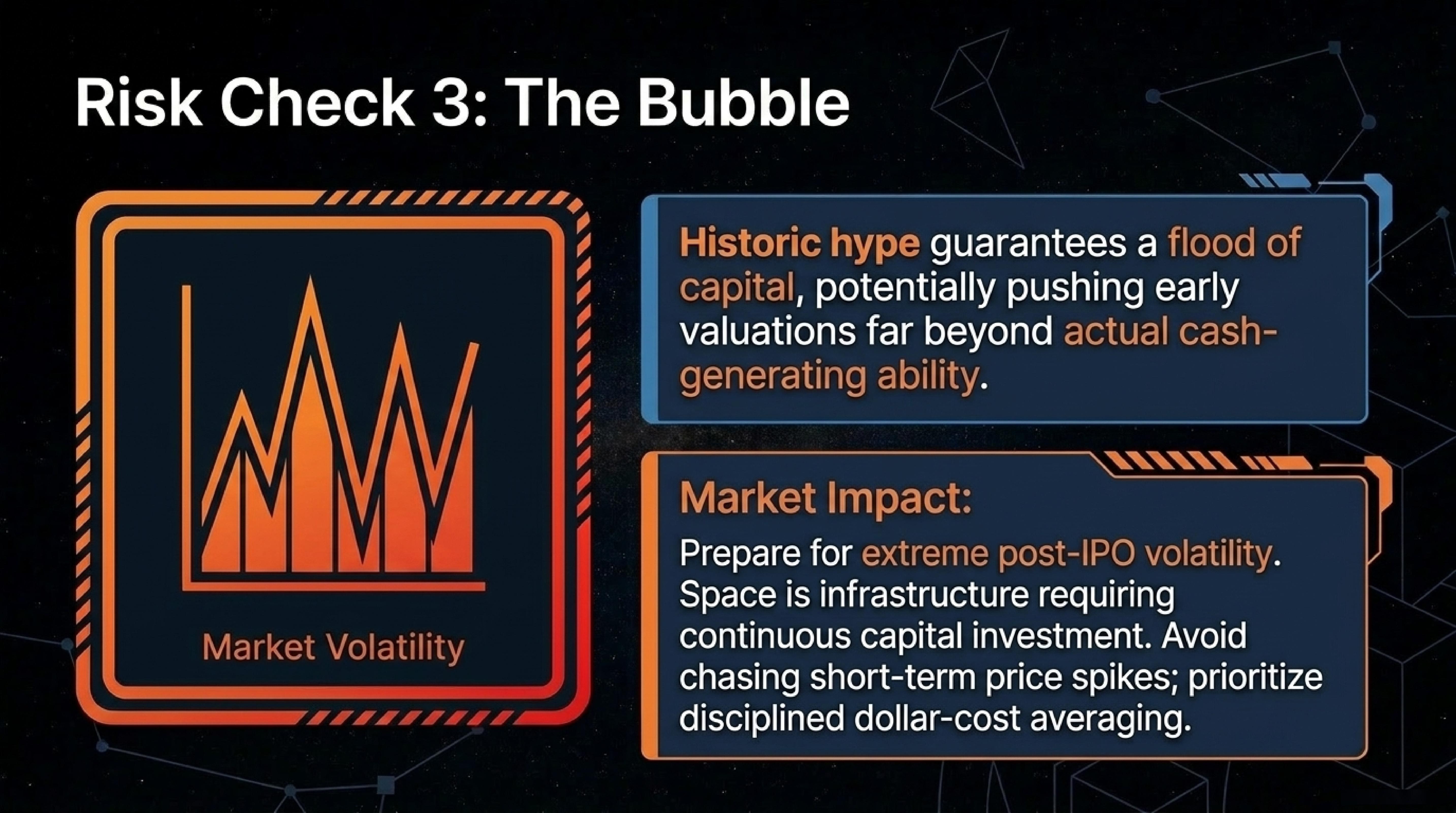
Finally, watch out for the valuation bubble that early-stage excitement creates, and the extreme volatility characteristic of the immediate post-IPO period. The historic nature of the SpaceX listing will draw a flood of market capital all at once, potentially pricing the stock far above its actual cash-generating ability, and creating a rollercoaster in the days and weeks after debut. The space industry is infrastructure — it requires continuous, massive capital investment over years. Before buying on pure excitement, acknowledge that the gravitational pull of post-IPO volatility is not trivial. A patient, long-term mindset with disciplined dollar-cost averaging will serve investors far better than chasing short-term price moves.
Beyond Earth and Into Space — Is Your Portfolio Ready for Liftoff?
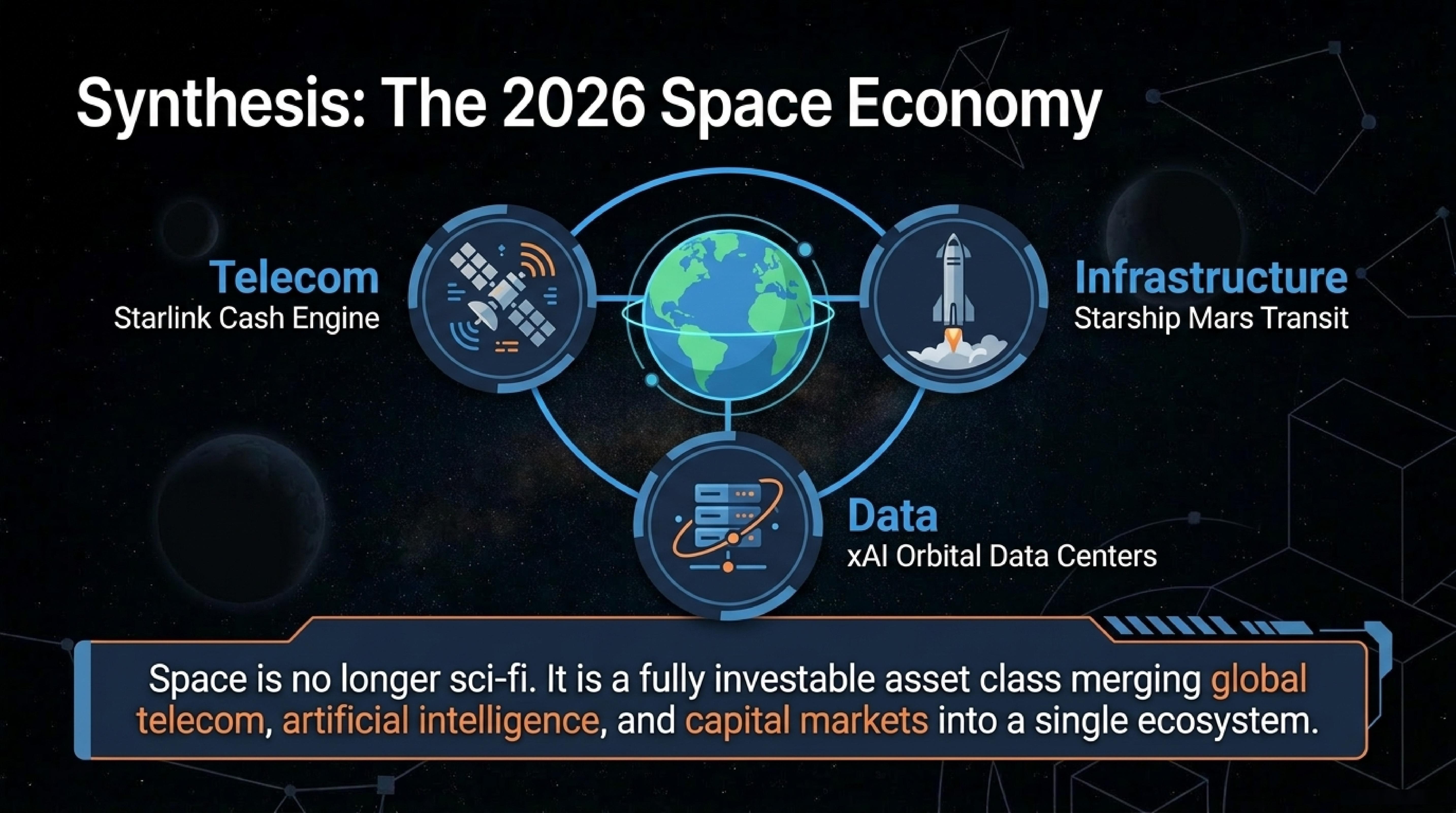
SpaceX's IPO push toward a $1.75 trillion valuation is more than a financial milestone. It's an unambiguous signal that the arena of human economic activity has expanded beyond Earth and into space. Projects that were pure science fiction just a few years ago — orbital internet, Mars colonization — have now become real, investable economic reality showing up in global portfolios.
In the space economy era now taking shape, rocket launch schedules will be consumed as casually as daily weather news, and retirement savings invested in satellite networks and orbital data centers will feel entirely normal. The transformation of rockets from government tax expenditure into a massive private profit-generation model is a paradigm shift that looks set to be the most powerful mega-trend driving global equity markets in the years ahead.
Of course, as we've examined, the physical failure risks inherent to the space industry and the volatility of early post-IPO trading are mandatory checkpoints before committing capital. Cold-eyed analysis and disciplined risk management through diversified vehicles like ETFs will serve investors far better than blind enthusiasm.
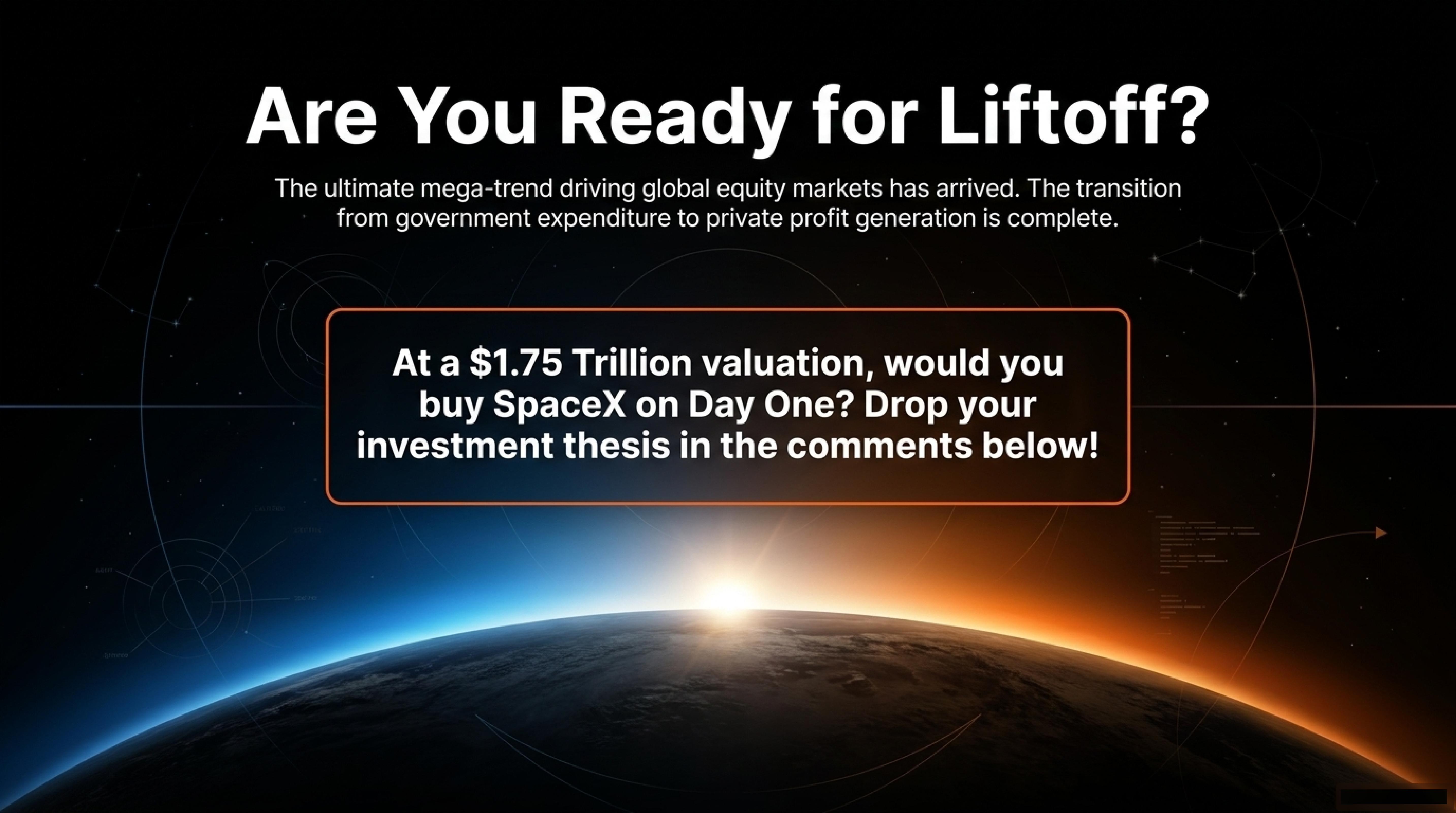
The choice is yours. At this historic inflection point — where space is being absorbed into capital markets as one of the hottest asset classes in history — is your portfolio ready to launch alongside SpaceX? Would you buy on day one? Drop your investment thesis and thoughts on the coming space economy in the comments below!
Frequently Asked Questions
Q. When can I actually buy SpaceX stock?
A. SpaceX filed its confidential IPO registration with the SEC on April 1, 2026. Reports suggest the company is targeting a listing as early as June 2026 — though given the typical SEC review timeline, a more realistic window is the second half of 2026 at the earliest, or early 2027.
Notably, Musk is reportedly considering allocating up to 30% of the IPO to retail investors — an unusually generous allocation — so watch for official subscription announcements from brokerages when the time comes.
Q. Could Starlink list separately as its own company?
A. Musk has mentioned a potential Starlink spin-off IPO in the past — but the IPO currently in motion is for SpaceX as a whole entity, not Starlink alone.
SpaceX is going to market as a complex conglomerate — combining the profitable Starlink cash engine, the next-generation Starship program, and the recently merged xAI artificial intelligence vision — targeting a valuation of up to $1.75 trillion. A Starlink-only listing at this stage appears unlikely.
Q. What space-related ETFs can I invest in before SpaceX lists?
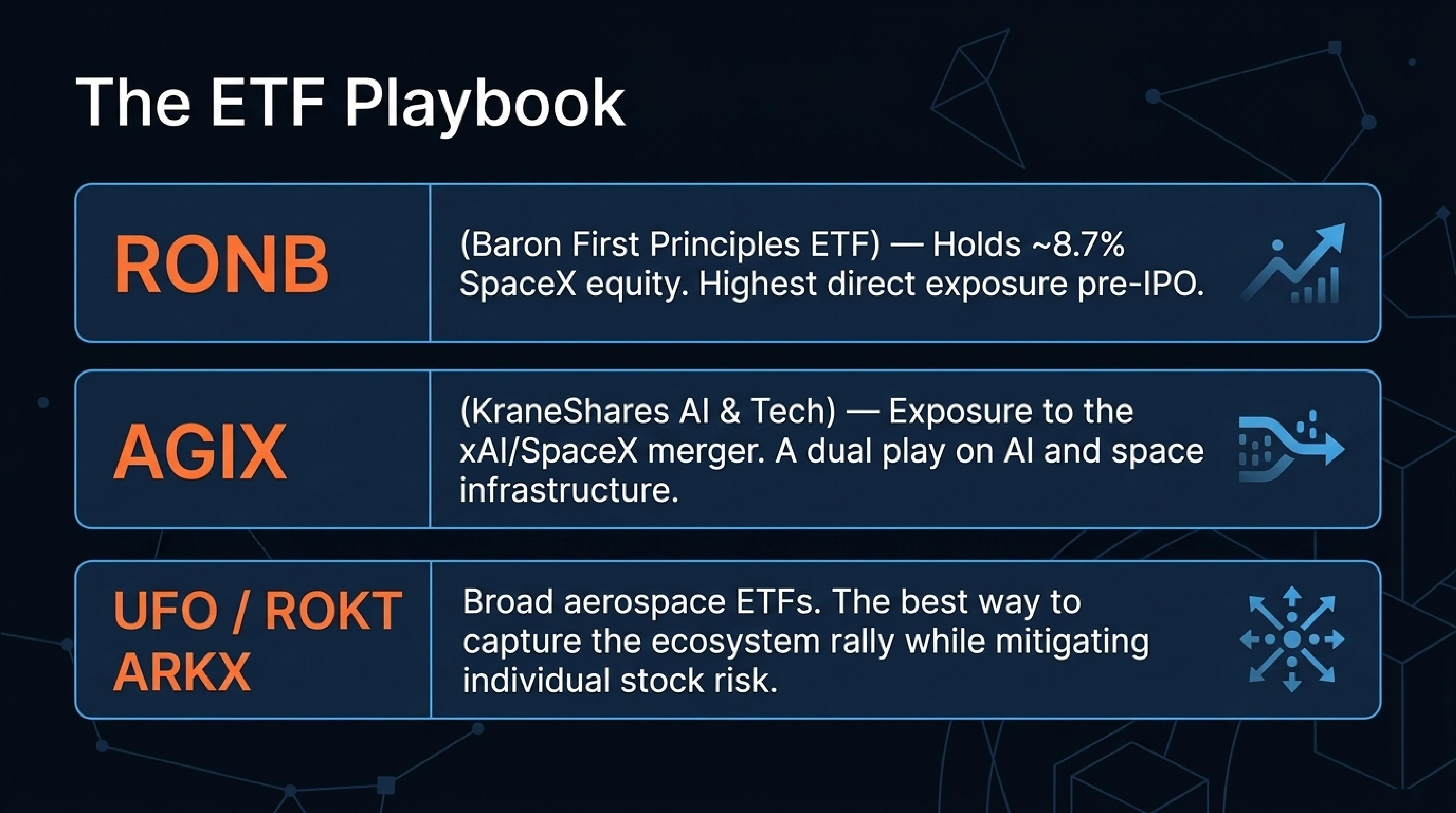
A. If accessing SpaceX IPO shares directly is difficult, or if early post-listing volatility feels too risky, ETFs that already hold SpaceX equity are a strong alternative:
- RONB (Baron First Principles ETF): Holds approximately 8.7% in SpaceX — among the highest SpaceX exposure of any U.S.-listed ETF.
- AGIX (KraneShares AI & Technology ETF): Gained partial SpaceX exposure through the xAI merger process — offers simultaneous investment in AI and space infrastructure.
- Broader aerospace/space ETFs (e.g., UFO, ROKT, ARKX): Provide diversified exposure across the global space economy value chain without concentration in a single name.
Since the space industry is still in its early stages, diversified ETF-based investing is generally recommended to manage individual stock risk effectively.
References
Everything You Need to Know About the SpaceX IPO — 4 Questions Answered
https://www.news1.kr/world/usa-canada/6130908
"Life-Changing Returns for Early Investors" — SpaceX Files Preliminary IPO Documents, Humanity's First Trillionaire May Be Near
https://www.sedaily.com/article/20034138
Korea's Space Industry Reaches Inflection Point — Shifting From Government-Led to Private-Sector Driven
https://www.ilyoeconomy.com/news/articleView.html?idxno=56534
TextBrush 텍스트브러시 | AI 텍스트 편집기
텍스트브러시는 드래그로 서식을 입히는 AI 텍스트 편집기입니다.
www.textbrush.app