Hanwha Solutions Slashes Its Rights Offering — 3 Investment Takeaways From Korea's Shareholder Value Era
A Public Apology From the CEO — What Happened at Hanwha Solutions?
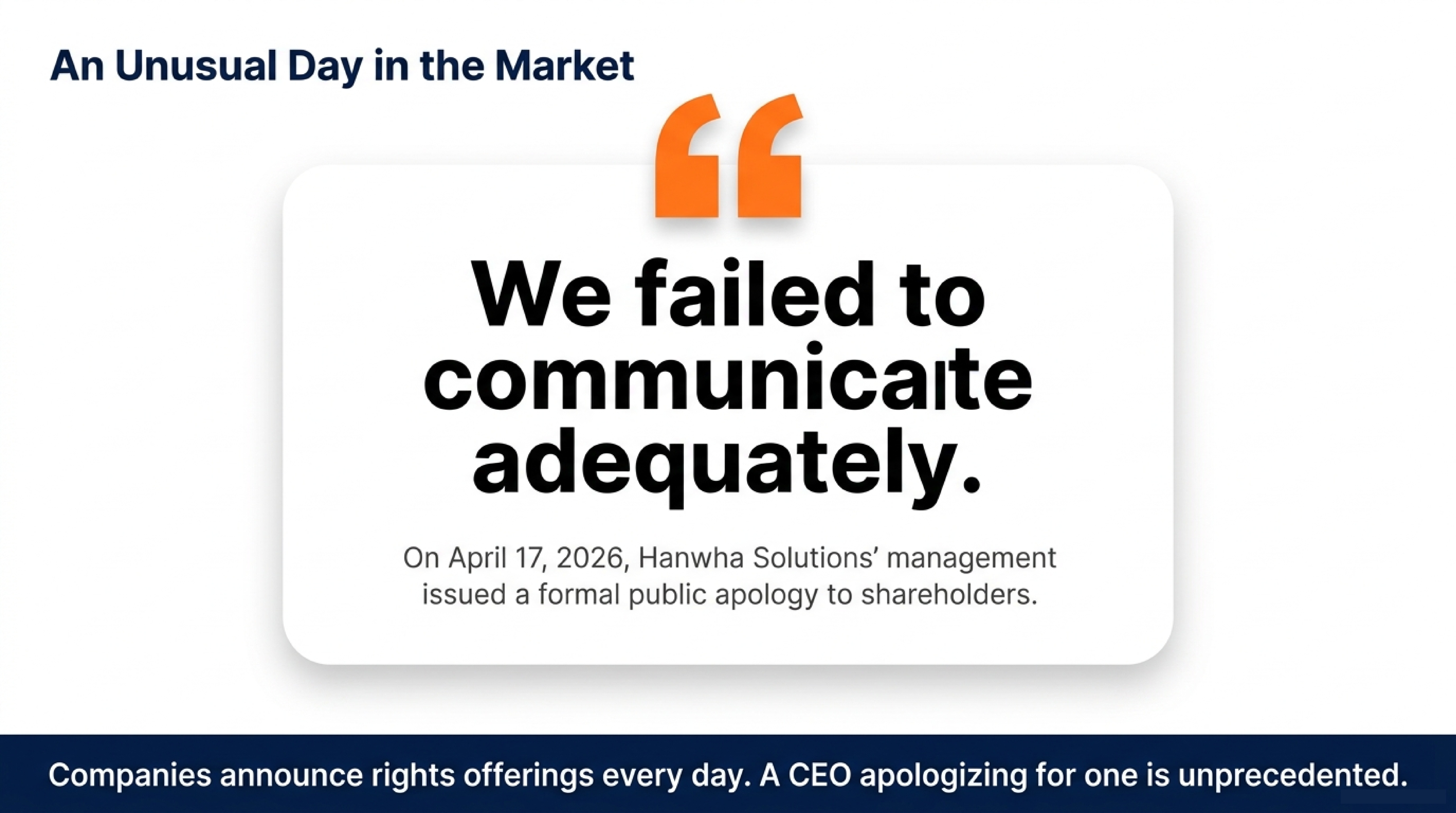
On April 17, 2026, something genuinely unusual landed in the Korean stock market: Hanwha Solutions' management issued a formal public apology to shareholders. Companies announcing rights offerings (new share issuances to raise capital) is common enough. But a CEO personally stepping forward to say "we failed to communicate adequately" — and meaning it — is anything but routine.
So what happened? The story begins with Hanwha Solutions dramatically cutting its planned rights offering from 2.4 trillion KRW (~$1.75 billion USD) down to 1.8 trillion KRW (~$1.3 billion USD) — a reduction of 600 billion KRW (~$435 million). The cut that drew the most investor anger: the debt repayment allocation was slashed from 1.5 trillion KRW to approximately 900 billion KRW.

But the company didn't just trim the numbers. Seemingly conscious of the market's cold reaction and the damage to shareholder value, Hanwha layered in some striking additional measures:
- A public apology from both co-CEOs: Management acknowledged that communication with shareholders during the initial rights offering announcement had been insufficient, and moved aggressively to rebuild trust.
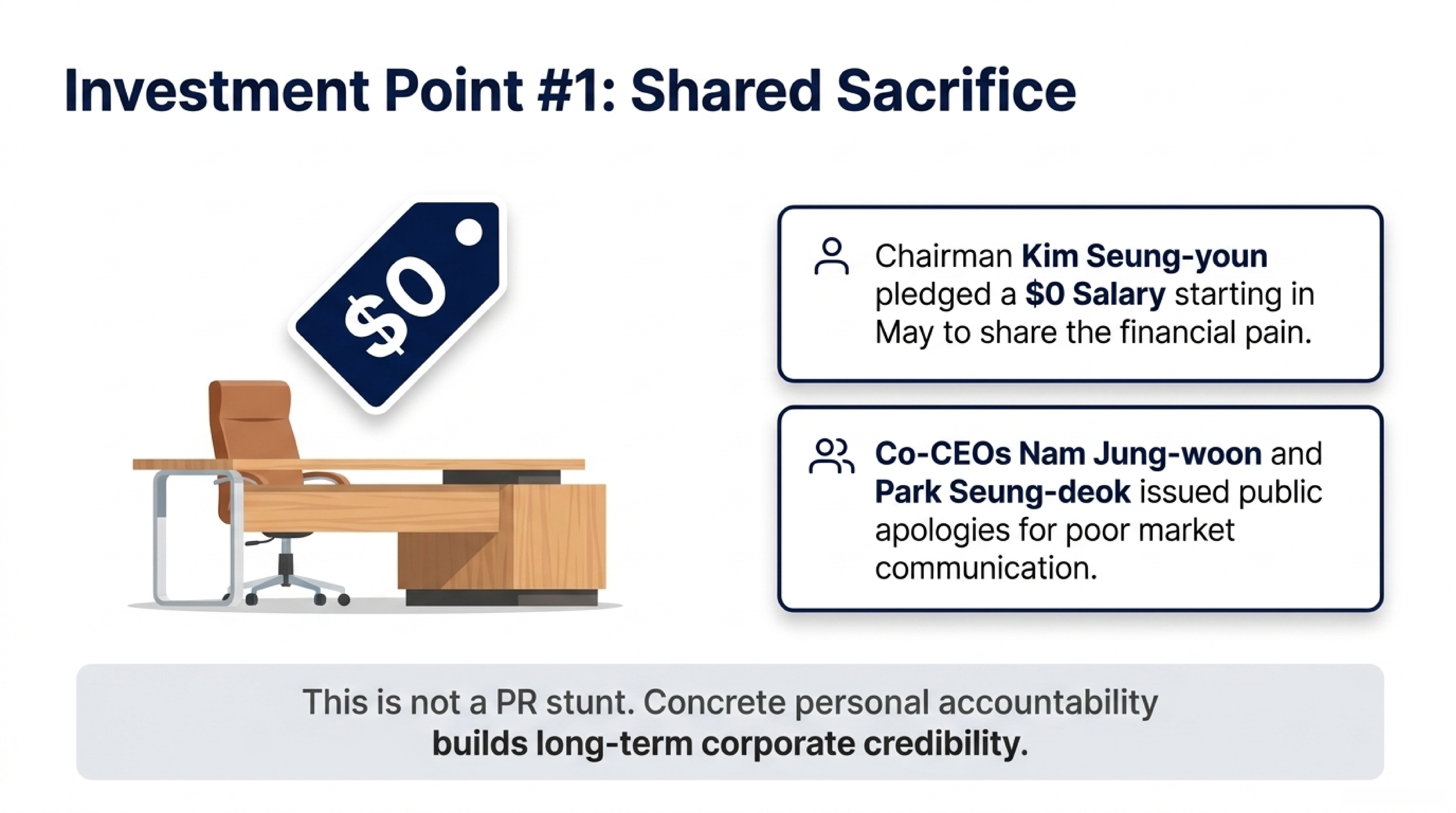
- Chairman Kim Seung-youn's zero-salary pledge: The chairman of Hanwha Group announced he would waive his compensation from Hanwha Solutions entirely — putting concrete personal accountability behind the words.
Rights offerings typically make existing shareholders nervous — more shares in circulation means dilution of everyone's stake. But Hanwha Solutions' response here is noticeably different from the norm. Rather than shutting out market criticism and pressing ahead, management stepped back, reduced the offering size, and had the controlling family publicly share in the pain. This strong signal of "we got it wrong, and we will protect shareholder value" goes well beyond a PR gesture — it raises genuinely important investment questions worth examining carefully.
What butterfly effect will this scaled-back 1.8 trillion KRW offering have on the share price? Can management win back the trust of a shareholder base that has grown noticeably more demanding? The market is watching closely.
From $1.75B to $1.3B — The Secret Behind the Rights Offering Reduction
Hanwha Solutions has reduced its planned rights offering from 2.4 trillion KRW to 1.8 trillion KRW, shaving off a substantial 600 billion KRW in the process. So where exactly did that money come from — and why was it cut?

The answer lies in debt repayment funding. Originally, Hanwha planned to use roughly 1.5 trillion KRW of the proceeds to pay down existing debt. That figure has now been cut to approximately 900 billion KRW. A simple analogy:
- Original plan: "Shareholders, we need you to help us pay off our debt — please contribute generously."
- Revised plan: "We'll sell some of our own assets and find the money ourselves to pay down debt — reducing the burden we're asking you to bear."
Large rights offerings are typically unwelcome news for existing shareholders because the more new shares a company issues, the more diluted each existing shareholder's stake becomes. In concrete terms, this decision reduces the number of new shares being issued from 72 million to 56 million — a meaningful reduction in both the subscription burden on shareholders and the dilution of their existing holdings.

What's notably smart about the revised plan is what wasn't cut: the approximately 900 billion KRW earmarked for capital expenditure and future growth investments remains fully intact. The 600 billion KRW gap will be funded through internal measures — including asset monetization. This isn't crash dieting. It's trimming the unnecessary fat (shareholder burden) while keeping the essential muscle (future investment) untouched.
So with this healthier capital structure, what future is Hanwha Solutions now building toward?
Investment Point 1: "I'll Stop Taking My Salary First" — Accountable Leadership
The most striking aspect of Hanwha Solutions' rights offering revision is not the numbers — it's the "accountable leadership" on display. This sends a heavier message about corporate governance than any balance sheet adjustment.
First and most notably: Hanwha Group Chairman Kim Seung-youn's pledge to work without compensation. Starting in May, the chairman will receive no salary from Hanwha Solutions. This is a powerful gesture of personal ownership over the rights offering's stated goals — technology investment for future growth and financial structure improvement. "I'll stop taking my own salary first" reads not as a token gesture but as a genuine act of shared sacrifice aimed at rebuilding shareholder trust.

The two co-CEOs also issued public apologies. The reasons Nam Jung-woon (Chemical Division) and Park Seung-deok (Q Cells Division) stepped forward publicly are clear:
- Acknowledging the communication failure: Management bowed and admitted it had not adequately communicated with the market and shareholders when the rights offering was first announced.
- Commitment to more engagement: The company pledged to significantly increase market touchpoints — through analyst meetings and earnings calls — going forward.
- No further share issuances through 2030: Management explicitly ruled out any additional rights offerings through the end of the decade, drawing a clear line to calm market anxiety.
Management visibly stepping up to share in shareholders' pain — rather than retreating behind corporate language — is a massive positive for corporate credibility. A company whose leadership apologizes and makes personal sacrifices during a crisis, rather than hiding behind closed doors, becomes a far more trustworthy long-term investment partner. This looks set to become a positive benchmark for governance in Korea's evolving shareholder value era.
Investment Point 2: Actually Listening to Shareholder Criticism — The Power of Communication
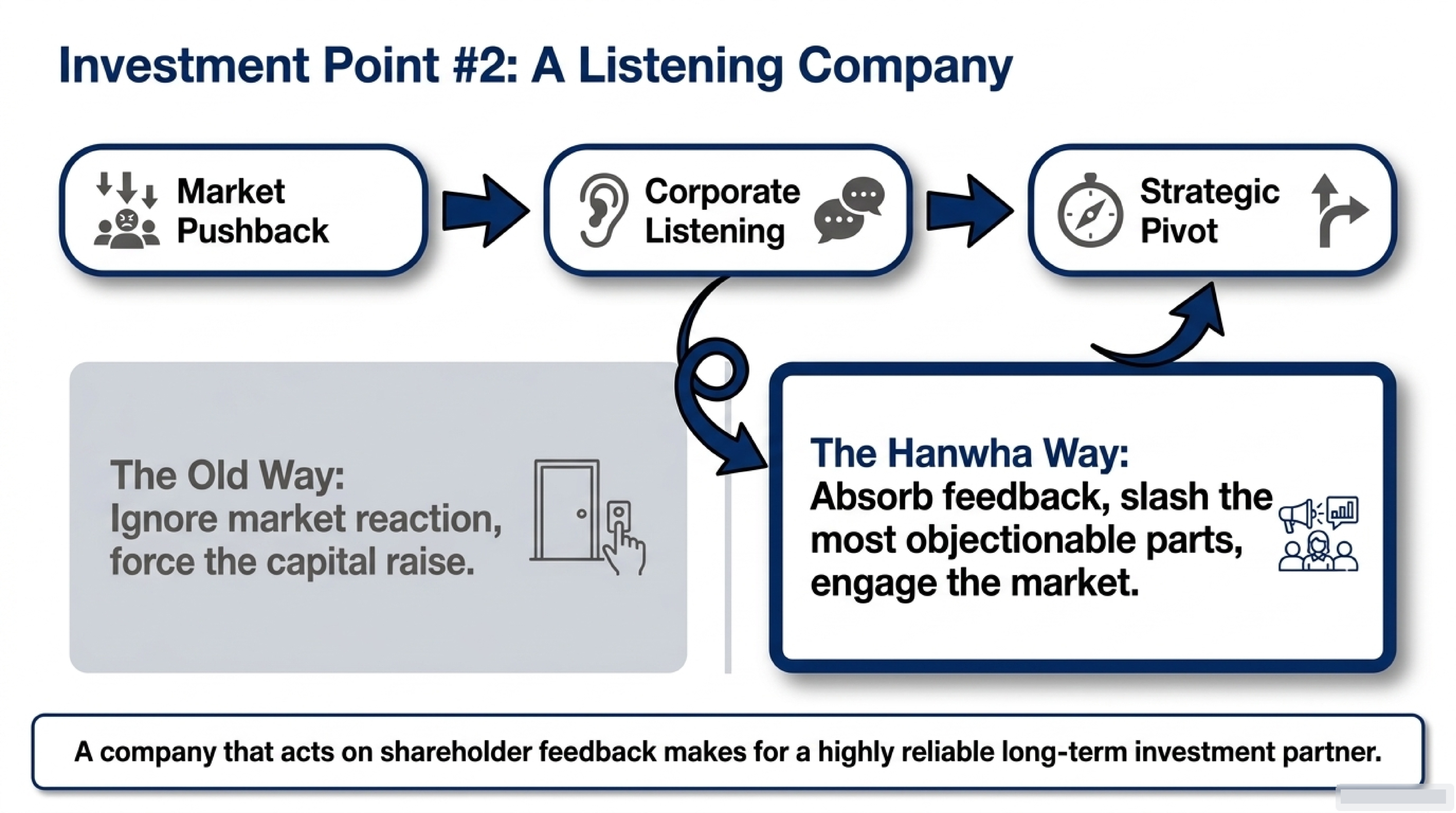
Anyone who has followed the Korean stock market long enough has seen this scenario play out repeatedly: a company announces a large rights offering, the share price craters, shareholders are furious — and management presses ahead anyway, unmoved. Hanwha Solutions' response this time was demonstrably different. Rather than ignoring the cold market reaction and harsh criticism, the company moved quickly to change course — demonstrating real flexibility and willingness to engage.
In practice, Hanwha cut aggressively in the areas shareholders found most objectionable — slashing the debt repayment allocation that had drawn the most criticism — while keeping its long-term strategic direction intact by maintaining the full capex budget for growth.
What is most impressive is management's attitude. It wasn't just the numbers that changed — in the middle of a crisis, the company actively engaged with the market, raising the transparency of its governance in a meaningful way. For an investor, a "communicating company" is a far more reliable long-term partner. A company that can absorb feedback from institutional and retail shareholders alike, and revise its plans accordingly, earns a justified expectation that it will continue to make reasonable decisions even when future challenges arise. Hanwha Solutions turning a painful public criticism into a catalyst for shareholder-friendly reform is, from a long-term perspective, a strong positive signal for corporate re-rating.

Investment Point 3: Protecting Shareholder Value Is No Longer Optional
Hanwha Solutions cutting its rights offering and having its top executives publicly commit to responsible governance is a telling sign of how dramatically the atmosphere in Korea's stock market has shifted. In the past, a company could push through a large capital raise on pure financing logic and get away with it. That era is over. Today, even the largest offerings are getting hit with the brakes when shareholders push back hard enough.
This episode is not just about one company. It's a symbolic scene from a much bigger macro trend: Korea's entire market is struggling to shed the "Korea Discount" — the persistent valuation gap between Korean listed companies and their global peers, which has long been attributed to weak governance, low shareholder returns, and controlling family dominance. Fueled by a surge in shareholder activism and the Korean government's own Corporate Value-Up program, shareholders' voices have grown louder than at any point in recent memory. Companies are finally feeling, in a tangible way, that shareholders are the actual owners.

This means investment strategy has to evolve as well. In the past, finding a company with strong revenue and solid operating profit was enough. Now, the first question every investor needs to ask is: "Does this company treat its shareholders as partners — or as an ATM?" A company that generates great profits but channels them exclusively to insiders and controlling shareholders, rather than returning value to all shareholders, can always blindside you.
The companies that will deliver sustainable long-term returns are those with transparent corporate governance and robust shareholder return policies — companies that think carefully about minimizing dilution and communicate openly when they need to raise capital, rather than simply raiding shareholders' pockets. The real message of Hanwha Solutions' rights offering trim is this: protecting shareholder value is no longer a choice for Korean companies. It has become a condition of survival.
Turning Crisis Into Opportunity — Here's What to Watch Next
Hanwha Solutions' decision to reduce its rights offering is more than a corporate correction. It's a symbolic moment demonstrating just how powerful shareholder voices have become in Korea's capital markets. The company slashed the most contentious component — debt repayment funding — and layered in swift governance improvements from senior leadership, sending a clear and credible signal of commitment to shareholder value protection.

Crisis, handled well, can become the foundation for opportunity. Market attention is now shifting to Hanwha Solutions' core business competitiveness and its share price trajectory. On that front, the outlook is encouraging: the ~900 billion KRW capex budget for next-generation solar product development remains fully intact, meaning the company's long-term growth engine has not been compromised. In particular, the U.S.-focused vertical integration strategy is expected to bear fruit, with the company's large-scale solar manufacturing hub — the "Solar Hub" — set to begin full operations in the second half of the year. Securities analysts are forecasting a return to profitability in the solar segment as early as Q1, and the share price has already shown resilience by recovering to the pre-announcement range of approximately 43,000 KRW.
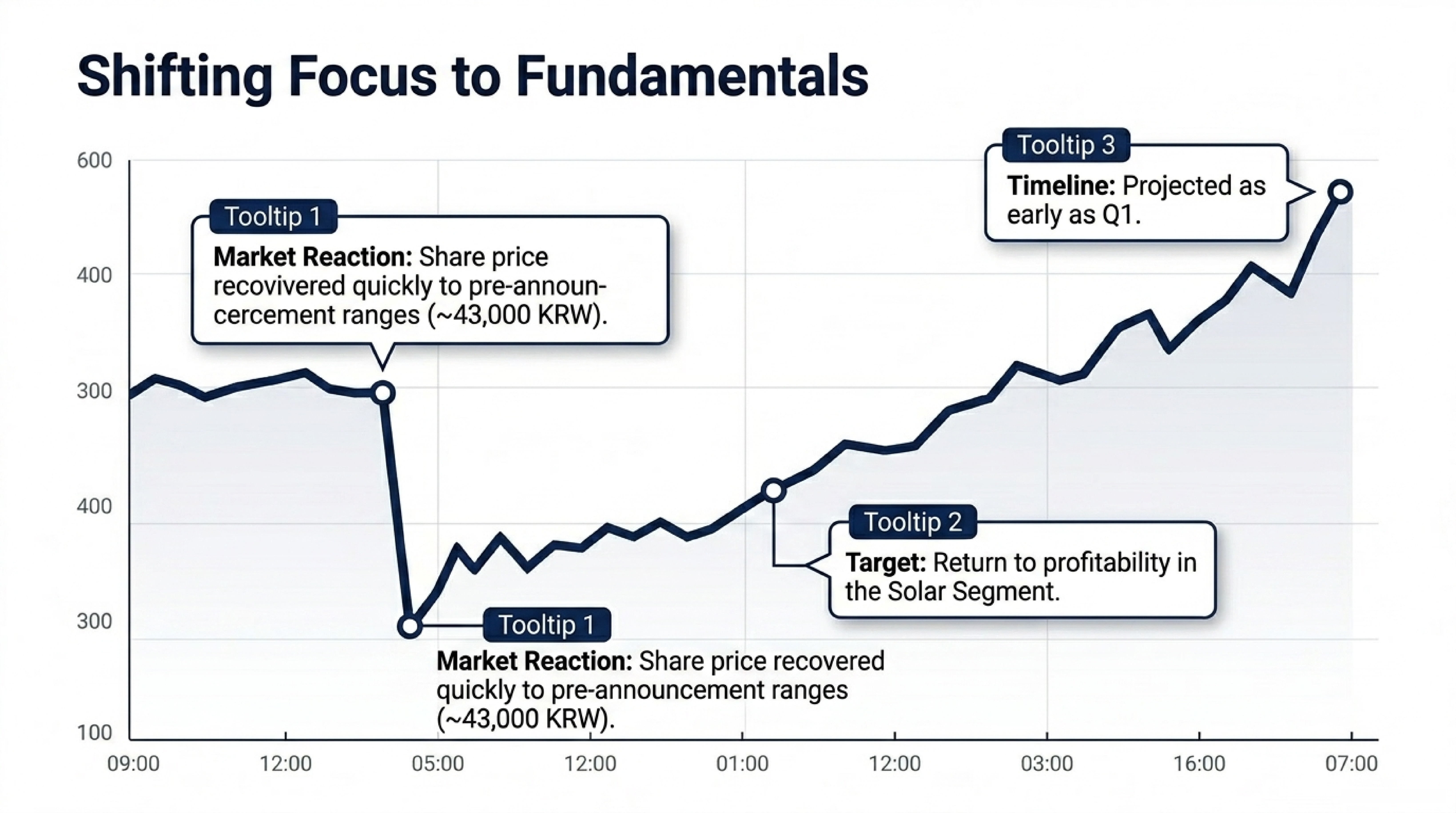
The key questions to track going forward are clear:
- Will management's apology and decisive action prove to be nothing more than a short-term painkiller to placate angry shareholders?
- Or will it mark the genuine starting gun of a lasting, shareholder-friendly corporate transformation?
Now is the time to carefully track how the promised shareholder return policies are actually implemented alongside the company's longer-term efforts to strengthen its core business competitiveness.
Today's news changes tomorrow's portfolio. What do you think Hanwha Solutions' next move should be? Leave a comment with your thoughts!

Frequently Asked Questions
Q. Why is reducing the size of a rights offering good for shareholders?
A. When a company conducts a rights offering, it issues new shares — and the more shares it issues, the more each existing shareholder's stake gets diluted in percentage terms.
By reducing the offering, Hanwha Solutions cut the number of new shares from 72 million to 56 million. This directly reduces both the dilution of existing shareholders' ownership and the financial burden on shareholders who might participate in the subscription — protecting shareholder value in the most practical sense.
Q. What was the 600 billion KRW that was cut originally going to be used for?
A. The cut funds were originally designated for debt repayment.
The original plan allocated 1.5 trillion KRW to paying down debt. In response to shareholder concerns, that figure has been cut to approximately 900 billion KRW. The resulting 600 billion KRW gap will be funded through self-help measures including asset sales, while the capex budget for future growth (approximately 900 billion KRW) remains fully intact as originally planned.
Q. Does a CEO pledging to waive their salary actually move the stock price?
A. A compensation waiver alone doesn't guarantee an immediate share price rally. Stock prices respond more directly to core business performance and earnings fundamentals.
However, it functions as a powerful signal that management is willing to share in shareholders' pain and take genuine personal responsibility. Over the long term, this kind of gesture raises corporate credibility, improves governance perception, and can become a meaningful positive investment factor.
Q. How should investors screen for shareholder-friendly companies going forward?
A. Look beyond revenue and profit numbers — evaluate corporate governance and shareholder return policies with equal rigor. Key questions to ask:
- Does management actively listen to and communicate with shareholders?
- Is the shareholder return policy robust — covering dividends, share buybacks, and cancellations?
- Does the company demonstrably try to minimize shareholder dilution when raising capital?
These factors are increasingly decisive in determining long-term investment outcomes.

References
Hanwha Solutions Reduces Rights Offering — CEOs Apologize, Pledge to "Protect Shareholder Value"
한화솔루션, 유증 축소…“주주가치 보호” 대표이사 사과
[뉴스토마토 윤영혜 기자] 이 유상증자 규모를 2조4000억원에서 1조8000억원으로 축소하고 발행 조건도 일부 조정하기로 했습니다. 김승연 한화그룹 회장은 한화솔루션에서 보수를 받지 않겠다고
v.daum.net
TextBrush 텍스트브러시 | AI 텍스트 편집기
텍스트브러시는 드래그로 서식을 입히는 AI 텍스트 편집기입니다.
www.textbrush.app