While U.S. Carriers Were Headed to the Middle East, This Happened at Scarborough Shoal
Satellite Images Just Caught Something Alarming in the South China Sea
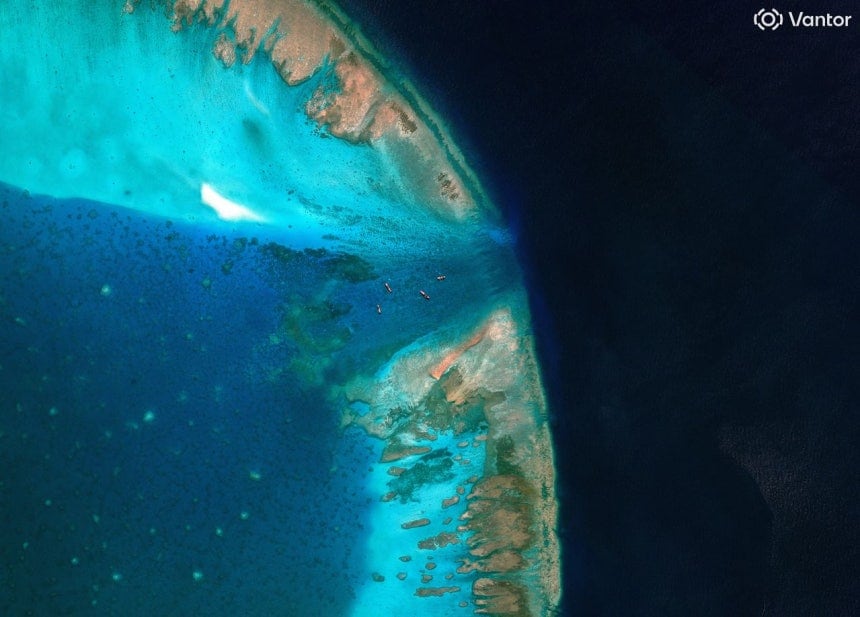
On April 15 and 16, 2026, newly released satellite images of the waters around Scarborough Shoal in the South China Sea revealed something both striking and deeply troubling. According to major international media outlets citing satellite imagery firm Vantour, China has installed a 352-meter floating barrier at the entrance to the shoal — one of the most contested maritime flashpoints between China and the Philippines.

This is no fishing net or string of buoys. It's a physical structure designed to block vessels from entering — and it has ratcheted up tensions in the South China Sea almost overnight. What makes it even more significant is the timing. Three U.S. aircraft carriers — including the USS George H.W. Bush — are currently deployed to the Middle East, where military tensions have been escalating sharply.
In other words: with U.S. attention and naval power focused on the Middle East, leaving a temporary power vacuum in the Asia-Pacific, China moved swiftly to tighten its grip on the South China Sea. Analysts say Beijing is exploiting the gap in American presence to conduct a show of force against neighboring countries — and to openly challenge the principle of freedom of navigation that the international community has long upheld.
This floating barrier is far more than a maritime incident. It represents:
- A live theater of great-power competition playing out in real time
- A potential trigger point that could reshape the security landscape across the entire Indo-Pacific
Understanding the full context behind this bold move — and the security ripple effects it may set off — has become genuinely urgent.
So Where Are the U.S. Carriers Right Now?
The South China Sea and the broader Indo-Pacific have long been the primary stage for U.S. naval power. Since 2015, the U.S. has conducted regular Freedom of Navigation Operations (FONOPs) in these waters alongside allies, using its carrier strike groups as the centerpiece of a strategy aimed at maintaining the balance of power and deterring any single nation from unilaterally dominating the seas.

So what happened to those carriers? The core of America's naval strength has been redirected to the Middle East in large numbers.
As military tensions with Iran and other actors in the Middle East have surged to a critical level, the U.S. made the difficult decision to pull carrier forces from the Indo-Pacific and send them west. According to multiple media reports, the USS Abraham Lincoln and USS Gerald R. Ford — and now the USS George H.W. Bush — bring the total to three American aircraft carriers now positioned near the Strait of Hormuz and surrounding Middle Eastern waters.

Even the world's most powerful military cannot be everywhere at once. Washington has found itself in a classic "prioritize and concentrate" dilemma — forced to focus its most powerful assets on the theater it deems most urgently at risk of igniting into open conflict.
- A power vacuum in the Indo-Pacific: With core naval assets concentrated on Middle East defense, a temporary military gap has opened up across the South China Sea.
- An unprecedented concentration of carriers: Three U.S. carriers simultaneously converging on a single region is an extraordinary and unusual deployment — a measure of just how urgent and grave the Middle East situation has become.
It is precisely into this gap — while Washington's attention and firepower are pointed elsewhere — that a quiet but consequential shift has begun near Scarborough Shoal. What we are witnessing now is the real-world butterfly effect of America's absence from the South China Sea.
China Seizes the Moment: The "Salami Slicing" Strategy in Action
China has a well-documented pattern of expanding its maritime control during windows when international attention is diverted to other crises, or when great-power oversight loosens. This occasion was no exception. With the U.S. carriers away, Beijing moved to install a floating barrier around Scarborough Shoal — a brazen move to consolidate de facto control over the disputed waters.
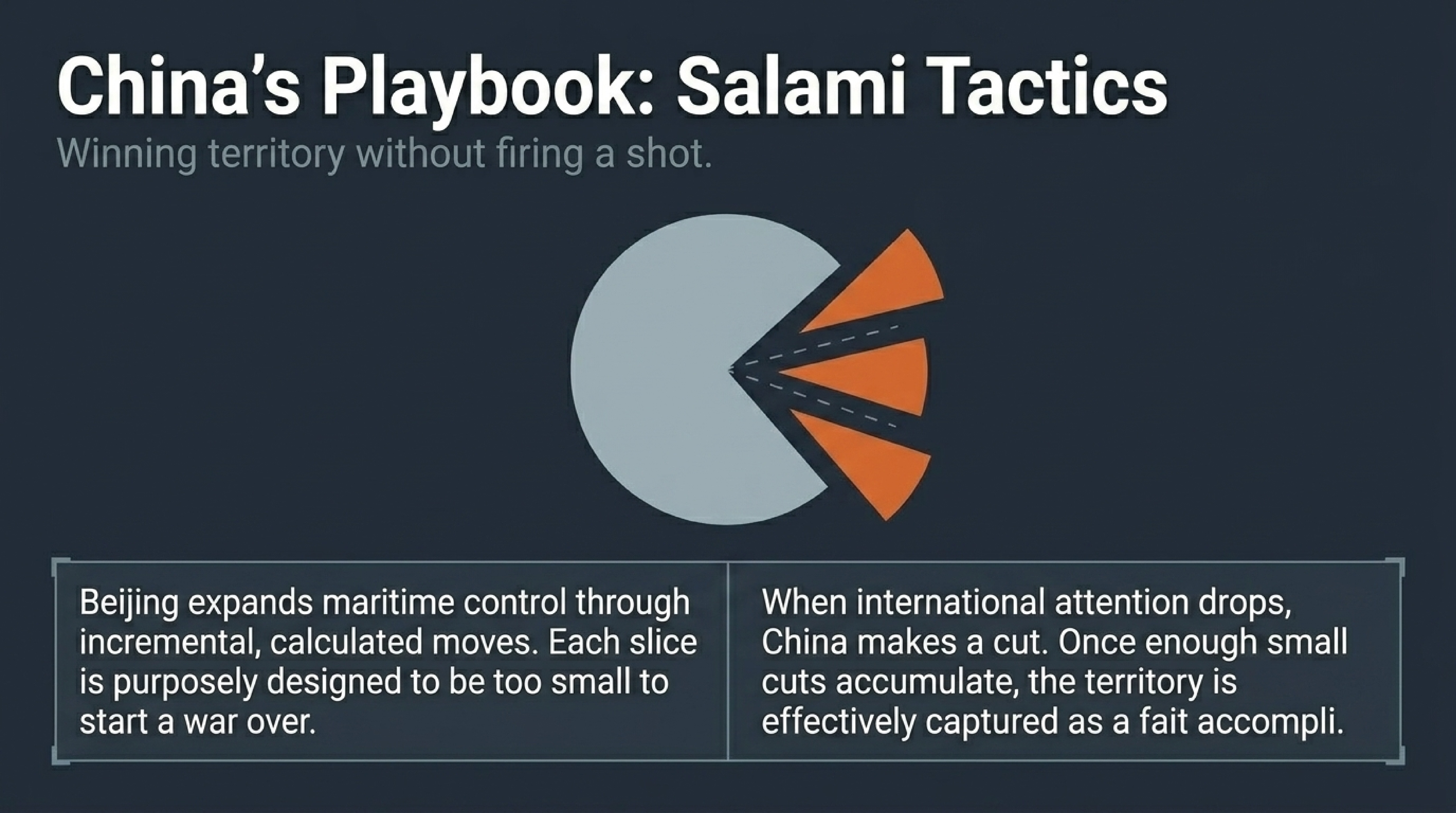
This type of behavior is well known in international relations under the term "Salami Tactics." Rather than launching a single provocative action large enough to trigger war or sweeping sanctions, the strategy involves making a series of incremental moves — each just small enough that no individual action justifies a forceful response:
- Repeatedly sending fishing boats and coast guard vessels into disputed waters
- Constructing small facilities on artificial islands
- Installing floating barricades at strategic chokepoints
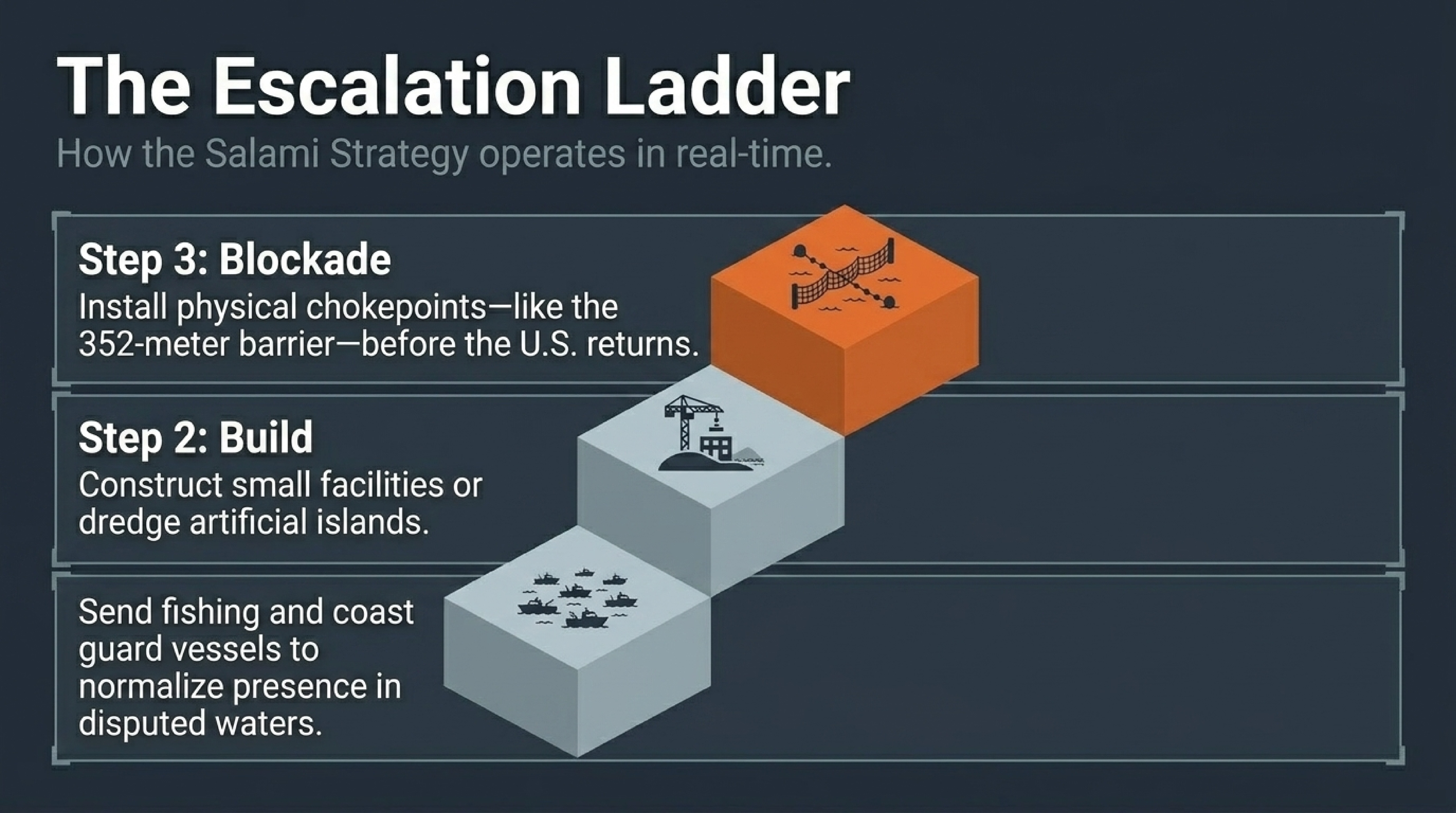
"Not worth going to war over" is the calculation behind each individual action. But once enough of these small moves accumulate, the entire area has effectively become Chinese-controlled territory — a fait accompli. It's a shrewd and aggressive game of timing: placing barricades throughout the neighborhood before the police return, and declaring "this was always our territory" before anyone can credibly object. This playbook is pushing South China Sea tensions to new levels of complexity.
Why Does Scarborough Shoal Matter So Much?
Scarborough Shoal sits roughly 220 kilometers off the west coast of Luzon, the main island of the Philippines. By contrast, it lies nearly 900 kilometers from China's Hainan Island — making it geographically far closer to the Philippines.
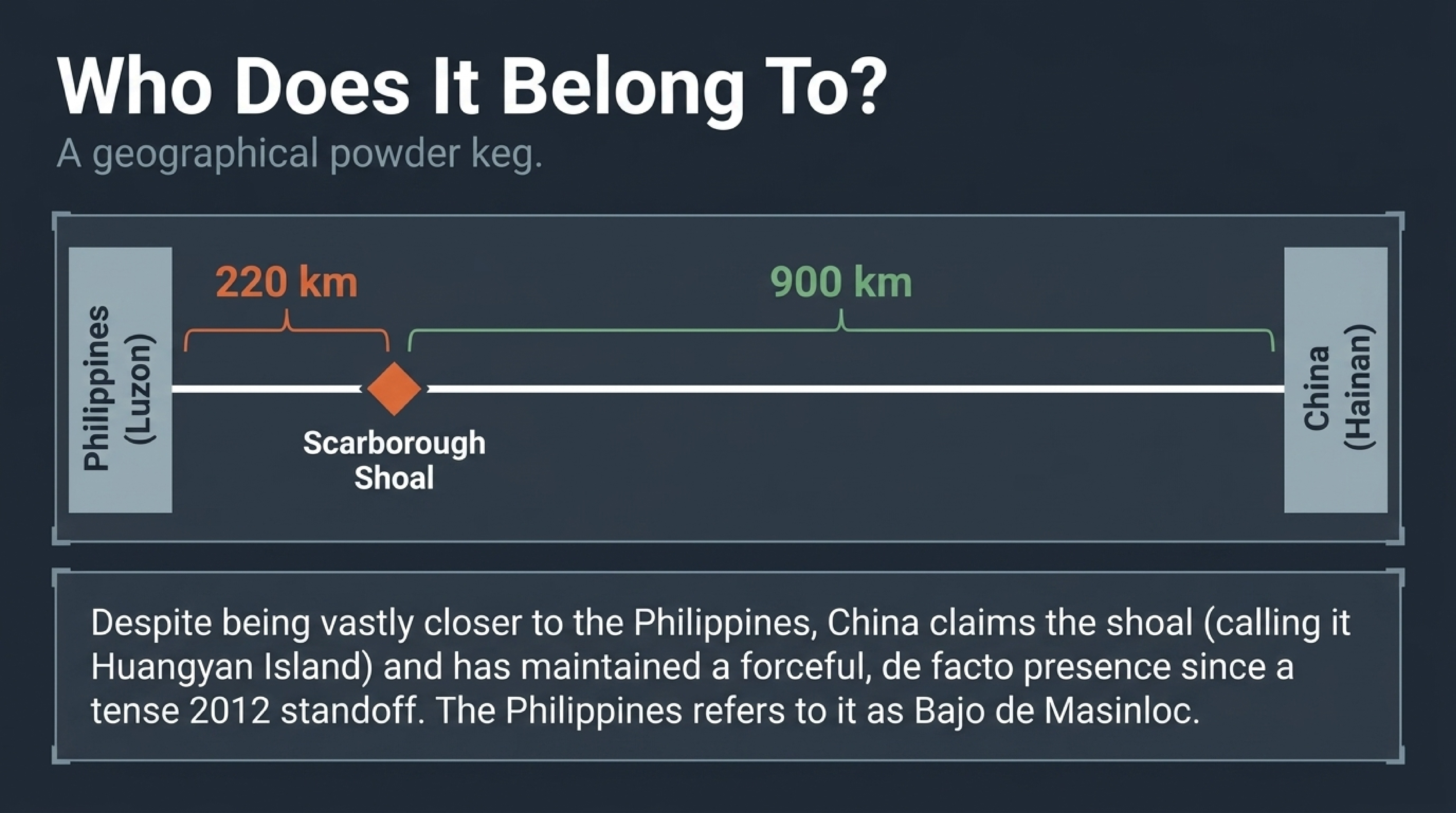
Yet this small reef has been a powder keg of sovereignty disputes between China and the Philippines for decades. China calls it Huangyan Island (黃岩島); the Philippines calls it Bajo de Masinloc. Neither side is prepared to back down.
The reasons why both sides refuse to yield are clear. First, the shoal sits atop extraordinarily rich fishing grounds — the livelihoods of fishermen from both nations depend on access to these waters. Beyond that, the surrounding sea lanes carry an enormous share of global maritime trade, making the area's economic and strategic value nearly incalculable.

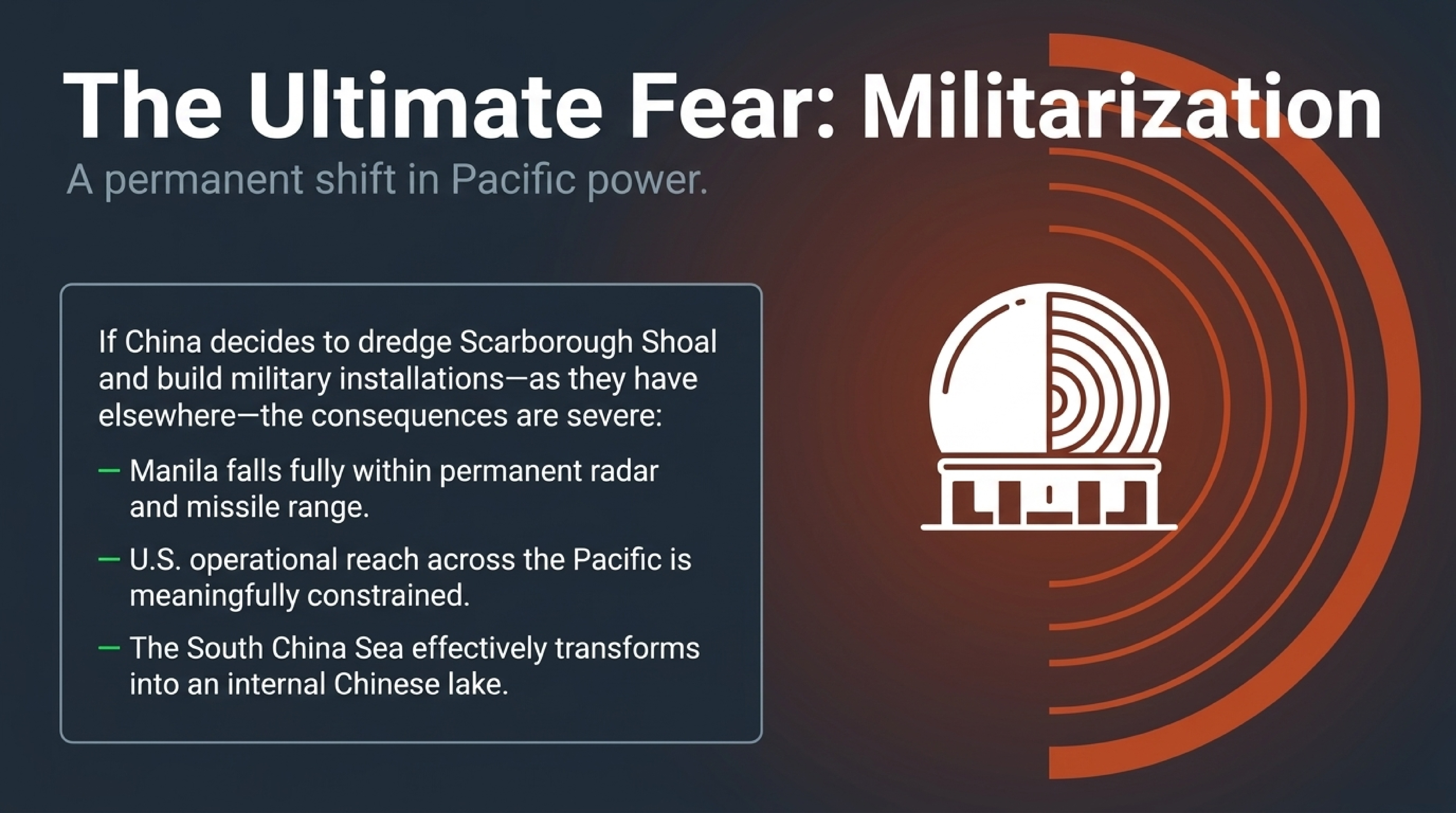
The most alarming concern is the potential for militarization. China has maintained effective control over the shoal since a 2012 standoff at sea. If Beijing were to dredge and build out the reef — equipping it with radar arrays and missile installations as it has done with other features in the South China Sea — the security consequences for Asia would be severe. Manila would fall well within range, and U.S. military operational reach across the Pacific would be meaningfully constrained. China's latest move to install a floating barrier while U.S. carriers are absent fits squarely within this larger strategic blueprint.
What the 352-Meter Floating Barrier Really Means
The 352-meter floating barrier installed at the entrance to Scarborough Shoal is anything but a simple plastic structure. It physically and completely blocks Philippine fishing vessels from entering the calm, fish-rich lagoon inside the shoal — the very waters these fishermen depend on for their livelihoods. This isn't drawing a line on a map. It's slamming shut a giant lock on a sea that another nation's citizens have fished for generations.

The scene around the barrier makes the gravity of the situation even clearer. Chinese coast guard vessels and maritime militia ships are positioned tightly around the structure in what appears to be an iron ring formation. This goes well beyond chasing off a few foreign fishing boats — it carries the unmistakable character of a full-scale show of force, communicating that any challenger will be overwhelmed.
The truly alarming message of this barrier lies in what it represents: a brazen, defiant consolidation of de facto control in contempt of international law. In 2016, the Permanent Court of Arbitration (PCA) ruled that China's sweeping claims over the South China Sea had no basis in international law. Beijing has flatly ignored that ruling ever since. The fact that China chose to install this massive barrier at the precise moment when three U.S. aircraft carriers were absent from the region makes the provocation all the more pointed.
Ultimately, the 352-meter barrier is a symbol of China's calculated determination to "tell the world: whatever the international community says, this sea is ours — completely." It is the product of an aggressive, long-term strategy to transform a disputed waterway into what Beijing considers an internal Chinese sea — not just physically blocking access, but locking in political reality.

Waves in the South China Sea — Shaking Security Across All of Asia
What is happening in the South China Sea is not a bilateral dispute that will quietly resolve itself between China and the Philippines. The Philippines and neighboring ASEAN countries — facing the prospect of losing access to vital seas — are deeply alarmed. China's decision to install a floating barrier at Scarborough Shoal the moment U.S. carriers stepped away has made that anxiety acute.
The bigger question is what happens when U.S. carriers return after the Middle East situation stabilizes. What if, by then, China has already installed barriers across multiple features and declared the entire area a fait accompli? Washington will push back hard with Freedom of Navigation Operations — and the risk of military friction between the two superpowers in that scenario is difficult to overstate. It's a collision course that should make anyone uncomfortable.
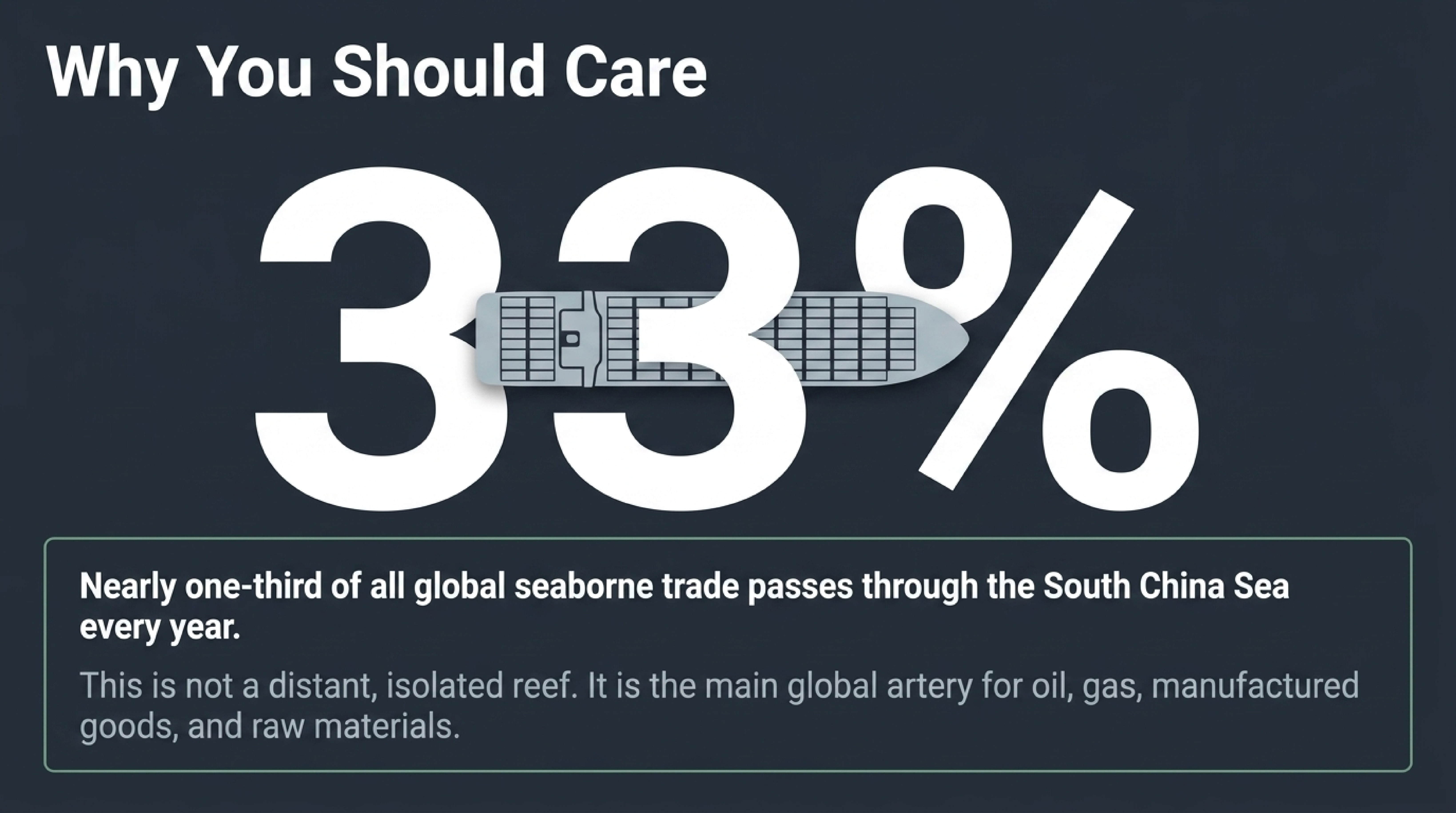
And this isn't a distant problem for observers far from the region. The South China Sea is one of the world's most critical maritime corridors. Nearly a third of global seaborne trade passes through it annually — oil, gas, manufactured goods, raw materials. For any country whose economy relies on that flow, a disruption is not a geopolitical abstraction. It hits supply chains, energy prices, and ultimately the cost of everyday goods.
- Heightened military tensions in this corridor could rapidly disrupt global shipping networks and send freight rates surging.
- That cascades into higher import costs for raw materials — which translates directly into price increases in supermarkets and fuel stations around the world.
The floating barrier at Scarborough Shoal is not just a structure on a faraway reef. It is the opening wave of something that could shake the security and economic foundations of the entire Asia-Pacific — and beyond. That is why this story demands our continued attention.
Why You Should Keep Watching This Story
China's decision to install a floating barrier at Scarborough Shoal while three U.S. carriers were managing escalating tensions in the Middle East carries far more weight than a standard territorial dispute. The fact that a physical barrier went up in a critical sea lane almost immediately after American naval attention was pulled to the other side of the world is a live demonstration of how global geopolitics operates as a system of interconnected pressure points.
This cannot be written off as an isolated foreign news item. Behind it lies the relentless, interlocking machinery of U.S.-China great-power competition. Every time American military attention and resources shift toward another crisis, China moves swiftly to expand its influence in the Indo-Pacific — this is a pattern worth internalizing as a core lens for reading international news. The Scarborough Shoal incident has demonstrated with painful clarity what kind of power vacuums and crises emerge along geopolitical fault lines the moment American strength is stretched thin.

It may feel like a story unfolding far from everyday life. But for any country or economy whose imports, exports, or energy supplies travel through the South China Sea, the stakes are deeply personal:
- Rising military tensions in this corridor can immediately disrupt global maritime logistics and drive up shipping costs.
- That pushes up the price of raw material imports — which filters through directly into higher prices at the grocery store and the gas pump.
To protect the stability of our daily lives and economies, we need to stay alert to the moves being made on this enormous geopolitical chessboard. The hidden connections running beneath the headlines of international news are worth following — and this story is one of them.
Frequently Asked Questions
Q. Who actually owns Scarborough Shoal?
A. Scarborough Shoal is currently a disputed territory, with the Philippines and China locked in an unresolved sovereignty standoff. Geographically, it lies far closer to the Philippines — but China claims it under the name Huangyan Island and asserts sovereignty over it forcefully.
In 2016, the Permanent Court of Arbitration (PCA) ruled that China's territorial claims had no basis in international law. China has ignored the ruling entirely, maintaining effective control since a 2012 standoff, and has now escalated by installing a floating barrier that blocks other nations' vessels from entering — drawing sharp international condemnation.
Q. What exactly does a floating barrier look like?
A. A floating barrier is a large-scale physical blockade deployed on the surface of the sea. It's not merely a line marking a zone — it's a structure made of numerous buoys linked together by heavy ropes or nets, forming a long, sturdy wall that physically prevents foreign vessels and fishing boats from entering.
The barrier captured in the latest satellite images at the entrance to Scarborough Shoal stretches an extraordinary 352 meters. It is being interpreted as a naked demonstration of China's intent to exercise total control over the disputed waters — treating them as its own internal sea.
Q. Why does the South China Sea dispute matter to people outside the region?
A. The South China Sea is one of the world's most critical economic lifelines — roughly a third of all global maritime trade passes through it, along with massive flows of oil and natural gas. If China were to dominate or restrict access during a military standoff with the U.S. or neighboring nations, the resulting disruption would ripple outward globally.
Any serious disruption to shipping through these waters would trigger spiking freight rates, rising raw material import costs, and broader inflationary pressure felt by consumers far from the conflict zone — including at grocery stores and gas stations around the world.

Q. When will the U.S. carriers return to the Indo-Pacific?
A. At this point, there is no definitive timeline for when the three carriers will return to the Asia-Pacific. Their redeployment will depend on how quickly — and how completely — the military situation in the Middle East is brought under control.
Analysts and observers widely expect that when U.S. carriers do return, they will find a China that has already entrenched its position — raising a serious risk of military friction as Washington pushes back through Freedom of Navigation Operations. Rather than predicting a specific date, the more important thing is to closely monitor how the broader security situation develops in the weeks and months ahead.

References
All 3 U.S. Carriers Head to Middle East — China Installs 'Floating Barrier' in South China Sea
https://n.news.naver.com/article/023/0003971155?cds=news_edit
Signs That a U.S.-China Military Clash in the South China Sea Is Approaching
http://weekly.chosun.com/news/articleView.html?idxno=16215
Scarborough Shoal — Wikipedia
https://ko.wikipedia.org/wiki/%EC%8A%A4%BC%B9%B4%EB%B2%84%EB%9F%AC_%EC%95%94%EC%B4%88
Philippine Group Breaks Through Chinese Blockade to Resupply South China Sea Fishermen — Yonhap
https://www.yna.co.kr/view/AKR20240516161200084
The South China Sea Issue and Korea's Sea Lane Security — Korea Institute for Maritime Strategy