US Military Coming to Korea for Repairs? Everything You Need to Know About the 'RSH' That Will Reshape K-Defense

US Fighter Jets Getting Repaired in Korea?
On April 22, 2026 (local time), a statement that sent shockwaves through the Korean defense industry emerged from a House Armed Services Committee hearing in Washington, D.C. General Xavier Brunson, Commander of United States Forces Korea (USFK), officially introduced the concept of a Regional Sustainment Hub (RSH) — framing it as a new paradigm that would fundamentally transform how U.S. forces manage and sustain their assets in the region.
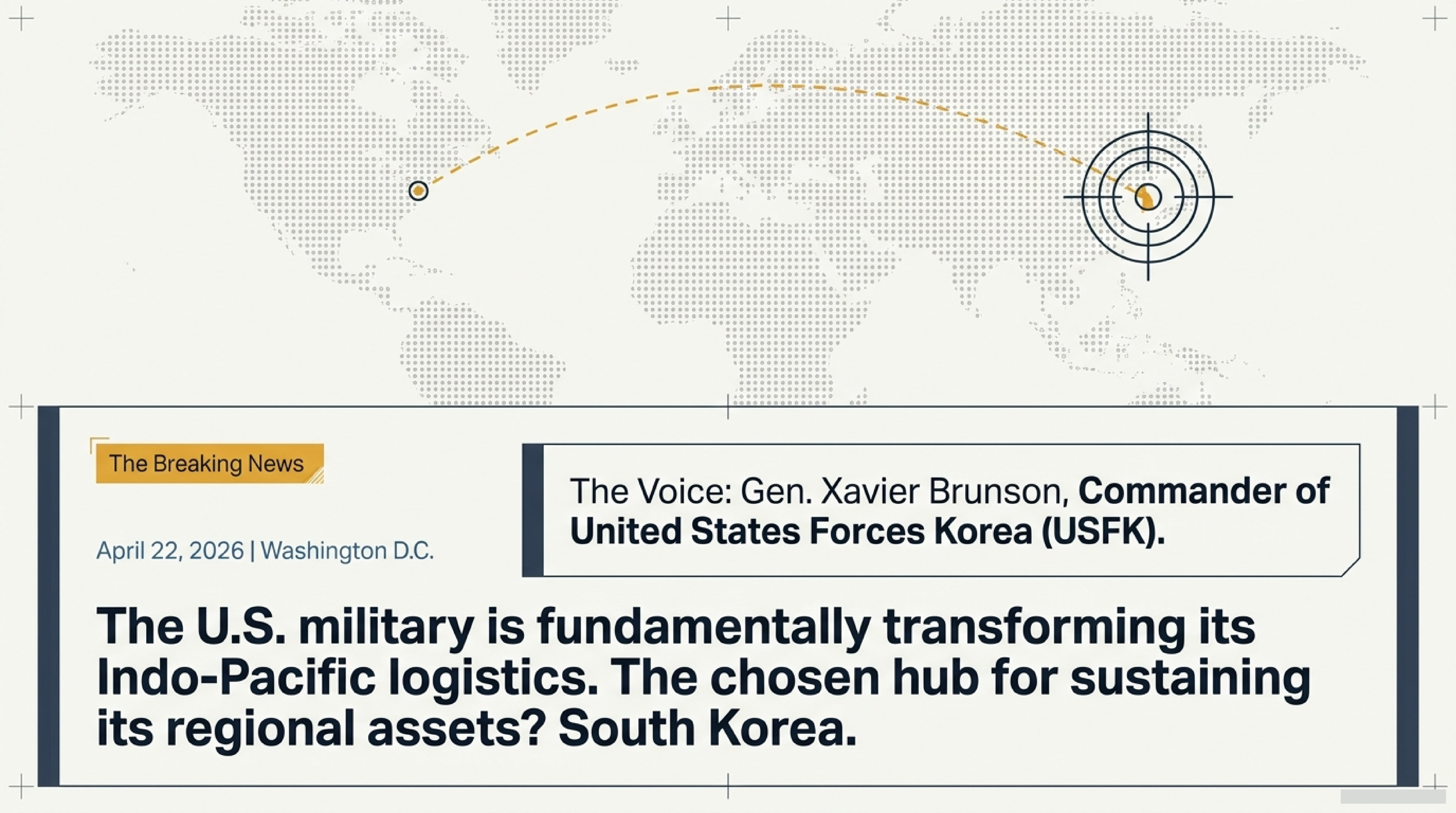
Until now, the U.S. military had predominantly handled the maintenance and repair of its globally deployed key assets — fighter jets, warships, and the like — through facilities centered on the American mainland. But General Brunson's statement was a bold declaration: to rapidly address maintenance demands for U.S. forces operating across the Indo-Pacific region, the military's chosen hub would be none other than South Korea.
The Korean defense industry immediately lit up with excitement. K-defense has already built a global reputation by exporting tanks and self-propelled artillery with outstanding performance and reliable delivery timelines. But this announcement means something qualitatively different: it signals the opening of an entirely new and vastly larger market — one centered not on manufacturing and selling weapons, but on directly maintaining and servicing the U.S. military's most advanced systems.
So what exactly does "RSH" — the term General Brunson specifically named and that has dominated defense news cycles ever since — actually mean? Let's break it down in plain language.
RSH and MRO — Explained Simply
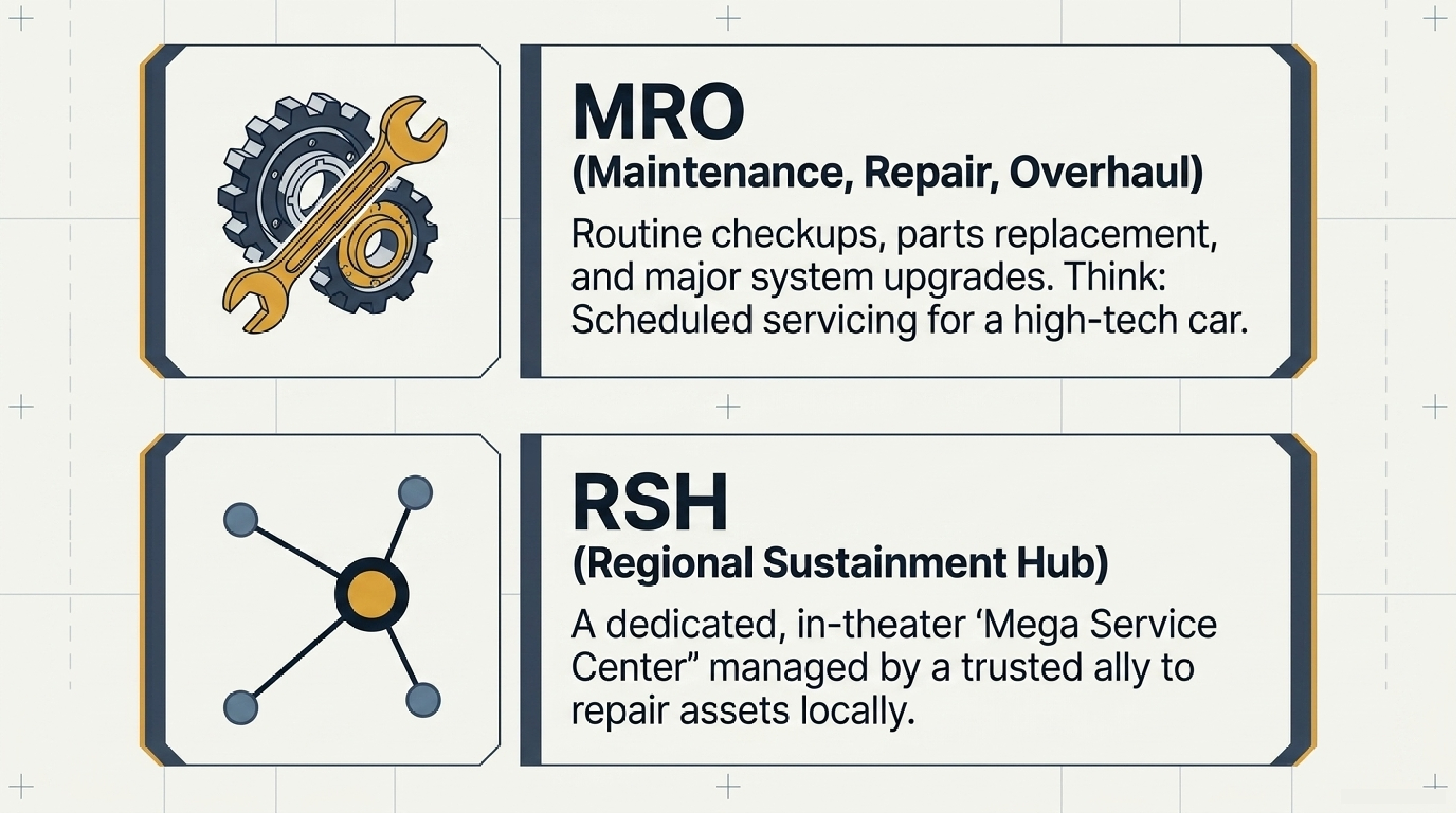
The acronyms 'RSH' and 'MRO' are cropping up all over defense news right now. They can sound technical and intimidating — but the core concept is essentially identical to taking your car in for scheduled servicing and repairs.
First: MRO (Maintenance, Repair, and Overhaul) simply refers to the ongoing work of maintaining, repairing, and upgrading military equipment. Even the most advanced fighter jet or warship needs regular replacement of consumable parts and repair of worn components to stay operational. This essential, routine management work is MRO.
Then what is an RSH (Regional Sustainment Hub)? It's essentially a declaration that the U.S. military intends to completely overhaul how it manages its equipment. As mentioned earlier, the U.S. has historically managed its forces from the American mainland. But think about it: when a fighter jet operating on the other side of the Pacific develops a problem, sending it all the way back to a U.S. maintenance depot and then back again takes enormous time and money.
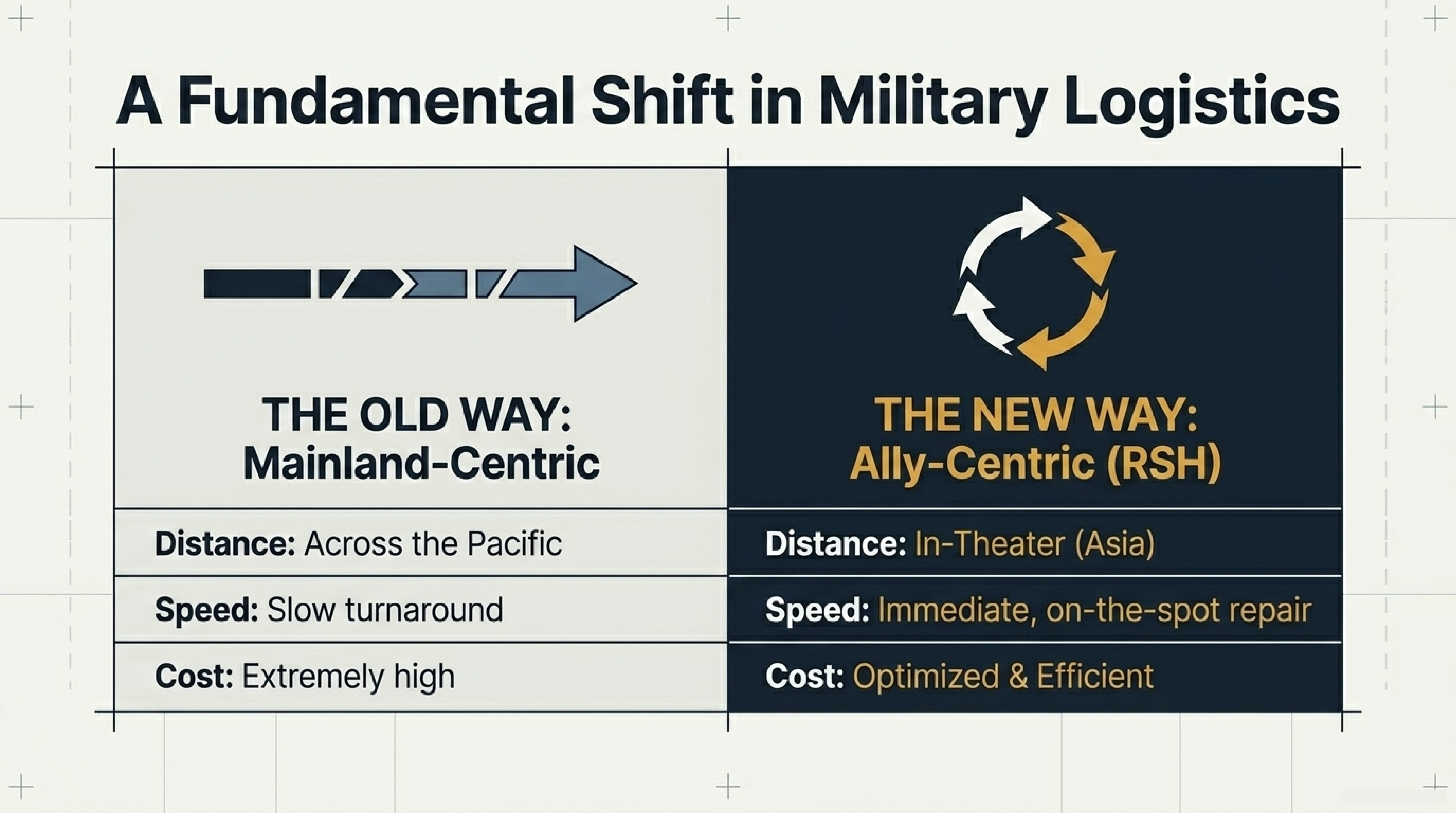
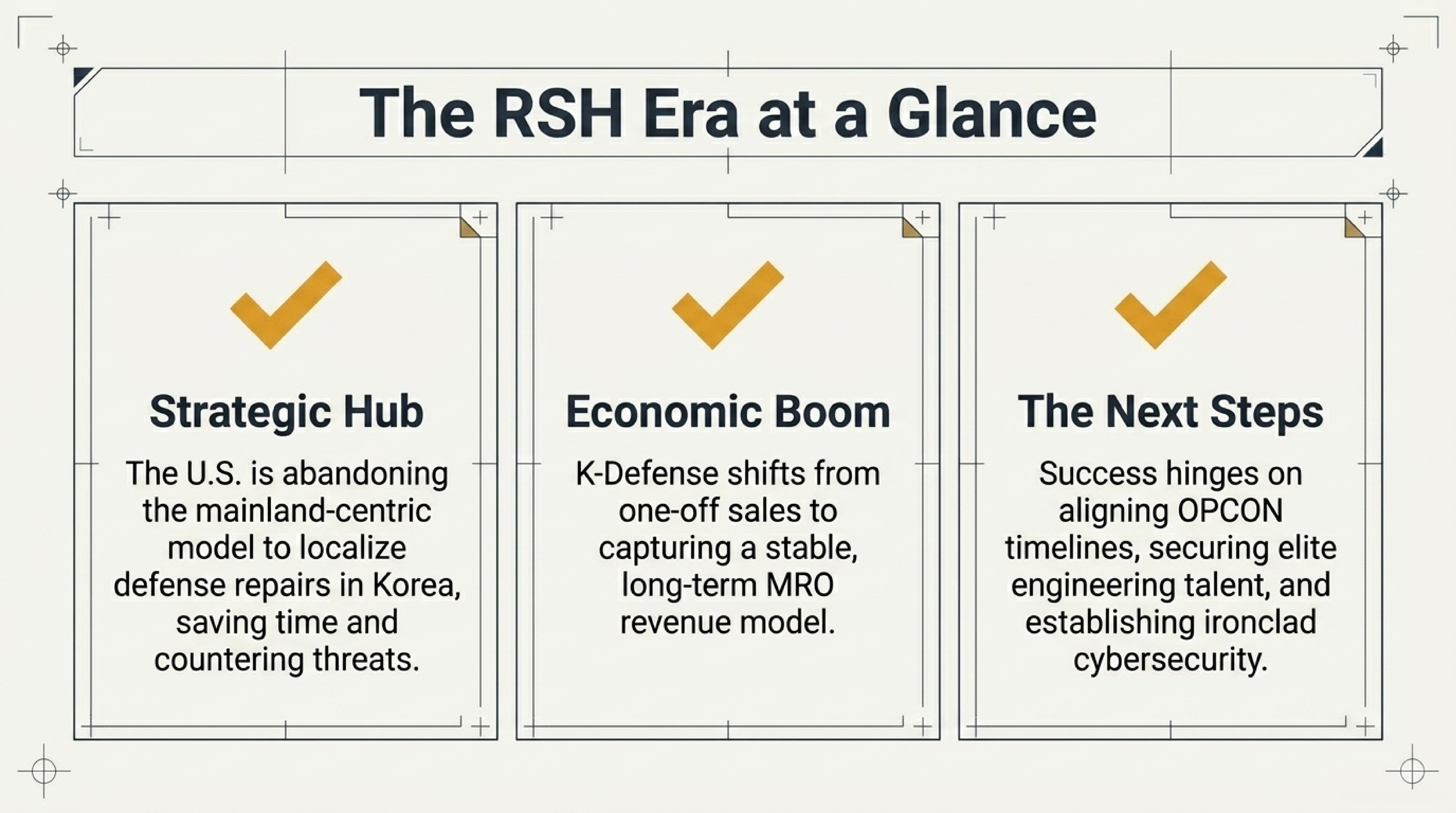
To overcome the limitations of physical distance and cut repair turnaround time, the U.S. military has adopted a new strategy. The idea is to hand MRO responsibilities to a trusted ally close to the operational theater — establishing that nation as a dedicated 'mega service center' for the entire region. That is the core concept of the RSH. It's a fundamental shift in military logistics — from a mainland-centric model to an ally-centric one — designed to get damaged equipment repaired on the spot and returned to the battlefield rapidly.
With the concept firmly established, one very natural question follows. There are many U.S. allies throughout the Indo-Pacific — so why did the U.S. military specifically choose South Korea for this critical hub role?
Why Korea Specifically? (Two Birds, One Stone)
The reason the U.S. military singled out South Korea — above all other allies — as its Regional Sustainment Hub is straightforward. South Korea uniquely satisfies two critical conditions simultaneously: the unrivaled manufacturing and maintenance capabilities of K-defense and its status as a strategic linchpin in the Indo-Pacific.
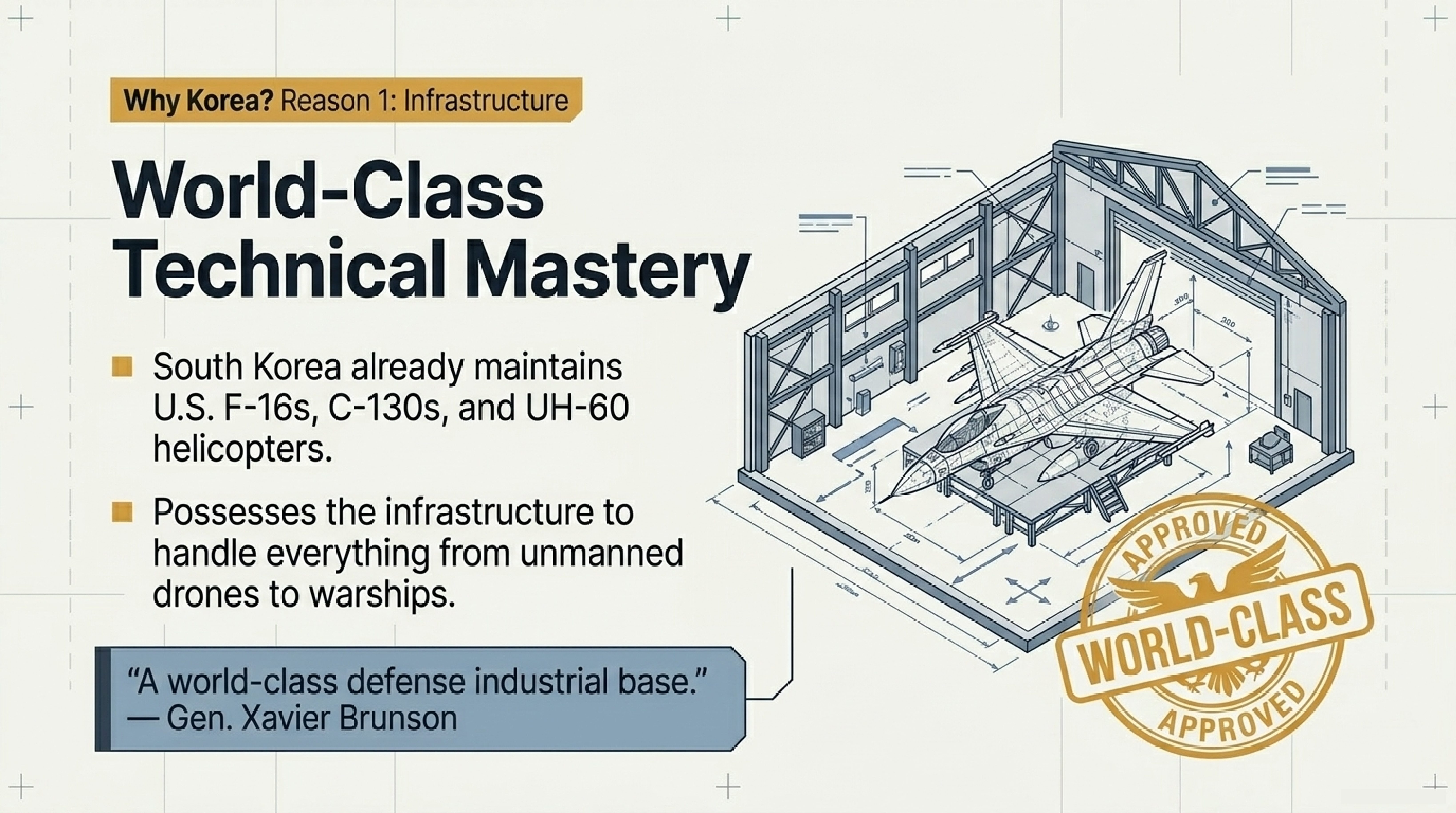
The first reason is Korea's globally recognized, robust maintenance infrastructure. At the House Armed Services Committee hearing, General Brunson praised Korea's defense industrial base as "world-class." That assessment is grounded in fact: South Korea has been a proven partner in performance upgrades and maintenance for U.S. military assets including F-16 fighter jets, C-130 transport aircraft, and UH-60 helicopters — consistently meeting the U.S. military's demanding standards. Korea has now firmly established itself as a nation with the unique technical capability and infrastructure to be trusted with everything from aircraft to warships, Patriot missile batteries, and unmanned drones.

The second reason is Korea's geopolitical position — directly relevant to countering China. The wars in Ukraine and the Middle East have taught the U.S. military painful lessons about how quickly supply chains can be severed. If a contingency broke out in the Indo-Pacific — around the Taiwan Strait, for example — sending damaged fighter jets and warships all the way back across the Pacific to the U.S. mainland for repairs would waste enormous time and resources. By contrast, a hub in Korea could immediately address maintenance needs for forces based in Korea, Japan, and across the region — effectively eliminating the 'tyranny of distance.'
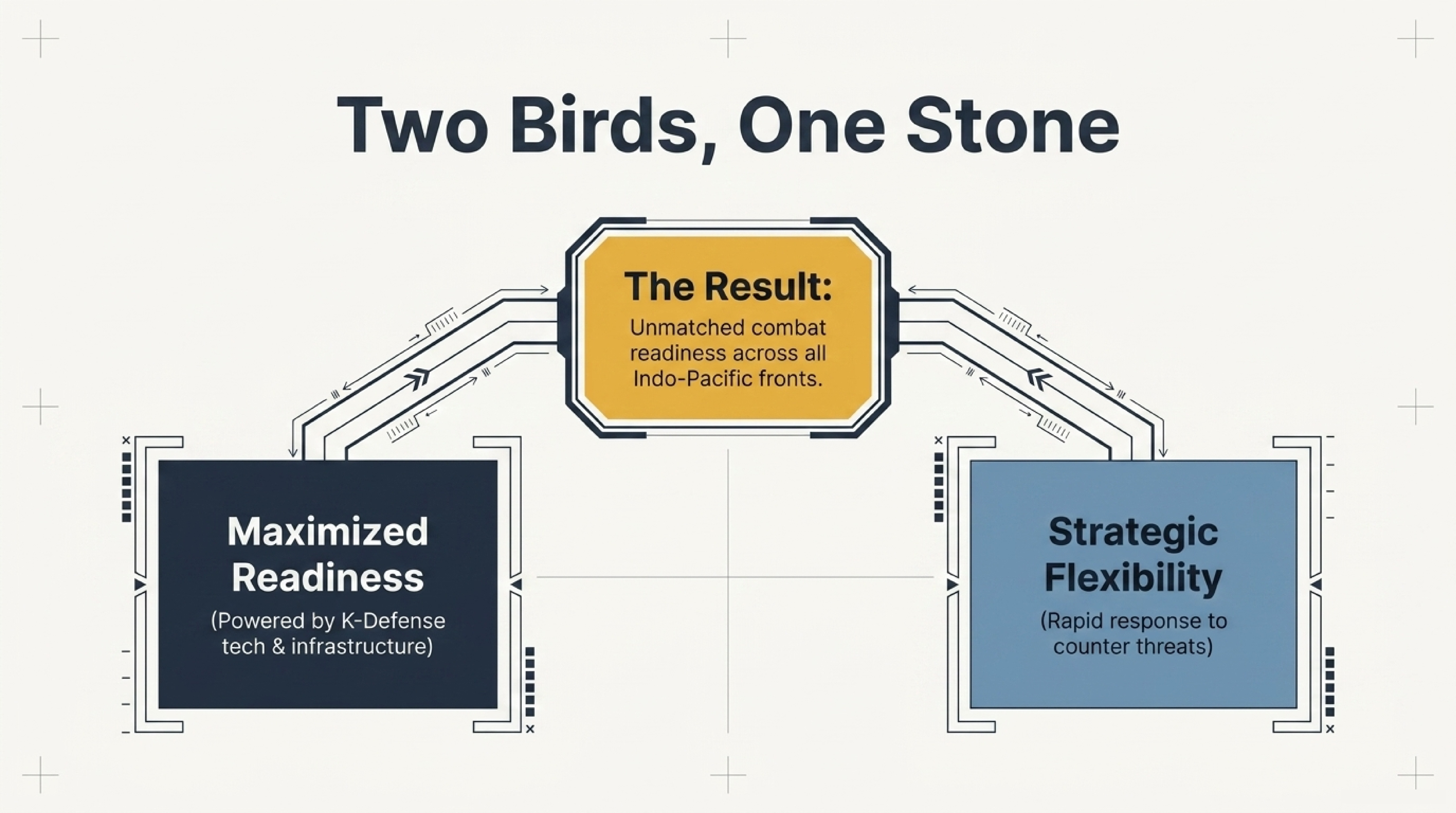
From Washington's perspective, designating South Korea as an RSH allows the U.S. to simultaneously catch two birds with one stone: maximizing equipment readiness through world-class maintenance services and securing rapid-response capability and strategic flexibility in any China-related contingency. The move reflects a deliberate and calculated strategy to distribute logistics support across trusted allies — raising overall combat readiness on all fronts.
Now that we've covered the macro-strategic reasons why South Korea was chosen as a core partner in U.S. global defense strategy, let's look at how this massive shift will concretely benefit the Korean economy and the balance sheets of Korean defense companies.

K-Defense: From Selling Weapons to Selling Services
The RSH designation is a genuine game changer — one that will transform the entire business model of Korea's defense industry. K-defense's winning formula up to this point has been rooted in manufacturing: making well-designed, cost-effective weapons and exporting them. But as Korea takes on significant volumes of U.S. military maintenance work, the playing field expands into a vastly larger 'service market' — one centered on the continuous management and repair of military systems over their operational lifetimes.
In the defense industry, MRO is often called the 'golden goose.' Arms exports are essentially one-time transactions — you make a sale and it's done. MRO, by contrast, generates steady and reliable revenue for the entire
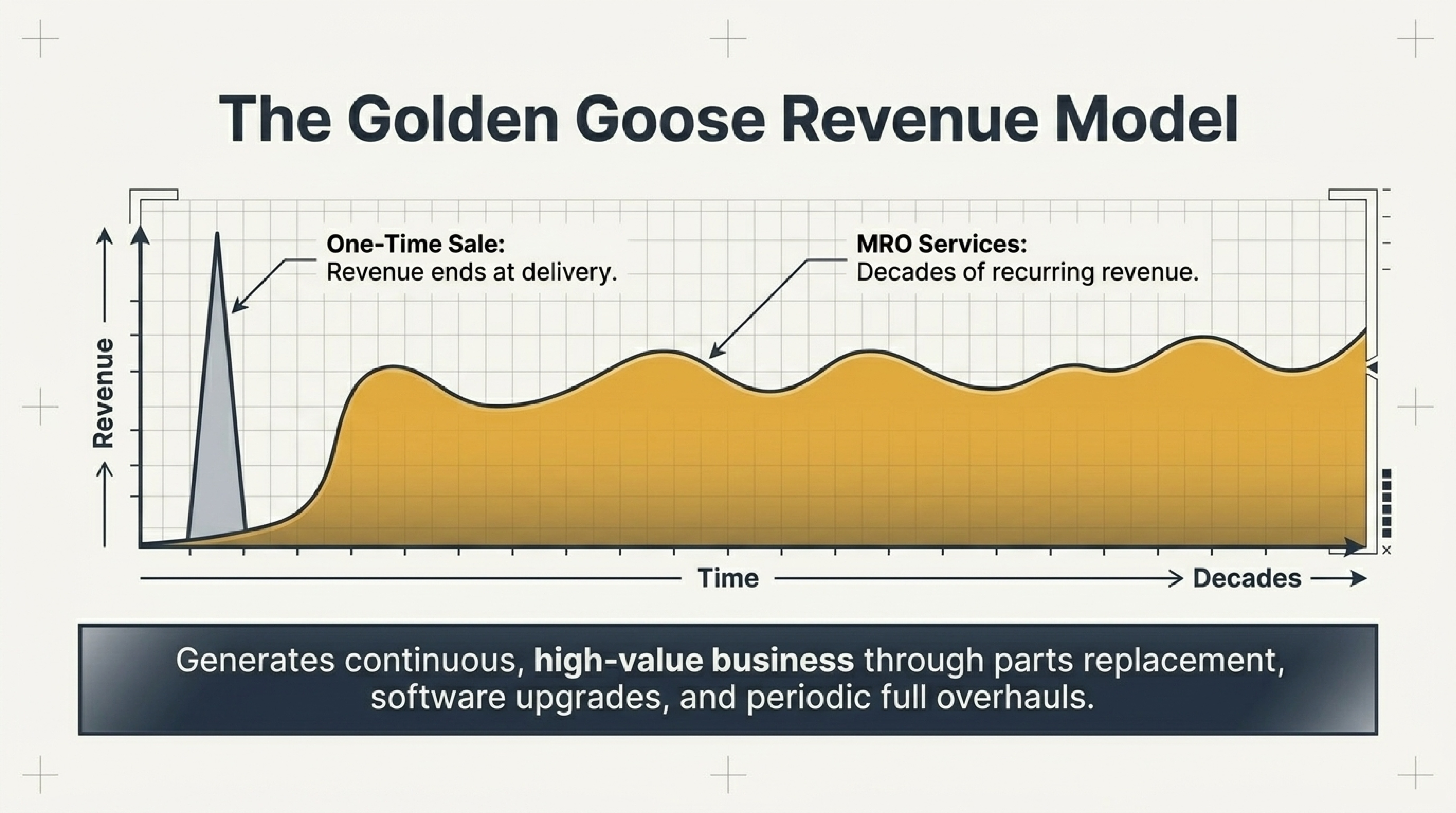
operational lifespan of a weapon system — potentially decades. From parts replacement to software upgrades to periodic full overhauls, the structure creates a continuous stream of high-value business that Korean companies can capture throughout the lifecycle of every system they maintain.
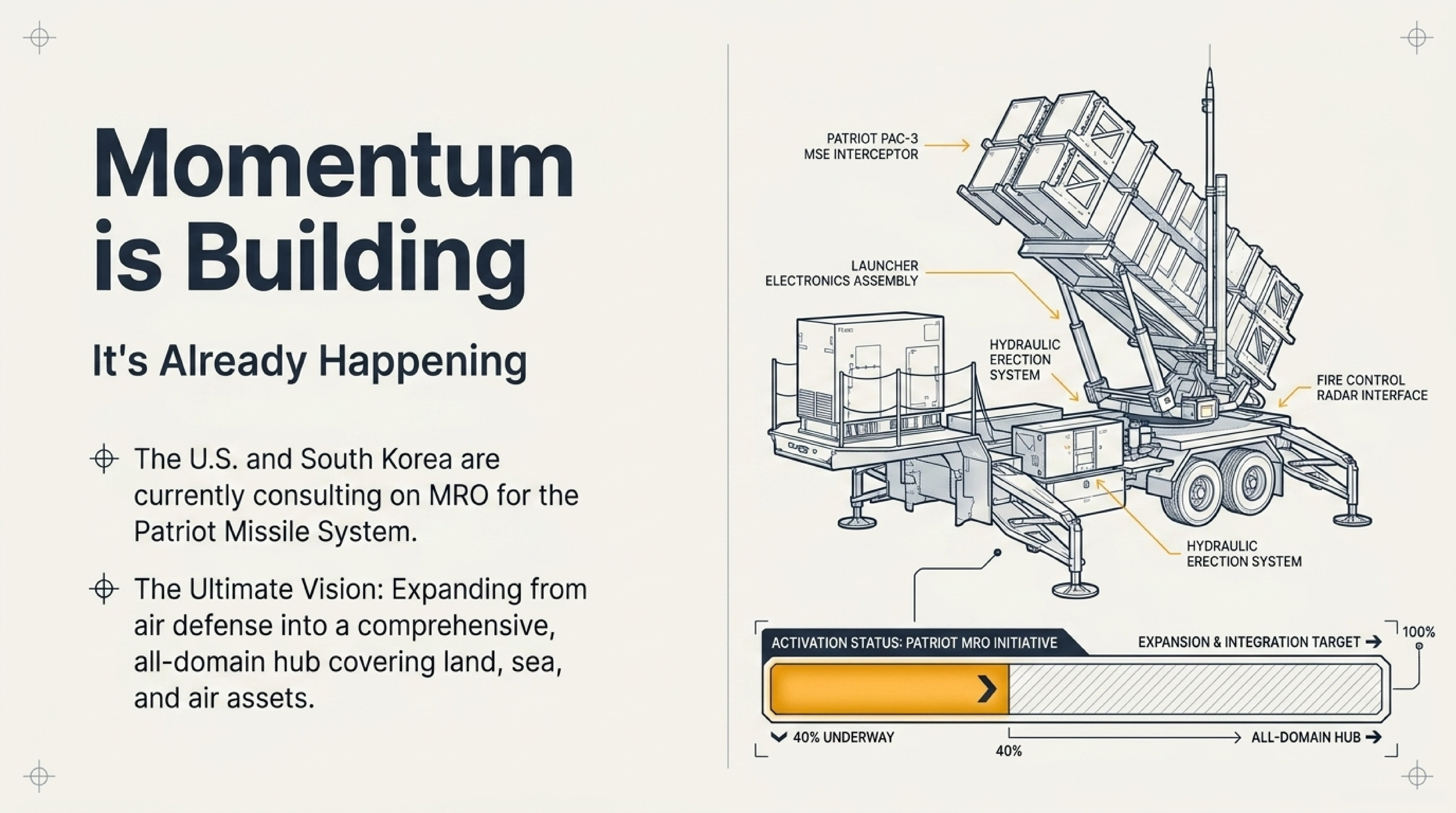
This shift is already manifesting in concrete moves. Recently, the U.S. and South Korea have begun consultations on maintaining and supporting the Patriot missile system — a key air defense asset for U.S. forces in Korea. And this is just the beginning. Washington's long-term vision is to build South Korea into a comprehensive, all-domain MRO hub covering U.S. fighter jets and warships across land, sea, and air.
For Korean defense companies, this is a golden opportunity to step up in class — moving beyond domestic sales and one-off exports to become a standing partner responsible for keeping the world's most powerful military's equipment operational at all times. New revenue models and enormous economic ripple effects are now within reach. But before getting swept away by the excitement, it's important to take a clear-eyed look at the practical challenges that must be addressed to fully seize this opportunity.

A Rosy Future? The Real Challenges That Still Need to Be Addressed
Behind every glittering blueprint, there are always practical obstacles that deserve calm examination. The first significant issue is the subtle divergence between the U.S. and South Korea over the timeline for transferring wartime operational control (OPCON). At the House Armed Services Committee hearing, General Brunson stated that he had submitted a roadmap to the Department of Defense for meeting OPCON transfer conditions, and specified the target date as 'Q1 2029.' Meanwhile, the South Korean military has consistently emphasized that the transfer should happen "as soon as" conditions are met. As the massive RSH logistics infrastructure takes root in Korea, how this OPCON transfer timeline plays out will be a critical variable to watch in the bilateral defense relationship.

There are also urgent physical and institutional preparations needed domestically before Korea can fully deliver on the all-domain MRO hub role. The most pressing priority is developing specialized human capital. The work of disassembling and reassembling advanced fighter jets and warships demands extraordinarily high technical skills — yet the defense industry continues to flag a persistent shortage of experienced engineers. Without systematic training infrastructure and improved compensation, it will be very difficult to handle the potentially explosive increase in maintenance workload that lies ahead.
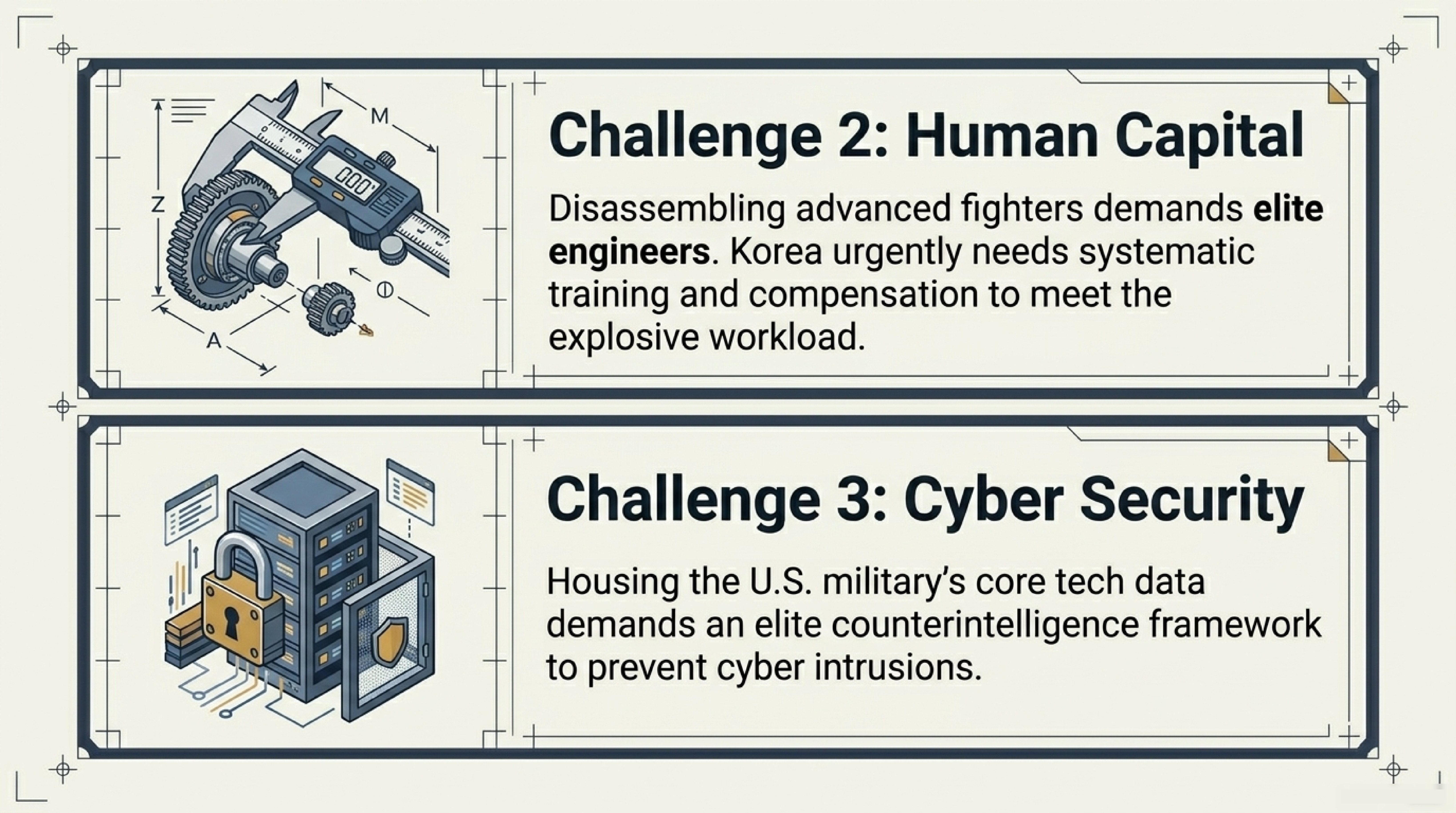
Building a rigorous security architecture is equally indispensable. As specifications and core technical data for the U.S. military's latest weapons systems enter the country, an elite-level counterintelligence framework capable of preventing cyber intrusions and classified data leaks must be in place. Maintaining America's unwavering trust requires guarding information as rigorously as servicing equipment. Ultimately, the RSH designation represents an extraordinary opportunity — but it also demands meticulous allied coordination and thorough domestic infrastructure preparation. It is as much a serious test as it is a prize.
K-Defense's Tomorrow: Evolving into a Global Defense Partner
The USFK's Regional Sustainment Hub (RSH) designation is far more than an expansion of U.S.-Korea logistics cooperation — it is a historic inflection point that will fundamentally elevate South Korea's defense industry to a new tier. If K-defense has diligently served as 'Asia's arsenal' — supplying tanks and self-propelled guns to the world on the strength of superior performance and fast delivery — it is now evolving into 'Asia's repair depot': directly maintaining and servicing the U.S. military's core assets.

The redirection of MRO work that previously flowed to the U.S. mainland toward South Korea as a regional partner nation carries enormous implications. It represents both a strategic decision by Washington to respond more rapidly to maintenance needs within the Indo-Pacific theater, and a formal acknowledgment by the world's most powerful military that Korea's defense capabilities and infrastructure are in a class of their own.
In conclusion, the RSH hub designation will provide K-defense with a stable, long-term revenue model that goes far beyond one-off export successes. If a vast global maintenance ecosystem encompassing everything from fighter jets to warships takes firm root on Korean soil, it will lift the technical capabilities of related SMEs, create large numbers of high-quality jobs, and generate a genuinely positive ripple effect throughout the economy.
Of course, as we've seen, real challenges requiring careful bilateral coordination do exist. But using the RSH designation as a firm launching pad, there is no doubt that K-defense will solidify its place as an unshakeable global defense partner. Here's to watching Korean defense companies rise — beyond mere 'manufacturing' to taking complete ownership of advanced 'services' as well — becoming total solution providers that the world's most demanding customer trusts completely.
Frequently Asked Questions
Q. What exactly is an RSH (Regional Sustainment Hub)?
A. An RSH (Regional Sustainment Hub) is the U.S. military's concept of delegating MRO (Maintenance, Repair, and Overhaul) responsibilities to a trusted ally near the operational theater — in effect, a 'mega service center' — rather than returning equipment to the American mainland.
Rather than shipping damaged equipment across the Pacific to U.S. depots, the RSH model allows for immediate in-theater repair — dramatically reducing the time and cost involved. It represents a new U.S. military logistics strategy designed to maximize equipment availability and operational readiness.
Q. Why is the MRO business so important for defense companies?
A. In the defense industry, MRO (Maintenance, Repair, and Overhaul) is known as the 'golden goose.' Unlike a one-time arms export transaction, MRO generates consistent, recurring revenue throughout the entire operational lifespan of a weapon system — potentially spanning decades.
- Parts replacement and repair
- Software upgrades
- Periodic full overhauls
The enormous ongoing value generated throughout the operational life of each system makes MRO a stable, long-term core revenue source for K-defense companies.
Q. Why does the U.S. military want to service its weapons in Korea rather than at home?
A. The primary reason is overcoming the constraints of distance and time. Sending a damaged fighter jet all the way across the Pacific to the U.S. mainland for repairs wastes enormous time and resources.
South Korea possesses world-class defense manufacturing and maintenance infrastructure, and its position as a strategic linchpin in the Indo-Pacific allows for rapid response when contingencies arise — making it the optimal choice as a forward maintenance hub.
Q. When is the OPCON transfer expected to happen?
A. At the recent House Armed Services Committee hearing, General Brunson clearly stated the target date for OPCON (wartime Operational Control) transfer as 'Q1 2029.'
However, the South Korean military has consistently emphasized that the transfer should take place "as soon as" the necessary conditions are met. Given the subtle gap between the two sides' positions, the coordination process and progress of the roadmap between the two allies will require close monitoring going forward.
References
USFK: "Korea Is a Regional Sustainment Hub" — Expansion of U.S. Asset Maintenance Underway (Yonhap)
https://www.yna.co.kr/view/AKR20260423062100504
U.S. Plans to Make Korea a Fighter Jet and Warship Maintenance Hub — Positioning for Rapid China Response
https://www.donga.com/news/Politics/article/all/20260424/133802890/2
Gap Between U.S. and Korea on OPCON Transfer — Brunson Says "Q1 2029," Korean Military Says "As Soon As Possible"
https://www.chosun.com/politics/diplomacy-defense/2026/04/24/SJXPLFKZBRCZZPXXKMSTWRO7BY/
TextBrush 텍스트브러시 | AI 텍스트 편집기
텍스트브러시는 드래그로 서식을 입히는 AI 텍스트 편집기입니다.
www.textbrush.app
'국제' 카테고리의 다른 글
| 이란, 미국에 새 종전 협상안 전달! 꽉 막힌 중동 정세 드디어 풀릴까? (0) | 2026.05.02 |
|---|---|
| 미 국방장관 폭탄선언 : "호르무즈 해협 무임승차 시대 끝났다" (0) | 2026.04.24 |
| 미군 무기 고치러 한국 온다? K방산 판도 바꿀 'RSH'의 모든 것 (1) | 2026.04.24 |
| 180조 베트남 에너지 시장 열린다! 한베 전력 협력과 PDP8 전략 핵심 정리 (0) | 2026.04.22 |
| 트럼프의 '거래' 방식: 호르무즈 해협 사태로 본 미국 우선주의 외교 전략 (0) | 2026.04.18 |